Facts
Respondent No. 2 alleged that, on 1 February 2024, the petitioners trespassed onto land he claimed to own, obstructed him from removing compost, abused and threatened him, and assaulted him.
Source reference: p. 4–5His complaint led to Crime No. 26/2024 against the petitioners under Sections 143, 341, 323, 504 and 506 read with Section 149 IPC.
Source reference: p. 4–5The petitioners sought to quash the FIR under Section 482 CrPC, contending that the complaint was a counterblast to Crime No. 25/2024, arising from the same incident, and that the dispute concerned property already involved in a civil suit.
Source reference: p. 5–6Respondent No. 2 opposed quashing, and the State submitted that the investigation was at an early stage.
Source reference: p. 6–7Issues
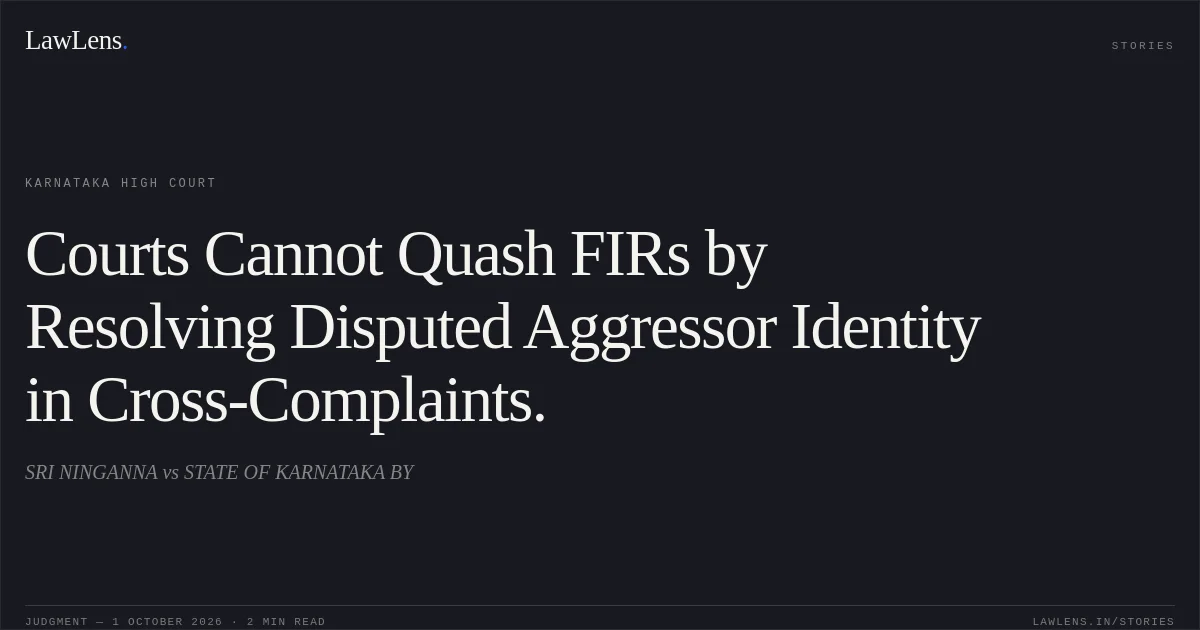
1. Whether the FIR should be quashed at the investigation stage where both sides had lodged complaints concerning the same incident and disputed who was the aggressor.
Source reference: p. 8–102. Whether the pending civil dispute and the petitioners’ allegations of false implication justified quashing the FIR before completion of the investigation.
Source reference: p. 9–10Law Applied
Section 482 CrPC empowers the High Court to prevent abuse of process and secure the ends of justice, but the Court will not conduct a mini-trial when deciding whether to quash a criminal proceeding.
Source reference: p. 9–10Where relevant evidence remains to be collected and the complaint and available material prima facie disclose cognizable offences, the Court should not determine disputed factual questions—such as who was the aggressor—or accept an unsubstantiated defence of false implication at the threshold.
Source reference: p. 9–10A pending civil dispute, by itself, is not a ground to discard a criminal complaint at the investigation stage.
Source reference: p. 9The petitioners cited Sri Gulam Mustafa v. State of Karnataka and another Karnataka High Court decision; the order does not set out or apply a specific proposition from either decision.
Source reference: p. 6Reasoning
The Court noted that Crime Nos. 25/2024 and 26/2024 arose from the same incident and contained competing allegations; the question of who initiated the confrontation therefore required assessment of evidence at trial, not resolution in a Section 482 petition.
Source reference: p. 8–9The investigation in Crime No. 26/2024 had not progressed beyond its initial stages, and relevant evidence remained to be collected.
Source reference: p. 9–10The Court held that it could not infer mala fides or false implication from the defence allegations at that stage.
Source reference: p. 9–10Nor did the pending civil suit, by itself, warrant quashing.
Source reference: p. 9–10The complaint and material then available prima facie disclosed cognizable offences.
Source reference: p. 9–10Holding
The Court held that the competing accounts, the allegation of counterblast, and the pending civil dispute did not justify quashing the FIR before investigation was completed.
Both petitions were dismissed as lacking merit; the FIR in Crime No. 26/2024 was not quashed.
Source reference: p. 10Acts & Sections Cited
10 provisions across 2 statutes referred to in this judgment. Each provision opens on LawLens.
Code of Criminal Procedure, 19731
Original Court PDF
SRI NINGANNAvsSTATE OF KARNATAKA BY
Click to open original judgment
Original judgment, available to read, download and summarize on LawLens.in