Facts
Union of India, through the North East Frontier Railway, awarded Madhucon Projects Ltd. a contract dated 18.10.2012 for construction of a railway tunnel on the Jiribam–Tupul railway line.
Source reference: paras. 3–4; pp. 3–4The contract period was 13 months, ending on 08.02.2013; it was subsequently extended up to 31.12.2013. Alleging non-execution of the work, the Railways terminated the contract on 20.08.2013.
Source reference: paras. 3–4; pp. 3–4The Arbitral Tribunal upheld the termination, rejected the contractor’s claims, rejected two of the Railway’s counterclaims, and allowed forfeiture of the earnest money/security deposit and performance guarantee.
Source reference: paras. 5–6; pp. 3–4The contractor challenged the award under Section 34 of the Arbitration and Conciliation Act, 1996. The District Judge set aside the award, holding that termination before the expiry of the extended completion period was premature and that the contractor had not been given an adequate opportunity to respond to the Railway’s counterclaim.
Source reference: paras. 7–9; pp. 4–5The Railways challenged that decision under Section 37.
Source reference: para. 1; p. 2Issues
1. Whether the District Judge exceeded the limited scope of review under Section 34 by reappreciating the evidence and substituting its view for the Arbitral Tribunal’s finding that termination of the contract was valid.
Source reference: paras. 25–29; pp. 11–152. Whether termination on 20.08.2013 was premature or unlawful merely because the completion date had been extended to 31.12.2013.
Source reference: paras. 8–11, 27–29; pp. 4–5, 13–153. Whether the Arbitral Tribunal’s consideration of the Railway’s counterclaim without granting the contractor a separate opportunity to file a written statement constituted a violation of natural justice, patent illegality, or a ground under Section 34.
Source reference: paras. 15–16, 20, 27–29; pp. 8–10, 13–15Law Applied
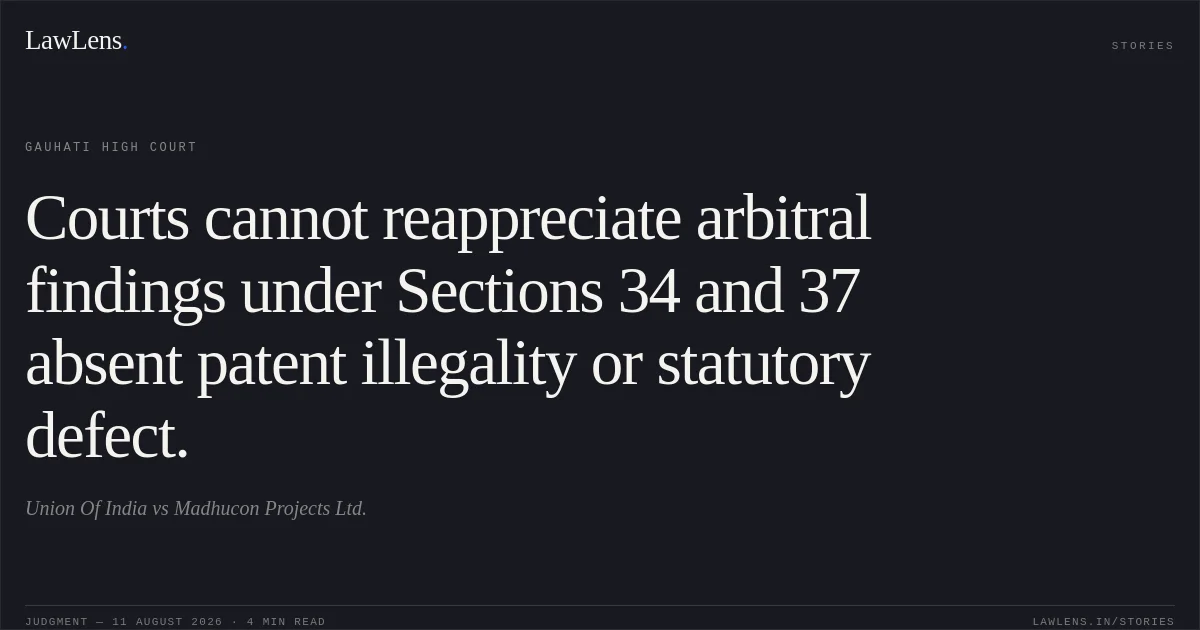
The Court applied Sections 19, 23, 34 and 37 of the Arbitration and Conciliation Act, 1996. Section 34 permits interference with an arbitral award only on specified statutory grounds, including incapacity, invalidity of the arbitration agreement, inability to present one’s case, excess of jurisdiction, conflict with public policy, and, for domestic awards, patent illegality appearing on the face of the award; however, the Court cannot reappreciate evidence or set aside an award merely for an erroneous application of law.
Source reference: para. 25; p. 11Section 19 provides that an arbitral tribunal is not bound by the CPC or the Indian Evidence Act, while Section 23 permits submission of a counterclaim.
Source reference: para. 29; p. 15Section 37 review cannot travel beyond the restrictions applicable under Section 34.
Source reference: no citationRelying on MMTC Ltd. v. Vedanta Ltd., PSA SICAL Terminals Pvt. Ltd. v. Board of Trustees, Ssangyong Engineering & Construction Co. Ltd. v. NHAI, and Delhi Airport Metro Express Pvt. Ltd. v. DMRC, the Court reiterated that a plausible and reasoned arbitral view is immune from appellate re-evaluation, and that patent illegality must be substantial, go to the root of the matter, and not amount to mere factual or legal error.
Source reference: paras. 12–14, 25–26; pp. 5–7, 11–13Reasoning
The High Court found that the Arbitral Tribunal had given a reasoned determination, based on the evidence, that no tunnelling work had commenced at the tunnel portal by 20.08.2013 and that the contractor had not completed even the approach road.
Source reference: paras. 10–11, 17, 29; pp. 4–5, 9, 14–15Consequently, the contractor could not reasonably have completed the work by the extended date of 31.12.2013, and the extension of time did not by itself invalidate the Railway’s termination.
Source reference: paras. 10–11, 17, 29; pp. 4–5, 9, 14–15The contractor was also unable to produce material demonstrating that work had commenced at the tunnel site, despite being given opportunities to do so before the High Court.
Source reference: para. 29; pp. 14–15The District Judge therefore impermissibly reassessed the merits and substituted its own contractual and factual conclusions for those of the Tribunal, without identifying any statutory defect under Section 34.
Source reference: paras. 25, 28–30; pp. 11–16As to the counterclaim, the Court held that the proceedings were governed by the Arbitration Act rather than the CPC; moreover, the Tribunal had not granted the Railway’s monetary counterclaims except to the extent of forfeiture of the security deposit and performance guarantee.
Source reference: para. 29; p. 15Such forfeiture followed from the contractual terms upon valid rescission, and the contractor failed to establish any prejudice from the absence of a further written statement.
Source reference: para. 29; p. 15Hence, there was no violation of natural justice or patent illegality warranting interference.
Source reference: no citationHolding
The Court answered the issues in favour of the Railways. It held that the termination dated 20.08.2013 was valid, that the District Judge had exceeded the permissible scope of Section 34 review, and that the alleged procedural irregularity concerning the counterclaim caused no prejudice and did not invalidate the award.
The appeal under Section 37 was allowed; the District Judge’s judgment dated 23.07.2019 in Misc. (Arb.) Case No. 32/2016 was set aside, and the Arbitral Tribunal’s award dated 29.06.2016 was restored.
Source reference: paras. 31–33; p. 16No order as to costs was made.
Source reference: paras. 31–33; p. 16Acts & Sections Cited
6 provisions across 1 statute referred to in this judgment. Each provision opens on LawLens.
Arbitration and Conciliation Act, 19966
Original Court PDF
Union Of IndiavsMadhucon Projects Ltd.
Click to open original judgment
Original judgment, available to read, download and summarize on LawLens.in