01Facts
The petitioner, a directly recruited District Registrar appointed in 1989, subsequently retired as Additional Inspector General of Registration on 31 December 2013.
His seniority was re-fixed pursuant to the Supreme Court’s decision in K. Madalaimuthu v. State of Tamil Nadu, (2006) 6 SCC 558.
p. 3His name was not initially sponsored for selection to the Indian Administrative Service for the 2007 and 2009 select lists.
p. 3Pursuant to earlier proceedings before the Supreme Court, the petitioner approached the Central Administrative Tribunal, which directed consideration of his candidature for the 2007 select list; the State’s challenge was unsuccessful before the High Court and the Supreme Court.
p. 3On reconsideration, the Review Selection Committee found that the last selected candidate, P. Muthuveeran, had secured 71 marks, whereas the petitioner had secured 69 marks, and therefore did not recommend his inclusion.
p. 4Following further rounds of litigation and directions for reconsideration, the same conclusion was reached.
p. 4The petitioner challenged the UPSC’s decision dated 17 August 2018 by filing the present writ petition in 2025.
pp. 4, 7–802Issues
i.1. Whether the petitioner’s case was properly “reconsidered” by the Review Selection Committee, including whether the marks awarded on the basis of his service records required fresh reassessment.
pp. 5–7 · ¶ 8–9ii.2. Whether the writ petition was maintainable when filed directly before the High Court without first approaching the Central Administrative Tribunal.
p. 7 · ¶ 10iii.3. Whether the writ petition was liable to be dismissed on the grounds of delay and laches, having been filed approximately seven years after the impugned decision.
pp. 6–8 · ¶ 6 and 10iv.4. Whether the High Court could interfere with the assessment of the petitioner’s suitability and relative merit by the expert Review Selection Committee.
pp. 8–9 · ¶ 11–1203Law Applied
The Court applied the principle that an aggrieved person challenging an order relating to service selection by the UPSC must ordinarily approach the Central Administrative Tribunal as the court of first instance.
p. 7 · ¶ 10It further applied the doctrine that writ relief may be denied where a challenge is brought after an unreasonable and unexplained delay, particularly where the impugned decision followed repeated reconsideration and earlier litigation.
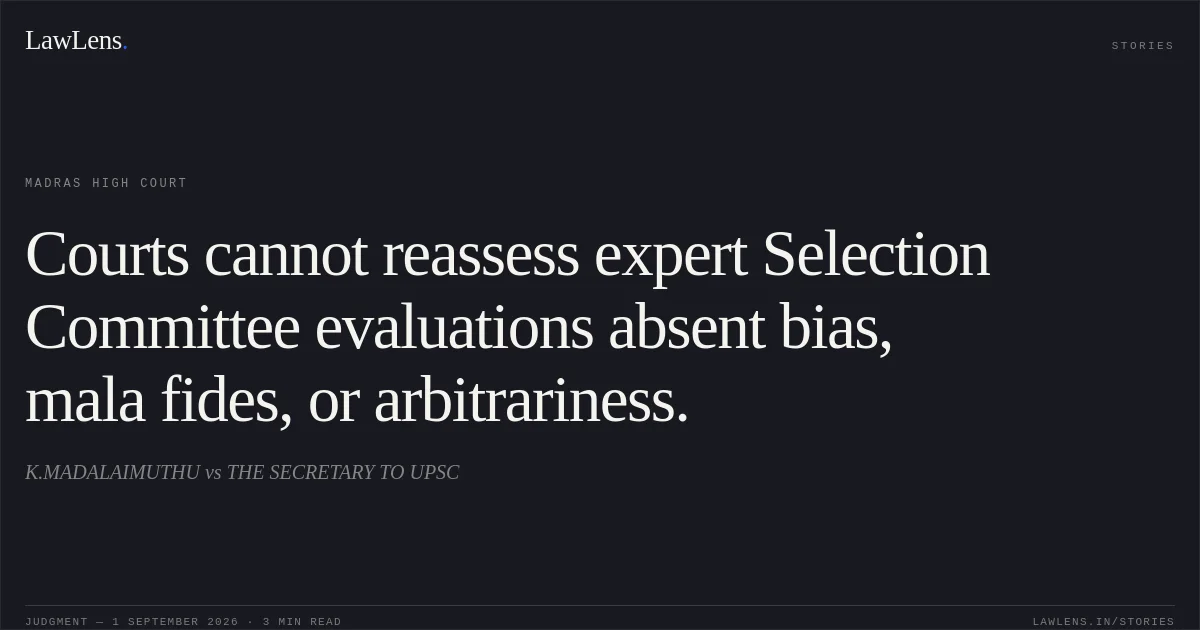
pp. 7–8 · ¶ 10On merits, the Court relied on Union Public Service Commission v. M. Sathiya Priya, (2018) 15 SCC 796, holding that assessment of service records, suitability and relative merit falls within the specialised domain of the duly constituted Selection Committee; courts should not substitute their own assessment except where the process is vitiated by bias, mala fides or arbitrariness.
p. 8 · ¶ 11The Court also relied on the earlier Division Bench order dated 28 February 2023 in Contempt Petitions Nos. 593 and 594 of 2019, which held that the UPSC’s adoption of the marks awarded in the Review Selection Committee meeting was consistent with the court’s directions; that order was confirmed by the Supreme Court on 22 September 2023.
p. 7 · ¶ 8–904Reasoning
The Court held that the petitioner’s contention that “reconsideration” required a completely fresh assessment of his service records had already been addressed by the Division Bench in the contempt proceedings.
pp. 5–7 · ¶ 8–9The Review Selection Committee had reconsidered the petitioner’s case pursuant to judicial directions and concluded, on the basis of the assessed marks, that he fell below the last selected candidate—69 marks as against 71 marks.
pp. 4, 7–9 · ¶ 8–12Since the Division Bench had accepted the UPSC’s approach and the Supreme Court had confirmed that decision, the Court found no basis to reopen the meaning or scope of reconsideration.
p. 7 · ¶ 8–9In addition, the petitioner challenged the 17 August 2018 decision only in 2025, despite retiring in 2013 and having participated in several earlier rounds of litigation. The delay was therefore held to be unreasonable.
pp. 7–8 · ¶ 10Finally, applying the limited scope of judicial review over expert selection assessments, the Court declined to reassess the petitioner’s service records or substitute its view for that of the Review Selection Committee, there being no demonstrated bias, mala fides or arbitrariness.
pp. 8–9 · ¶ 11–1205Holding
The writ petition was dismissed both on the grounds of delay and laches and on merits.
p. 9 · ¶ 13The Court upheld the UPSC Review Selection Committee’s decision dated 17 August 2018 not to include the petitioner in the 2007 select list for appointment by selection to the IAS, holding that the petitioner’s case had been duly reconsidered and that the Court could not substitute its assessment for that of the expert Selection Committee.
pp. 7–9 · ¶ 8–13No costs were awarded, and the connected miscellaneous petition was closed.
p. 9 · ¶ 13Original Court PDF
K.MADALAIMUTHUvsTHE SECRETARY TO UPSC
Click to open original judgment
Original judgment, available to read, download and summarize on LawLens.in