Facts
The appellants applied for Work Inspector posts notified on 2 February 2024. At counselling and verification, the authorities found that they held Diplomas in Engineering (Electronics and Communication), whereas the notification required a Diploma in Civil, Mechanical, or Electrical Engineering from an institution approved by the Government of Tamil Nadu
Source reference: p.3–4The appellants relied on G.O. (Ms.) No. 178, Higher Education (J1) Department, dated 17 July 2015, concerning equivalence involving certain bachelor’s degrees. The Single Judge dismissed their writ petitions, and the appellants filed these appeals under Clause 15 of the Letters Patent
Source reference: p.3–4Issues
Whether the appellants’ Diplomas in Engineering (Electronics and Communication) met the educational qualification prescribed for Work Inspector posts
Source reference: p.3–4Whether the equivalence stated in G.O. (Ms.) No. 178, dated 17 July 2015, applied to the appellants’ diplomas and could support their eligibility
Source reference: p.4Whether the Court could itself compare academic subjects or substitute its view for that of the expert bodies responsible for determining equivalence
Source reference: p.4–5Law Applied
The recruitment notification governs the educational qualifications required for appointment to the advertised posts
Source reference: p.3–4Equivalence of academic qualifications is to be assessed by the competent expert committee, which compares the subjects and other relevant academic features; the Government must then issue an order granting equivalence before the qualification may be accepted for appointment to a government post
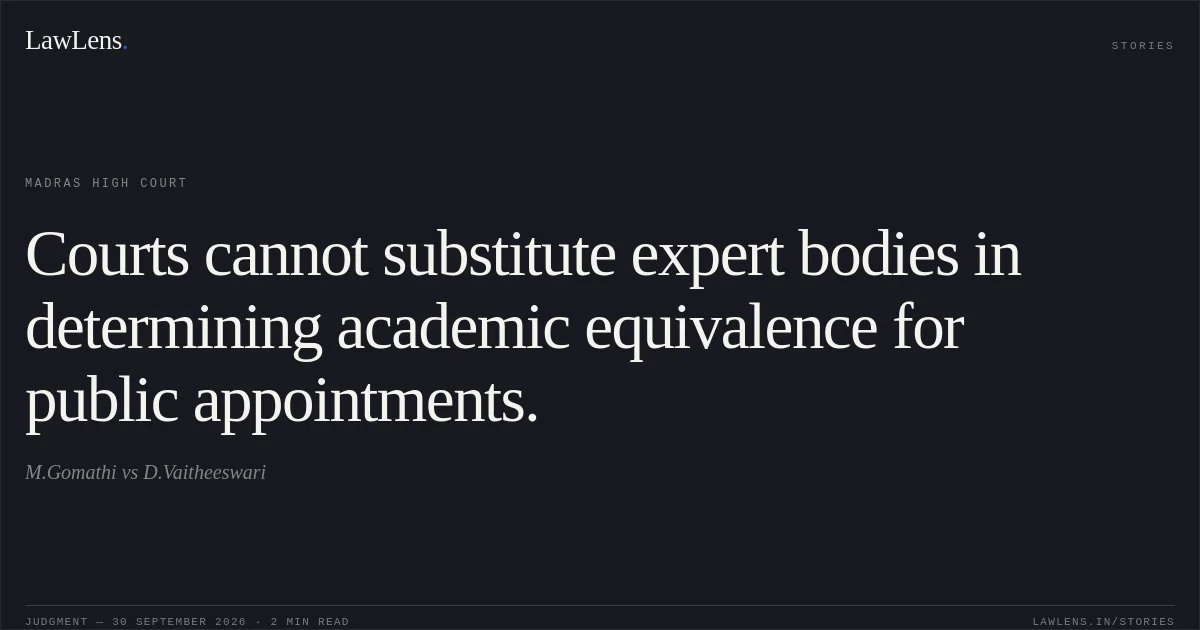
Source reference: p.4–5Courts should not substitute their own views for those of domain experts or undertake academic subject comparisons in judicial review
Source reference: p.5Reasoning
The notification required a diploma in Civil, Mechanical, or Electrical Engineering, while the appellants held diplomas in Electronics and Communication
Source reference: p.3–4The cited Government Order addressed equivalence involving B.E. degrees, including B.E. (Electronics and Instrumentation Engineering), and did not concern a Diploma in Electronics and Communication; it therefore did not establish the appellants’ eligibility
Source reference: p.4The Court also declined to compare the academic subjects itself, holding that equivalence was for the expert committee and Government to determine
Source reference: p.4–5As the appellants lacked the qualification specified in the notification, rejection of their candidatures was not perverse
Source reference: p.5Holding
The Division Bench held that the appellants did not possess the prescribed educational qualification and that the Single Judge’s decision required no interference
Both writ appeals were dismissed, with no order as to costs; the connected miscellaneous petitions were closed
Source reference: p.5Original Court PDF
M.GomathivsD.Vaitheeswari
Click to open original judgment
Original judgment, available to read, download and summarize on LawLens.in