Facts
The petitioner filed a public interest litigation before the Madhya Pradesh High Court seeking directions to the respondent authorities, particularly the Municipal Council, Shahdol, to incorporate continuous, safe, accessible and properly demarcated footpaths into the proposed Budhar Chowk–Balpurwa Bus Stand Road, Shahdol, stated to be approximately 18 metres wide.
Source reference: para. 1The petitioner asserted that the road would serve substantial pedestrian traffic, including residents, students, workers, women, elderly persons and persons with disabilities, particularly because of its connectivity with the New Bus Stand.
Source reference: paras. 2–3It was alleged that the Shahdol Development Plan, 2026 did not specifically provide for a continuous footpath and that the ongoing stage of construction presented an opportunity to incorporate pedestrian infrastructure before the road and allied works were completed.
Source reference: paras. 4–5, 14–16The respondents denied any illegality, stating that the project was being executed in accordance with the sanctioned plan, technical requirements, available right of way and site conditions, and contended that no technical or expert material established that the design was unsafe or unlawful.
Source reference: paras. 18–19Issues
Whether the Court should direct the respondent authorities to review or modify the sanctioned design of the Budhar Chowk–Balpurwa Bus Stand Road and incorporate continuous, accessible and protected footpaths in the absence of technical or expert material demonstrating illegality, arbitrariness or inherent unsafety.
Source reference: paras. 20–24Whether the petitioner established an enforceable constitutional, statutory or fundamental right warranting interference under Article 226 of the Constitution in relation to the planning and execution of the proposed road.
Source reference: paras. 21–23, 26Whether the respondent authorities should be directed to decide the petitioner’s pending representations in light of the Supreme Court’s decision in Maniyar Iliyyaz @ Shaik Riyaz v. P. Ayyappan.
Source reference: para. 1(g); paras. 9–10Law Applied
The Court considered Articles 36 to 38 of the Constitution, particularly the Directive Principles concerning public welfare, social and economic justice and a just social order; however, Article 37 makes the Directive Principles non-enforceable by courts, although they constitute fundamental principles of governance.
Source reference: para. 21Judicial review under Article 226 ordinarily examines the legality and fairness of administrative decision-making and does not permit substitution of the Court’s technical opinion for that of specialised planning and engineering authorities, unless the decision is shown to be arbitrary, unreasonable, mala fide or contrary to law.
Source reference: para. 23The Court also considered the petitioner’s reliance on Maniyar Iliyyaz @ Shaik Riyaz v. P. Ayyappan, which was cited for recognition of the right to walk and the corresponding public duty regarding footpaths; nevertheless, the Court required material demonstrating an actual violation of an enforceable legal, statutory or fundamental right before granting relief.
Source reference: paras. 9–10, 21–22Reasoning
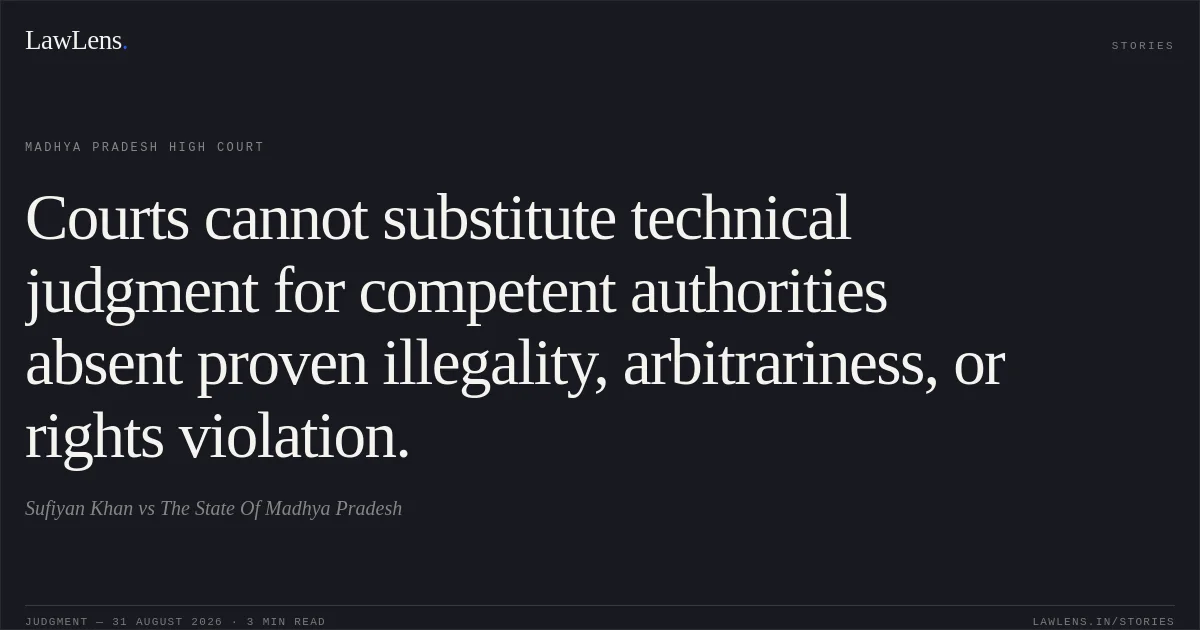
The Court accepted that pedestrian safety and public convenience constituted legitimate public concerns, but held that the petitioner had not produced any approved road design, alignment, technical proposal, expert report or other cogent material showing that the sanctioned project was illegal, arbitrary, inherently unsafe or contrary to mandatory standards.
Source reference: paras. 20, 22, 24The mere width of the proposed road, its proximity to the New Bus Stand, or the absence of an express footpath reference in the Development Plan did not establish a constitutional or statutory violation.
Source reference: paras. 18, 22Since the design and execution of public infrastructure primarily fell within the competence of planning and engineering authorities, the Court declined to interfere merely to impose its own assessment of the appropriate pedestrian design.
Source reference: para. 23The Court further treated the claim as premature because the road had not yet been properly constructed and the precise requirement for pedestrian movement could be assessed after the actual alignment, dimensions and technical conditions became available.
Source reference: paras. 24–25Although the Directive Principles and pedestrian-safety considerations could guide administrative action, they could not, without proof of an enforceable legal violation, justify a mandamus altering the project.
Source reference: para. 21Holding
The Court answered the issues against the petitioner and held that no basis for interference under Article 226 had been established.
The writ petition was accordingly dismissed for want of cogent material proving illegality, arbitrariness, inherent unsafety or infringement of an enforceable fundamental or statutory right.
Source reference: para. 26However, the Court clarified that dismissal did not relieve the respondent authorities of their continuing obligation to execute, maintain and regulate the road in accordance with law, the sanctioned plan, applicable technical standards and constitutional principles of public welfare and pedestrian safety.
Source reference: para. 27There was no order as to costs.
Source reference: para. 27Original Court PDF
Sufiyan KhanvsThe State Of Madhya Pradesh
Click to open original judgment
Original judgment, available to read, download and summarize on LawLens.in