Facts
Respondent No. 1, a practicing radiologist in the Unreserved (UR) category, secured the 142nd rank in the DNB PDCET 2025
Source reference: p. 2She opted for a Radio-Diagnosis seat at Government Hospital, Panchkula (Respondent No. 3) as her first preference, despite knowing the seat was reserved for the Other Backward Classes (OBC) category
Source reference: p. 2When no OBC candidate qualified for the seat in the first round, she was allotted her second preference at a private hospital, which she rejected
Source reference: p. 3She filed a writ petition seeking de-reservation of the vacant OBC seat to the UR category to prevent "national wastage" of a medical seat
Source reference: p. 3The Single Judge allowed the petition, directing the National Board of Examinations (NBE) to de-reserve the seat
Source reference: p. 4The NBE appealed, contending it lacked the authority to de-reserve and citing a policy to transfer vacant seats to the NEET PG pool
Source reference: p. 5Issues
1. Whether a vacant OBC category seat in a Post-Diploma DNB course can be de-reserved and offered to Unreserved candidates when no eligible reserved category candidates are available
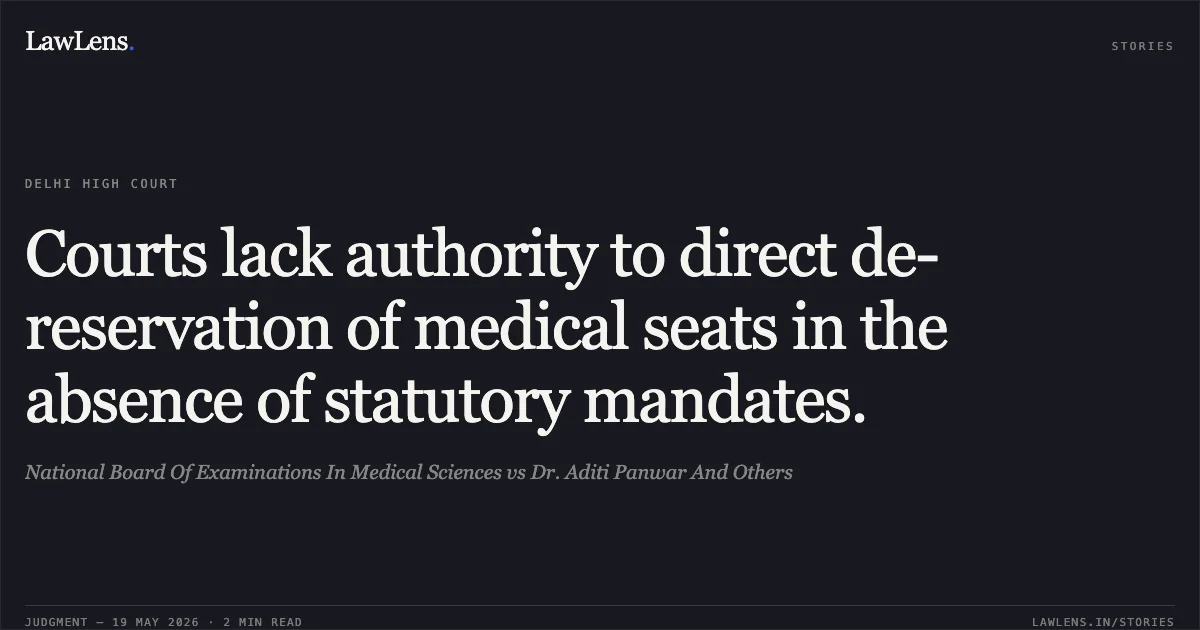
Source reference: p. 11, para. 272. Whether the Court has the jurisdiction to command the executive to de-reserve a seat in the absence of specific statutory or executive mandates
Source reference: p. 31, para. 66; p. 39, para. 14Law Applied
Article 15(5) of the Constitution regarding reservations in educational institutions
Source reference: p. 11Ashoka Kumar Thakur v. Union of India (2008) and P.V. Indiresan (2) v. Union of India (2011), which established that unfilled OBC seats in Central Educational Institutions should revert to the general category to prevent vacancy
Source reference: p. 14-16Post-Graduate Institute of Medical Education and Research v. K.L. Narasimhan (1997) and S.S. Sharma v. Union of India (1981), which hold that a court cannot issue a writ of mandamus to de-reserve a post/seat as such power lies exclusively within the executive domain
Source reference: p. 40-41Reasoning
Justice Shukla reasoned that medical seats are a scarce public resource and leaving them vacant constitutes national wastage; thus, in the absence of an explicit bar, de-reservation is a "plausible view" aligned with Supreme Court precedents on education
Source reference: p. 25, 33Justice Hari Shankar analyzed that reservation is a matter of social justice and the executive's policy (15th Accreditation Committee Meeting) to transfer vacant seats to the NEET PG pool was a valid exercise of discretion not specifically challenged
Source reference: p. 38, 43Justice Hari Shankar reasoned that directing de-reservation without a statutory basis violates the separation of powers and rewards a candidate (Respondent No. 1) who knowingly applied for a seat for which she was ineligible
Source reference: p. 39-40Holding
Justice Shukla voted to partially allow the appeal by shifting the direction of de-reservation from the NBE to the Union of India
Justice Hari Shankar voted to allow the appeal and dismiss the writ petition, holding that the court cannot mandate de-reservation
Source reference: p. 43The matter was referred to the Hon’ble Chief Justice for placement before a Third Judge to resolve the following point of difference: "Whether the learned Single Judge was correct in directing de-reservation of the Radiodiagnosis seat... to throw it open to Unreserved category candidates"
Source reference: p. 44Acts & Sections Cited
2 provisions across 1 statute referred to in this judgment. Each provision opens on LawLens.
Original Court PDF
National Board Of Examinations In Medical SciencesvsDr. Aditi Panwar And Others
Click to open original judgment
Original judgment, available to read, download and summarize on LawLens.in