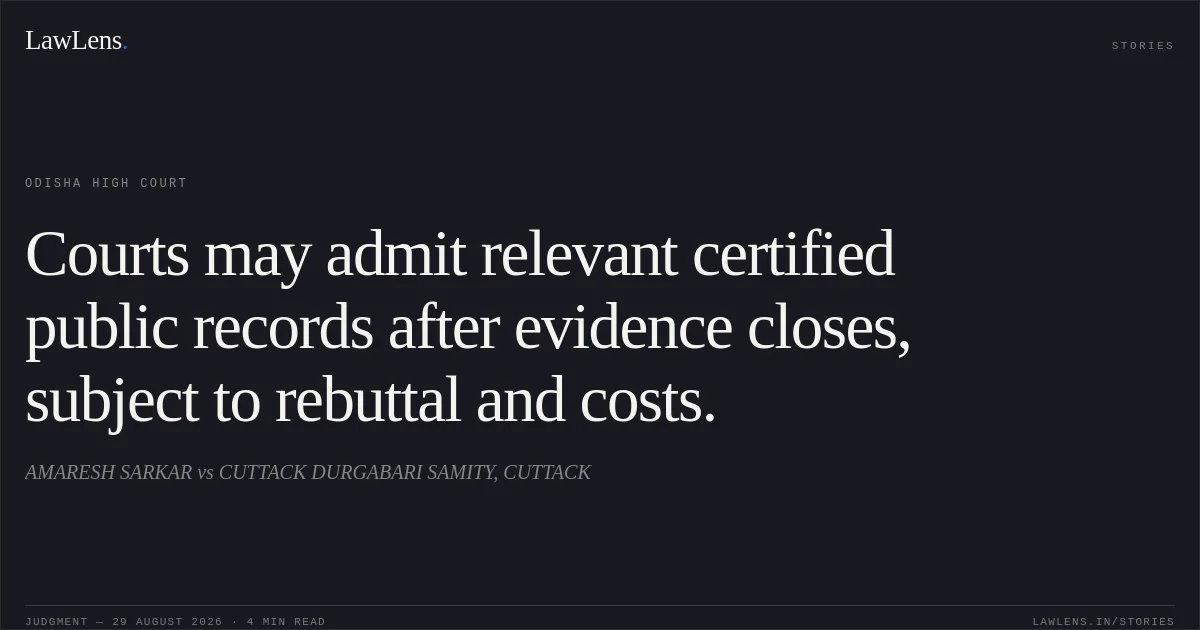
Facts
Cuttack Durgabari Samity instituted C.S. No.9 of 2011 seeking declaration of title, possession and consequential reliefs concerning the suit property. Amaresh Sarkar subsequently instituted C.S. No.424 of 2022 seeking recovery of possession and permanent injunction over the same property. Both suits were transferred for analogous trial and disposal by a common judgment.
Source reference: pp.2–3; para. 2(i)–(iv)The Samity claimed possession under a deed dated 10 September 1967 executed by Chandan Bilasini Dasi, who was the darpatadar, and asserted that it had constructed permanent structures on the property and remained in continuous possession. Sarkar, claiming to be the adopted son and successor of Chandan Bilasini Dasi, disputed the deed and contended that she had only a life interest and lacked authority to alienate or encumber the property.
Source reference: pp.3–5, 7–9; para. 2(v)–(x), 3(iii)–(v)After closure of evidence and when the suits were at the stage of arguments, Sarkar sought permission to produce and exhibit the certified copy of the judgment and decree in F.A. No.16 of 1968. The Trial Court rejected the application on the ground that no satisfactory explanation had been given for the delayed production and that the document’s necessity had not been established. Sarkar challenged that order under Article 227 of the Constitution.
Source reference: pp.1, 8–11, 16; paras. 1, 3(vii)–(xiii), 5Issues
Whether the Trial Court was justified in refusing, at the stage of arguments, to receive and exhibit the certified copy of the judgment and decree in F.A. No.16 of 1968?
Source reference: p.16; para. 6Whether delayed production of the document could be permitted where it was arguably relevant and necessary for adjudication, subject to safeguards such as recall, rebuttal and costs?
Source reference: pp.17–21; paras. 8–16Whether a judgment relied upon as evidence of what it adjudicated between particular parties and concerning particular property must be formally brought on record and exhibited, rather than merely cited as legal precedent?
Source reference: p.22; para. 18Law Applied
The Court applied Order VII Rule 14(3) and Order VIII Rule 1-A(3) CPC, which permit late production of documents with the leave of the Court, and Order XIII Rule 1 CPC, which ordinarily requires documentary evidence to be produced on or before settlement of issues.
Source reference: pp.17–18; paras. 8–9K.K. Velusamy v. N. Palanisamy, (2011) 11 SCC 275, holding that deletion of Order XVIII Rule 17-A does not completely bar reception of evidence after closure of evidence; the Court may exercise inherent power under Section 151 CPC where the material is relevant and necessary in the interests of justice, while ensuring that the power is used sparingly.
Source reference: p.18; para. 10Billa Jagan Mohan Reddy v. Billa Sanjeeva Reddy, (1994) 4 SCC 659 establishes that relevant documents may ordinarily be received before arguments conclude, with an opportunity to prove, rebut and address their effect.
Source reference: pp.10–11, 21; paras. 3(xii), 16Kanda v. Waghu, AIR 1950 PC 68 and Kumar Gopika Raman Roy v. Atal Singh, 1929 31 Bom LR 734, recognise that official records of undoubted authenticity should ordinarily be admitted where they may assist the Court in deciding the controversy.
Source reference: pp.19–20; paras. 11–12The ultimate relevance and evidentiary effect of the judgment remained subject to Sections 40–43 of the Evidence Act.
Source reference: p.23; para. 20(iii)Reasoning
The High Court held that the Trial Court’s discretion had not been properly exercised because it considered only the lateness of the application and the absence of a detailed explanation, without examining the document’s apparent connection with the pleaded dispute concerning Chandan Bilasini Dasi’s title and capacity to execute the 1967 instrument.
Source reference: pp.20–21; paras. 13–15The certified judgment was a public judicial record whose authenticity was not challenged; the petitioner had also pleaded matters relating to the earlier litigation and was not attempting to introduce an entirely new case or cure a purely evidentiary defect.
Source reference: p.21; para. 15The Court rejected the contention that the judgment could simply be cited without being exhibited. It distinguished between a judgment cited as an authority, which is a source of law and requires no exhibition, and a judgment tendered to establish the fact and effect of an adjudication between particular parties concerning particular property, which must enter the evidentiary record.
Source reference: p.22; para. 18Any prejudice caused by late production could be addressed by permitting the Samity to recall D.W.2, lead limited rebuttal evidence and receive the document subject to objections regarding relevance, admissibility and evidentiary value.
Source reference: pp.21–23; paras. 16–20The Court expressly refrained from deciding the validity of the 1967 deed, the nature of the Samity’s possession, or the legal effect of the earlier judgment.
Source reference: pp.16, 23–24; paras. 7, 21Holding
The CMP was allowed. The High Court quashed the Trial Court’s order dated 3 August 2026 and directed that the certified copy of the judgment and decree in F.A. No.16 of 1968 be received and marked as an exhibit in both suits.
The exhibition was made subject to all objections regarding relevance, admissibility, evidentiary value, Sections 40–43 of the Evidence Act, and its operation against persons who were not parties to the earlier appeal.
Source reference: p.23; para. 20(iii)The Samity was permitted to recall D.W.2 and adduce limited rebuttal evidence, and Sarkar was directed to pay costs of ₹20,000 as a condition precedent to exhibition of the document.
Source reference: p.23; para. 20(iv)–(v)The Trial Court was directed to dispose of both suits by a common judgment, preferably within three months.
Source reference: p.24; para. 20(vi)Acts & Sections Cited
2 provisions across 2 statutes referred to in this judgment. Each provision opens on LawLens.
Limitation Act, 19631
Code of Civil Procedure, 19081
Original Court PDF
AMARESH SARKARvsCUTTACK DURGABARI SAMITY, CUTTACK
Click to open original judgment
Original judgment, available to read, download and summarize on LawLens.in
![A police constable cannot be removed for unauthorized absence without a Rule 359-compliant inquiry.. Mohammad Sidiq Khan vs D/o Home Ut Of Jammu & Kashmir. CAT - ['Srinagar']. LawLens](/stories/thumbnails/a-police-constable-cannot-be-removed-for-unauthorized-absence-without-a-rule-359-compliant-7b43fc316bd94f22a62676153bbc9d54.webp)
![A Review DPC lacks authority to determine or alter inter se seniority.. SAURABH KUMAR vs REVENUE. CAT - ['Patna']. LawLens](/stories/thumbnails/a-review-dpc-lacks-authority-to-determine-or-alter-inter-se-seniority-4b21640f20af46fcabdfc8273d2ce959.webp)