Facts
Mohammed Mufazil purchased the disputed property at Kalarahanga, Bhubaneswar, and died in 2021, leaving his widow, Appellant No. 1, and two daughters, including minor Appellant No. 2
Source reference: p. 2–3, 11The mother applied under Sections 29 and 31 of the Guardians and Wards Act, 1890, for appointment as guardian of the minor’s property and permission to sell the minor’s interest, stating that she lacked sufficient income and that the proceeds would be used for the minor’s welfare
Source reference: p. 3–5The major daughter supported the application; the State and no other person opposed it
Source reference: p. 5, 12The District Judge dismissed the petition, holding that the mother was not a legal guardian of the minor’s property and that the requirements for sale had not been established
Source reference: p. 6–8The mother and minor appealed
Source reference: p. 8Issues
Whether the District Judge’s decision was perverse and whether the mother could be appointed by the Court as guardian of the minor’s property.
Source reference: p. 13–16Whether the requirements for permission to alienate the minor’s interest for her welfare or evident advantage under Section 31 of the Guardians and Wards Act were satisfied.
Source reference: p. 16–19What was the minor’s lawful share in the property, and what safeguards should govern any sale.
Source reference: p. 19–27Law Applied
Under Sections 7 and 17 of the Guardians and Wards Act, 1890, a court may appoint a guardian of a minor’s property where appointment serves the minor’s welfare, assessed by relevant circumstances including the proposed guardian’s capacity and relationship with the minor.
Source reference: p. 14–16Sections 29 and 31 prohibit a guardian from transferring a ward’s immovable property without prior court permission and permit permission where there is necessity or evident advantage to the ward; Sections 31(2)–(3) allow conditions, while Section 34 provides for a guardian’s bond and related duties.
Source reference: p. 16, 26Under Mahomedan law, the mother is not, merely by status, the legal guardian of a minor’s property; however, in default of the specified legal guardians, the court may appoint a guardian for protection and preservation of the property.
Source reference: p. 13–15The Court relied on Imambandi v. Mutsaddi, AIR 1918 PC 11, and Meethiyan Sidhiqu v. Muhammed Kunju Pareeth Kutty, AIR 1996 SC 1003, on the limits of a mother’s authority absent legal or court-appointed guardianship.
Source reference: p. 13, 6–7It also applied Sunni inheritance principles concerning fixed shares, residue and radd (return) to determine the daughters’ interests, while treating the legal-heir certificate as insufficient by itself to conclusively establish fractional shares.
Source reference: p. 20–25Reasoning
The mother’s status did not make her a legal guardian under Mahomedan law, but that did not preclude her appointment by the court under the Guardians and Wards Act. She had the minor’s care and custody, had maintained and educated her, and there was no evidence of an adverse interest or objection to her appointment.
Source reference: p. 14–16The father’s death, the mother’s stated lack of sufficient income, the minor’s educational and maintenance needs, and the property’s distance from the family’s residence collectively established necessity or, at minimum, evident advantage; the absence of a precise valuation called for safeguards rather than rejection of the application.
Source reference: p. 17–19On the stated succession facts, the Court calculated each daughter’s share as 7/16 after the widow’s 1/8 share and application of radd, but directed that the minor’s exact lawful share be verified from title and succession material before any sale.
Source reference: p. 24–26, 28Holding
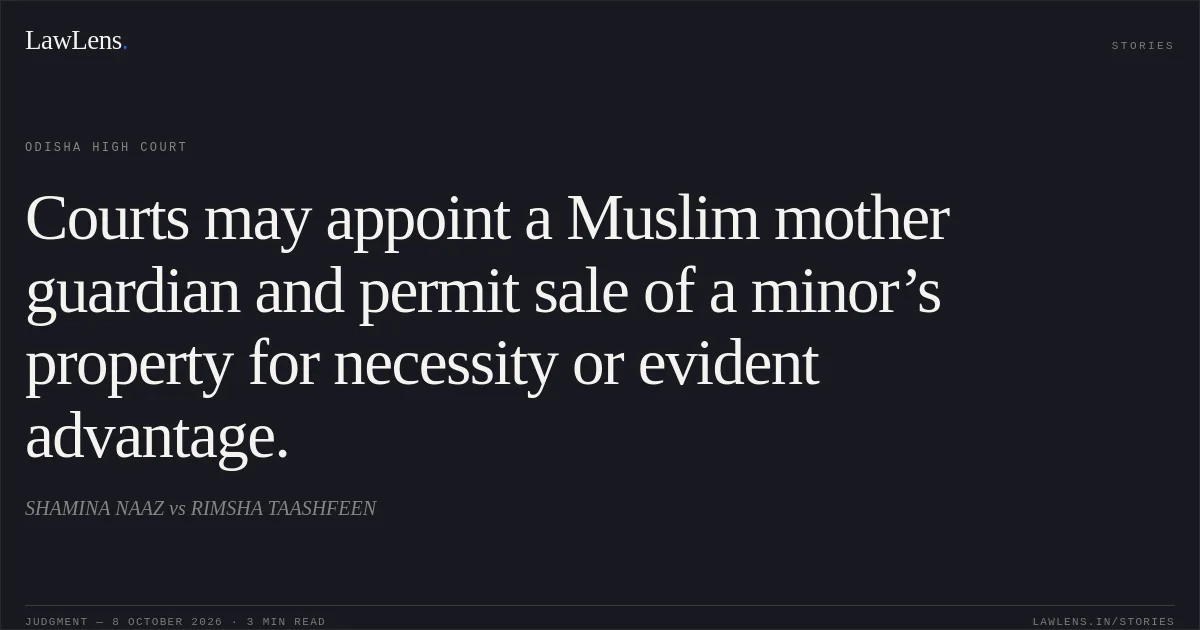
The High Court held that the mother could be appointed by the court as guardian of the minor’s property and that a controlled sale was justified.
It set aside the dismissal and allowed the appeal, appointing the mother as guardian for the limited purposes of protection, management and the authorised transaction.
Source reference: p. 27–28Sale was confined to the minor’s verified lawful share, subject to independent valuation, a minimum-price safeguard, prior compliance with the guardianship court’s requirements, bond and surety, deposit or secure investment of the minor’s net proceeds, and accounting to that court.
Source reference: p. 26–30The judgment clarified that the mother’s authority arose from her court appointment and the conditional permission granted, not from status as the minor’s legal guardian under Mahomedan law.
Source reference: p. 30Acts & Sections Cited
6 provisions across 1 statute referred to in this judgment. Each provision opens on LawLens.
Guardians and Wards Act, 18906
Original Court PDF
SHAMINA NAAZvsRIMSHA TAASHFEEN
Click to open original judgment
Original judgment, available to read, download and summarize on LawLens.in