Facts
The Petitioner, a hospital situated in the State of Punjab, filed a writ petition seeking to set aside a communication dated 15.12.2025 issued by Respondent No. 2, the National Accreditation Board for Hospitals and Healthcare Providers (NABH).
Source reference: p. 1The impugned communication informed the Petitioner that it had not been recommended for empanelment with the Ex-Servicemen Contributory Health Scheme (ECHS).
Source reference: p. 1Although the Respondents are located in Delhi and the order was issued from Delhi, the Petitioner-hospital is located in Punjab, and the effects of the decision are felt therein.
Source reference: p. 1-2Issues
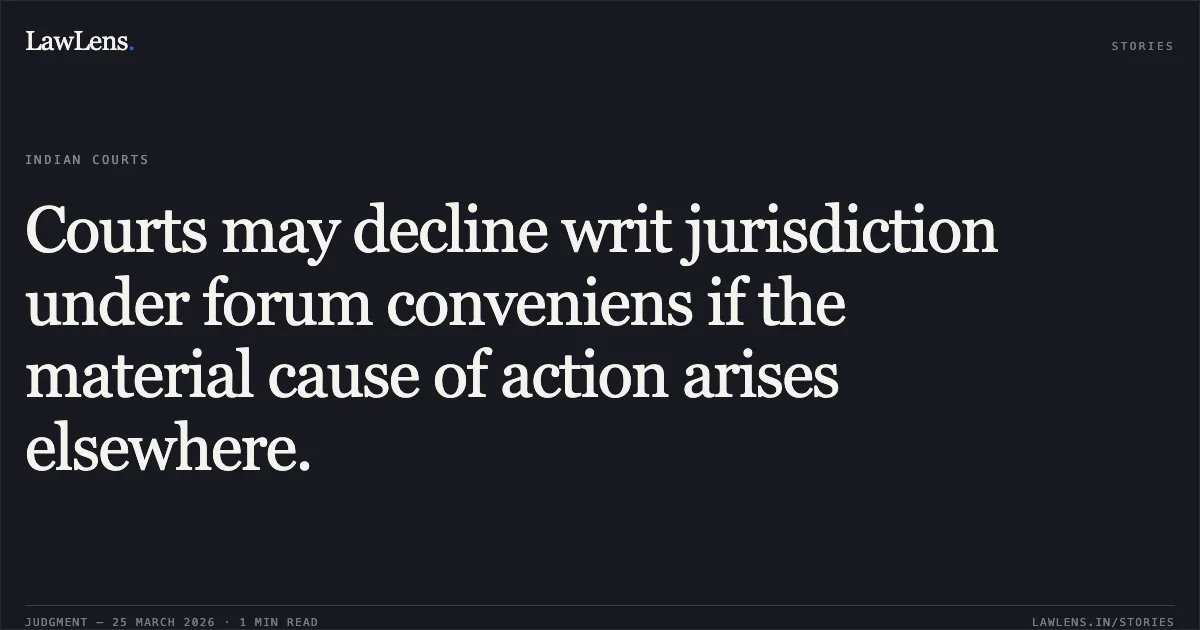
Whether the Delhi High Court should exercise territorial jurisdiction over a matter where the underlying cause of action and the Petitioner are situated outside Delhi, solely because the decision-making authority is located within Delhi.
Source reference: p. 2 / para. 3Whether the doctrine of forum conveniens permits the Court to refuse the exercise of discretionary jurisdiction despite a small part of the cause of action arising in Delhi.
Source reference: p. 3 / para. 5Law Applied
The Court primarily applied the doctrine of forum conveniens and the principle of "dominant facts" or "material, essential and integral facts" to the lis.
Source reference: p. 2 / para. 38The Court relied on the precedent of Indure Pvt. Ltd. v. Government of NCT of Delhi and Ors. (2026:DHC:1605), which established that the location of a pan-India authority in Delhi should not be the sole reason to entertain a writ petition if the legal injury occurs elsewhere.
Source reference: p. 2 / para. 36-37The Court cited Kusum Ingots & Alloys Ltd. v. Union of India and Anr. (2004) 6 SCC 254, which held that a High Court may refuse to exercise discretionary jurisdiction even if a small part of the cause of action arises within its limits.
Source reference: p. 3 / para. 5Reasoning
The Court reasoned that since the Petitioner-hospital is situated in Punjab, the entire cause of action effectively arose outside Delhi.
Source reference: p. 1The Court observed that because Delhi is the national capital, many authorities with pan-India jurisdiction are headquartered there; however, the act of passing an order or holding a hearing in Delhi is often non-essential and non-integral to the actual dispute.
Source reference: p. 2 / para. 37-38The Court emphasized that entertaining such petitions would erroneously transform the Delhi High Court into a "mini-pan-India Superior Court".
Source reference: p. 2 / para. 36Applying the principles from Kusum Ingots, the Court determined that while the Respondents' location provided a technical nexus, it was not a determinative factor that compelled the Court to decide the matter on merits when the "dominant facts" were located in Punjab.
Source reference: p. 3-4Holding
The Court held that it would not entertain the writ petition as the material cause of action arose outside its territorial jurisdiction.
The petition was dismissed; however, the Court granted the Petitioner liberty to approach the appropriate jurisdictional High Court (Punjab).
Source reference: p. 4 / para. 8Original Court PDF
Sai Kripa Eye And Children HospitalvsQuality Council Of India & Anr.
Click to open original judgment
Original judgment, available to read, download and summarize on LawLens.in