Facts
Respondent No. 1 filed O.S. No. 58/2018 seeking recovery of money with future interest.
Source reference: paras. 1–3, 6–9The petitioner, defendant No. 1, repeatedly failed to participate in the trial proceedings, including by not filing his written statement within time and by failing to cross-examine witnesses despite opportunities.
Source reference: paras. 1–3, 6–9The Trial Court had previously allowed applications to reopen evidence and recall witnesses.
Source reference: paras. 1–3, 6–9After the petitioner was absent when the matter was posted for his evidence, the Trial Court treated his evidence as nil and posted the suit for arguments.
Source reference: paras. 1–3, 6–9The petitioner then filed I.A. Nos. 10 and 11 under Section 151 CPC to reopen the case and recall the order closing his evidence; the Trial Court rejected both applications on 13 March 2024.
Source reference: paras. 1–3, 6–9The petitioner challenged that order under Articles 226 and 227 of the Constitution.
Source reference: paras. 1–3, 6–9Issues
1. Whether the Trial Court’s rejection of the petitioner’s applications to reopen the case and recall the order closing his evidence warranted interference.
Source reference: paras. 4–5, 10–112. Whether the petitioner should be granted a final opportunity to lead evidence, subject to conditions, despite his repeated defaults.
Source reference: paras. 10–11Law Applied
Section 151 of the Code of Civil Procedure, 1908, preserves the court’s inherent powers to make orders necessary for the ends of justice; the applications before the Trial Court invoked that provision.
Source reference: paras. 1, 2In exercising its supervisory jurisdiction under Articles 226 and 227, the High Court considered whether the circumstances justified interfering with the Trial Court’s order.
Source reference: p. 2The Court applied the principle that a litigant’s conduct and repeated defaults may justify refusing further opportunities, but that an opportunity to present evidence may be granted where necessary to protect the litigant’s valuable rights, subject to conditions that promote expeditious disposal.
Source reference: paras. 9–11No precedent was cited.
Source reference: no citationReasoning
The Court accepted that the petitioner had repeatedly failed to participate diligently, allowing evidence to be closed and then seeking reopening or recall, and that the Trial Court had relied on this conduct in rejecting the applications.
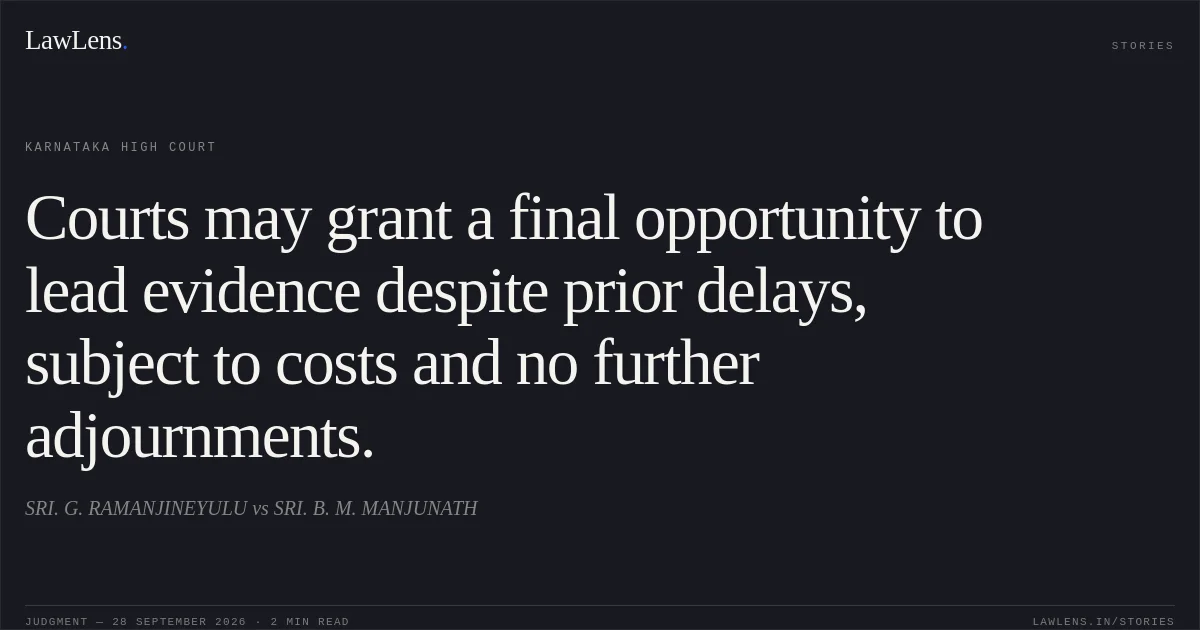
Source reference: paras. 6–10Nevertheless, considering the valuable rights involved in the suit, the Court concluded that the petitioner should receive one final opportunity to lead evidence.
Source reference: para. 11It balanced that opportunity against the history of delay by requiring payment of costs and prohibiting further adjournments.
Source reference: para. 11Holding
The High Court allowed the writ petition and set aside the Trial Court’s order dated 13 March 2024.
I.A. Nos. 10 and 11 were allowed, permitting the petitioner to lead evidence upon payment of ₹10,000 to the Legal Services Authority.
Source reference: para. 12The petitioner was directed not to seek any further adjournment and to cooperate with the Trial Court, which was requested to dispose of the suit expeditiously.
Source reference: para. 12Acts & Sections Cited
1 provisions across 1 statute referred to in this judgment. Each provision opens on LawLens.
Code of Civil Procedure, 19081
Original Court PDF
SRI. G. RAMANJINEYULUvsSRI. B. M. MANJUNATH
Click to open original judgment
Original judgment, available to read, download and summarize on LawLens.in