Facts
The complainant, Investicon Financials (through proprietor Malay Nahar representing a Hindu Undivided Family), filed a complaint under Section 138 of the Negotiable Instruments Act, 1881, against the petitioner/accused regarding the dishonor of a cheque for Rs. 33,00,000
Source reference: para. 2(i)The petitioner contended that the loan was settled via a payment of Rs. 33,00,000 made on the same day into a different account held by Malay Nahar
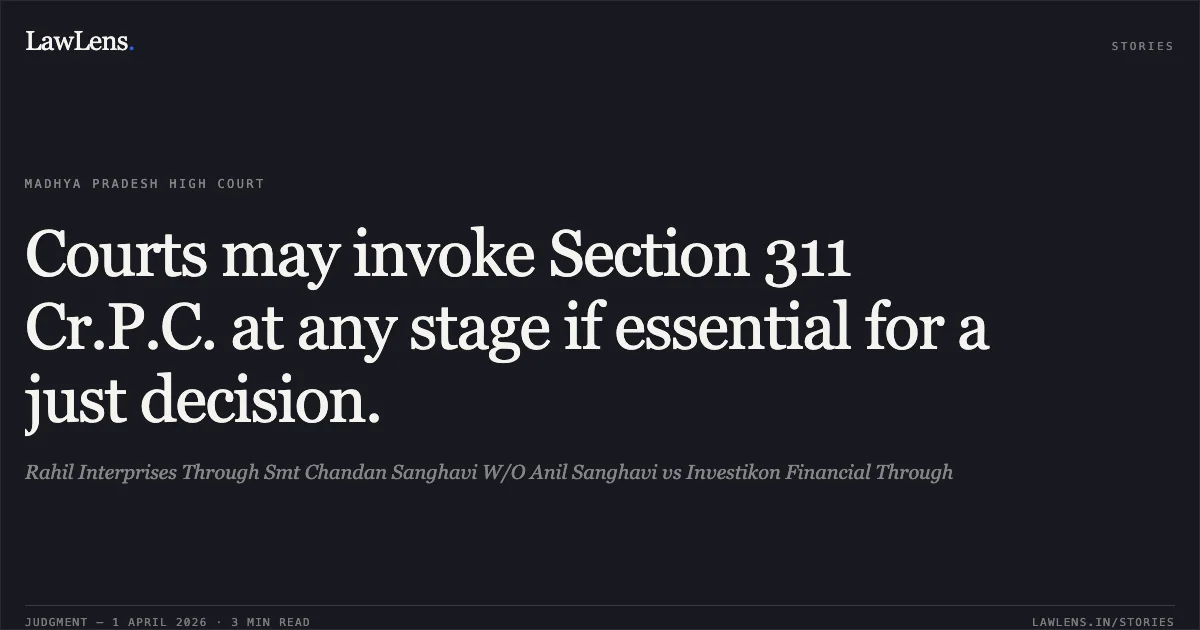
Source reference: para. 3Following the conclusion of the trial and after the matter was reserved for final judgment, the complainant filed an application under Section 311 of the Cr.P.C. (Section 348 of BNSS, 2023) to recall himself, examine a Chartered Accountant, and produce bank certificates to clarify that the loan and the alleged repayment involved distinct transactions across accounts held in different legal capacities (HUF vs. Individual)
Source reference: para. 2(iii), 4The Judicial Magistrate First Class, Jaora, allowed the application
Source reference: para. 1The petitioner challenged this order, alleging it was an attempt to fill a lacuna in the prosecution's case
Source reference: para. 3Issues
1. Whether the Trial Court was justified in exercising its discretion under Section 311 of the Cr.P.C. to allow additional evidence after the case was reserved for judgment
Source reference: para. 3, 172. Whether the proposed additional evidence was essential for a "just decision" or constituted an impermissible attempt to fill gaps in the complainant's case
Source reference: para. 15-16Law Applied
The Court applied Section 311 of the Cr.P.C. (Section 528 BNSS), which provides the court with broad discretionary and mandatory powers to summon, examine, or recall any person if their evidence appears essential to the just decision of the case
Source reference: para. 8It relied on Rajaram Prasad Yadav v. State of Bihar [AIR 2013 SC 3081], which held that the court should ensure a judgment is not rendered on inconclusive facts and that the "filling of a lacuna" objection cannot override the court's duty to find the truth
Source reference: para. 7It further cited Varsha Garg v. State of Madhya Pradesh [2023 Livelaw SC 662], affirming that the closure of evidence is not an absolute bar to Section 311, as the court's role is discovery of truth rather than being a "hapless bystander"
Source reference: para. 8Reasoning
The Court noted that the central dispute involved whether the petitioner’s payment of Rs. 33,00,000 into one of the complainant's accounts (Account No. ...158) satisfied the debt owed to another account (Account No. ...138)
Source reference: para. 11, 14While both accounts were operated by Malay Nahar, they were held in different legal capacities—one as an HUF proprietor and the other in an individual capacity
Source reference: para. 12The Court reasoned that to resolve the inconsistency regarding whether the deposit related to a distinct transaction, the proposed testimony of the Chartered Accountant and the bank certificates were essential
Source reference: para. 15, 16It held that under the second limb of Section 311, the court has a mandatory duty to receive evidence that is germane to the issue
Source reference: para. 8The Court found that allowing this evidence would not cause "substantial prejudice" to the accused, as the petitioner retains the right to cross-examine the witnesses and lead rebuttal evidence
Source reference: para. 16Holding
The High Court dismissed the petition, holding that the Trial Court did not commit any manifest error or material irregularity in allowing the Section 311 application
The Court concluded that the exercise of discretion was necessary for a complete and just adjudication of the dispute between the parties
Source reference: para. 16The petition was found to be meritless under Section 528 of BNSS/482 of Cr.P.C.
Source reference: para. 18Acts & Sections Cited
10 provisions across 4 statutes referred to in this judgment. Each provision opens on LawLens.
Bharatiya Nagarik Suraksha Sanhita, 20232
Code of Criminal Procedure, 19735
Negotiable Instruments Act, 18812
Indian Penal Code, 18601
Original Court PDF
Rahil Interprises Through Smt Chandan Sanghavi W/O Anil SanghavivsInvestikon Financial Through
Click to open original judgment
Original judgment, available to read, download and summarize on LawLens.in