Facts
The petitioner, a former Naib Tehsildar in the General Record Room, Jammu (2009–2012), was accused of conspiring with a Patwari (co-accused Riaz Ahmed) to tamper with revenue records (Khasra No. 127/1) to confer undue benefits upon a private individual
Source reference: para 2-3Following the filing of a chargesheet, the Special Judge (Anti-Corruption) Jammu, vide order dated 19.01.2019, observed that the investigation was inadequate regarding the petitioner’s specific role and whether he or a subordinate held physical custody of the records
Source reference: para 4, 11The Trial Court directed the investigating agency to "rectify the lapse"
Source reference: para 4Subsequently, the agency recorded additional statements of two witnesses but submitted them in report form rather than a formal supplementary chargesheet
Source reference: para 5, 21Based on this, the Trial Court passed orders dated 01.06.2019 and 08.06.2019 framing charges against the petitioner under the JK PC Act and RPC
Source reference: para 1, 6The petitioner challenged these orders, alleging judicial bias and lack of jurisdiction to order further investigation after taking cognizance
Source reference: para 7-8Issues
1. Whether the Trial Court’s direction to the investigating agency to "rectify the lapse" in investigation indicated judicial bias or pre-meditation against the petitioner.
Source reference: para 102. Whether a Magistrate or Special Judge possesses the jurisdiction to direct "further investigation" after taking cognizance but before the commencement of trial (framing of charges).
Source reference: para 153. Whether charges can be framed based on a "half-baked" supplementary report that fails to follow the prescribed statutory format.
Source reference: para 21, 29-30Law Applied
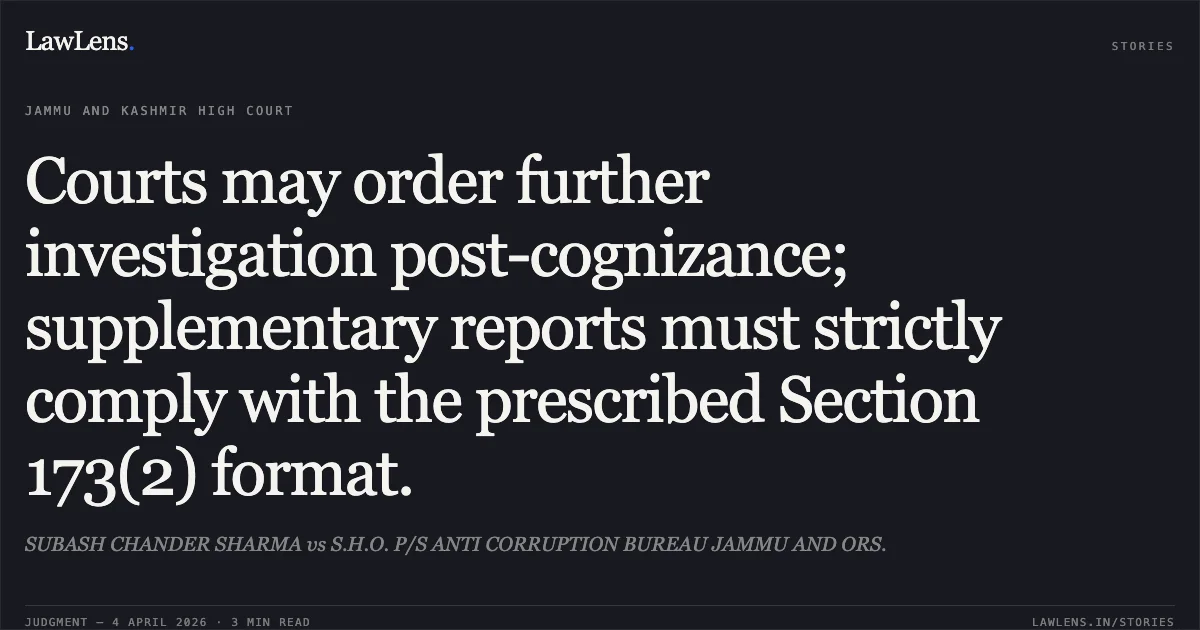
The court relied on Section 173(8) of the CrPC, which allows for further investigation even after a police report has been forwarded to the Magistrate
Source reference: para 18It applied the principle from Ram Lal Narang v. State (Delhi Administration) (1979) and Hasanbhai Valibhai Qureshi v. State of Gujrat (2004), holding that defective investigations discovered during trial can be cured by further investigation
Source reference: para 15, 17Furthermore, the court cited VinuBhai HariBhai Malaviya v. State of Gujrat (2019), affirming that a Magistrate’s power to ensure a "proper investigation" under Section 156(3) continues until the trial actually commences with the framing of charges
Source reference: para 18Regarding procedural compliance, the court invoked Dablu Kujur v. State of Jharkhand (2024), which mandates that supplementary reports must be submitted in the form prescribed under Section 173(2)
Source reference: para 21Reasoning
The High Court first rejected the allegation of bias, noting that the Trial Court’s 19.01.2019 order actually protected the petitioner by observing he could not be charged solely based on his official designation without evidence of an overt act
Source reference: para 12The Court held that directing the agency to "rectify the lapse" was a valid exercise of the power to order further investigation to ensure a fair trial under Article 21
Source reference: para 18-20However, the Court found the subsequent investigation and framing of charges flawed
Source reference: para 30It noted that the investigating officer failed to verify the petitioner's specific defense—that the records were under the "lock and key" of a subordinate and tampered with before his tenure—despite having the technology (FSL) to determine the approximate age of the ink and tampering
Source reference: para 24-26The Court criticized the agency for submitting a "half-baked" report in a non-prescribed format, which the Trial Court erroneously accepted as sufficient to frame charges despite its earlier findings of inadequacy
Source reference: para 21, 28-29Holding
The High Court upheld the Trial Court’s order dated 19.01.2019, confirming the power to order further investigation post-cognizance
However, it quashed the orders dated 01.06.2019 and 08.06.2019 regarding the framing of charges against the petitioner
Source reference: para 31(ii)The Court directed the respondent-agency to conduct a thorough and objective further investigation, specifically verifying the age of the tampering and the petitioner’s defense, and to file a final report in the prescribed form under Section 173(2) CrPC
Source reference: para 31(iii)-(iv)The Trial Court was directed to consider the question of framing charges afresh thereafter
Source reference: para 31(iv)Acts & Sections Cited
3 provisions across 1 statute referred to in this judgment. Each provision opens on LawLens.
Indian Penal Code, 18603
Original Court PDF
SUBASH CHANDER SHARMAvsS.H.O. P/S ANTI CORRUPTION BUREAU JAMMU AND ORS.
Click to open original judgment
Original judgment, available to read, download and summarize on LawLens.in