Facts
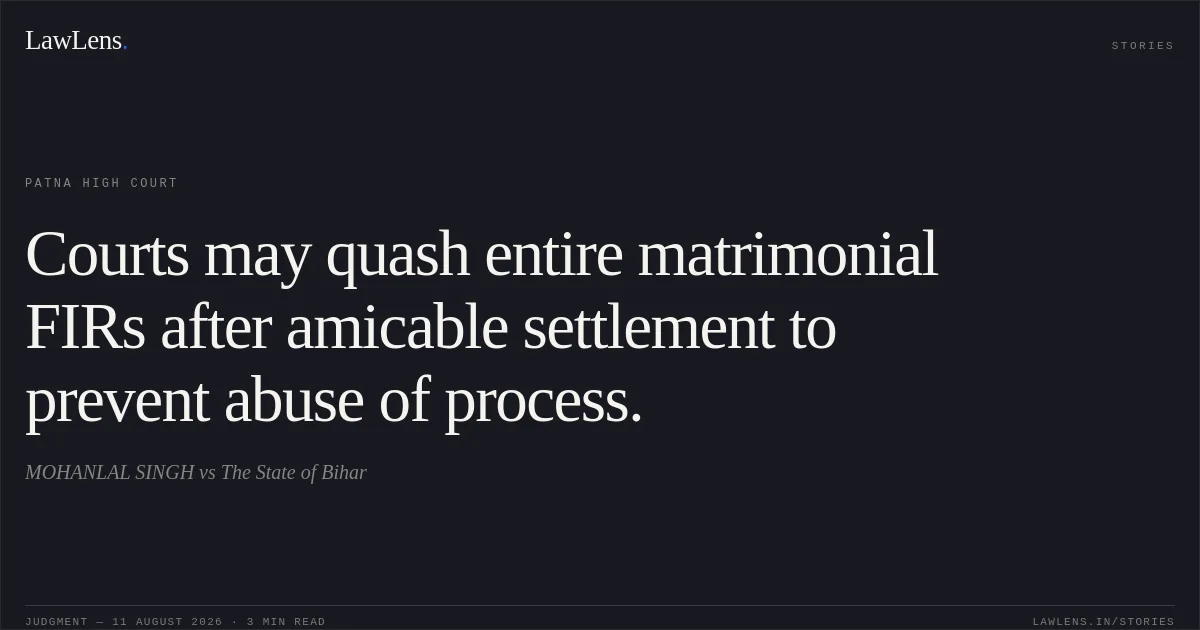
The petitioners, who were family members of the husband of Opposite Party No. 2, sought quashing of Bypass P.S. Case No. 96 of 2022, registered for offences under Sections 341, 323, 506 and 498A read with Section 34 of the IPC and Sections 3 and 4 of the Dowry Prohibition Act.
Source reference: p. 1, para. 2The FIR alleged that Opposite Party No. 2 had been subjected to cruelty on account of non-payment of dowry and because she had given birth to female children.
Source reference: p. 2, para. 3The petitioners contended that they lived separately, had no interference in the matrimonial life of Opposite Party No. 2, and that her husband was posted as an officer in the Cabinet Secretariat, Delhi.
Source reference: p. 2, para. 4It was also submitted that the husband had instituted proceedings under Section 9 of the Hindu Marriage Act for restitution of conjugal rights.
Source reference: p. 2, para. 4During the proceedings, the parties amicably settled their dispute; the husband and Opposite Party No. 2 resumed cohabitation and were leading a peaceful matrimonial life.
Source reference: p. 3, paras. 6–7The parties appeared before the Court and confirmed the compromise.
Source reference: p. 3, paras. 6–7Opposite Party No. 2 did not oppose the petition.
Source reference: p. 5, para. 9Issues
Whether the High Court should exercise its inherent jurisdiction under Section 482 Cr.P.C. to quash an FIR involving matrimonial and dowry-related offences when the parties have amicably settled their dispute and resumed peaceful matrimonial life?
Source reference: p. 3, paras. 6–8; p. 5, para. 10Whether the FIR could be quashed in its entirety, including proceedings against the husband, although the husband was not a party to the quashing application?
Source reference: p. 6, para. 11Whether continuation of the criminal proceedings against the relatives of the husband, in the circumstances of the settlement and absence of a continuing matrimonial dispute, would constitute an abuse of the process of law?
Source reference: p. 3, paras. 5–8; p. 5, para. 10Law Applied
The Court applied Section 482 Cr.P.C., which preserves the High Court’s inherent power to prevent abuse of the process of any court and to secure the ends of justice.
Source reference: p. 5, para. 10It relied on Gian Singh v. State of Punjab, (2012) 10 SCC 303, which recognises that the High Court may quash even non-compoundable criminal proceedings where the dispute is essentially private or matrimonial, the parties have settled, and continuation of the prosecution would serve no useful purpose.
Source reference: p. 4, para. 8The Court also referred to Preeti Gupta v. State of Jharkhand, (2010) 7 SCC 667 and Kahkashan Kausar @ Sonam v. State of Bihar, (2022) 6 SCC 599, concerning judicial caution against implicating the husband’s relatives through general and omnibus allegations in matrimonial disputes.
Source reference: p. 2, para. 5Relying further on Dara Lakshmi Narayana v. State of Telangana, (2025) 3 SCC 735 and Mange Ram v. State of Madhya Pradesh, 2025 SCC OnLine SC 1681, the Court held that, where a matrimonial dispute has been amicably resolved, the Court should bring finality to the litigation and prevent continuation of proceedings that would amount to an abuse of process or miscarriage of justice.
Source reference: p. 3, para. 8; p. 5, para. 10Reasoning
The Court treated the dispute as a matrimonial conflict that had been conclusively resolved through compromise.
Source reference: no citationThe petitioners were relatives of the husband, and the Court noted the need for caution in cases involving allegations against the husband’s family members, particularly where such allegations may be general or omnibus.
Source reference: p. 3, paras. 5–7The physical appearance and statements of the parties confirmed that the settlement was genuine and that the husband and Opposite Party No. 2 had resumed their conjugal relationship.
Source reference: p. 3, para. 6Applying the principles in Gian Singh, Dara Lakshmi Narayana and Mange Ram, the Court concluded that the likelihood of a meaningful prosecution was substantially undermined by the settlement and that continuing the proceedings would prolong a dispute that was no longer live.
Source reference: p. 4, para. 8; p. 5, para. 10The Court therefore considered quashing necessary both to secure the ends of justice and to prevent abuse of the criminal process.
Source reference: no citationIt further held that keeping proceedings pending against the husband, despite his not being a petitioner, would serve no useful purpose in view of the parties’ settlement.
Source reference: p. 6, para. 11Holding
The Court answered the issues in favour of the petitioners.
It held that the matrimonial dispute had been amicably settled and that continuation of the criminal case would constitute an unnecessary and abusive prosecution.
Source reference: p. 5, para. 10Exercising its inherent jurisdiction under Section 482 Cr.P.C., the Court quashed Bypass P.S. Case No. 96 of 2022 dated 8 March 2022 and all proceedings arising from it in their entirety, including those against the husband, and allowed the application.
Source reference: p. 6, paras. 11–12Acts & Sections Cited
8 provisions across 4 statutes referred to in this judgment. Each provision opens on LawLens.
Indian Penal Code, 18604
Hindu Marriage Act, 19551
Code of Criminal Procedure, 19731
Original Court PDF
MOHANLAL SINGHvsThe State of Bihar
Click to open original judgment
Original judgment, available to read, download and summarize on LawLens.in