Facts
The Judicial Magistrate First Class, Thandla, convicted the applicant of an offence under Section 138 of the Negotiable Instruments Act, 1881, and the Sessions Judge, Jhabua, dismissed his appeal and affirmed the judgment.
Source reference: para. 1During the revision, the parties reported an amicable settlement. The Principal Registrar verified that the compromise was voluntary and free from coercion.
Source reference: paras. 2–3The applicant had paid the entire settled amount to the respondent/complainant.
Source reference: para. 6Issues
Whether the parties’ compromise could be accepted at the revision stage and the applicant acquitted of the Section 138 offence.
Source reference: paras. 4, 6–7Whether costs should be imposed as a condition of compounding, and what consequence should follow if the applicant failed to pay them.
Source reference: paras. 4–5, 8, 10Law Applied
Section 147 of the Negotiable Instruments Act permits compounding of offences under the Act.
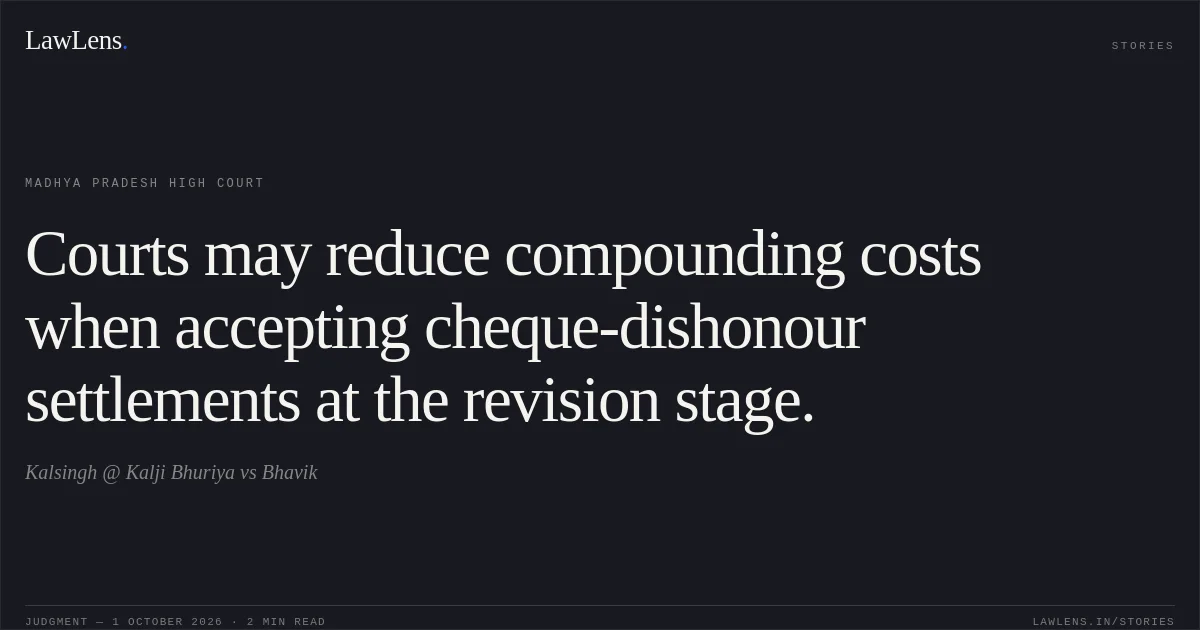
Source reference: no citationIn Damodar S. Prabhu v. Sayed Babalal H., (2010) 5 SCC 663, the Supreme Court prescribed graded costs for delayed compounding of Section 138 cases: 15% of the cheque amount when compounding is sought before a Sessions Court or High Court in appeal or revision, while also recognizing that the competent court may reduce costs in light of the case’s specific facts and circumstances, with reasons recorded.
Source reference: paras. 4–5The High Court relied on these principles in considering the compromise and directing payment of costs.
Source reference: paras. 7–8Reasoning
The Court accepted the verified, voluntary compromise, noting that the dispute was private in nature and the full settled amount had been paid.
Source reference: paras. 3, 6–7Applying Damodar S. Prabhu, it permitted compounding at the revision stage and directed costs of Rs. 3,000, equivalent to 1% of the cheque amount, payable to the High Court Legal Services Authority, Indore, within 10 days.
Source reference: para. 8The Court made the benefit of acquittal conditional on payment, providing that non-payment would leave the applicant liable to undergo the trial court’s sentence.
Source reference: para. 10Holding
The revision was allowed, the judgments of the courts below were set aside, and the applicant was acquitted of the Section 138 offence on the basis of the compromise.
The applicant was ordered to deposit Rs. 3,000 in costs within 10 days; his bail bonds were to stand discharged subject to compliance.
Source reference: paras. 8–10If he failed to deposit the costs, the acquittal would not enure to his benefit and he would remain liable to undergo the trial court’s sentence in accordance with law.
Source reference: paras. 8–10Acts & Sections Cited
3 provisions across 2 statutes referred to in this judgment. Each provision opens on LawLens.
Negotiable Instruments Act, 18812
Code of Criminal Procedure, 19731
Original Court PDF
Kalsingh @ Kalji BhuriyavsBhavik
Click to open original judgment
Original judgment, available to read, download and summarize on LawLens.in