Facts
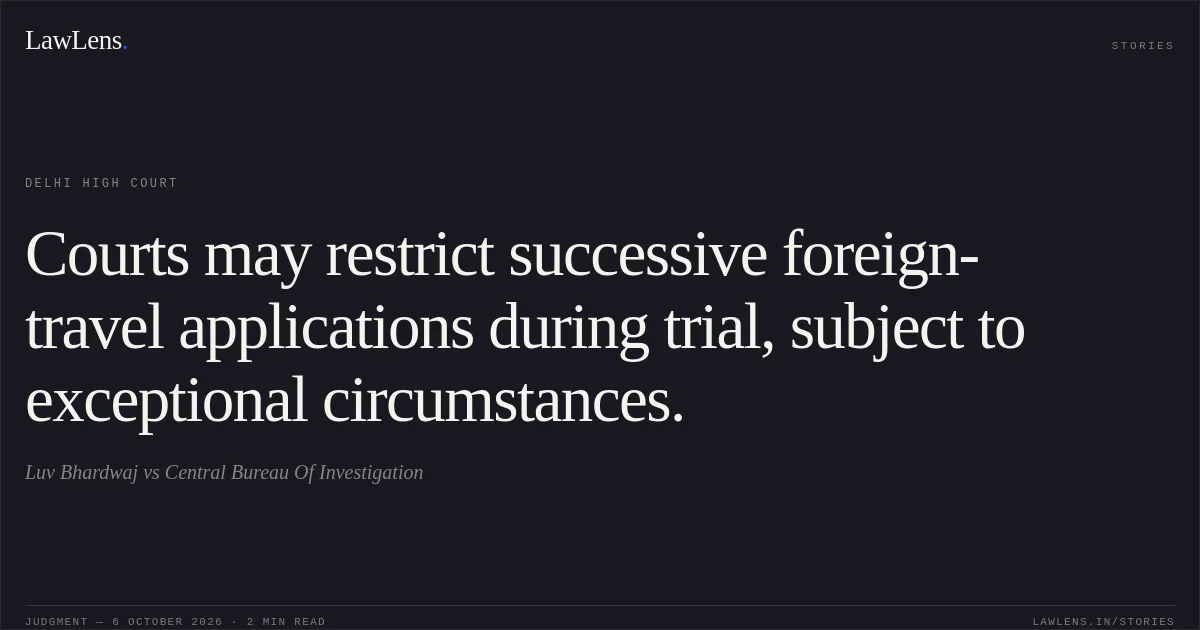
The petitioner challenged paragraph 7(l) of the Special Judge, CBI’s order dated 9 September 2026, which permitted him to travel to Istanbul and Paris but restricted him from making a similar travel application for six months, except in “exceptional and compelling circumstances”.
Source reference: para. 1–3, 8The petitioner had previously travelled abroad, including to Istanbul in July 2026, and stated that he had complied with the conditions imposed on earlier permissions.
Source reference: para. 4, 10–11His challenge was confined to the six-month restriction; the travel permitted by the order had already taken place.
Source reference: para. 3Issues
1. Whether the six-month restriction on making a further foreign-travel application, subject to an exception for “exceptional and compelling circumstances,” impermissibly infringed the petitioner’s right to travel abroad under Article 21 of the Constitution.
Source reference: para. 4, 8–92. Whether the Trial Court could impose that limited restriction to regulate repeated travel requests and safeguard the orderly progress of pending criminal proceedings.
Source reference: para. 15, 18Law Applied
Section 528 of the Bharatiya Nagarik Suraksha Sanhita, 2023, was invoked as the basis for the petition.
Source reference: para. 1The right to travel abroad is a facet of personal liberty under Article 21, but it is not absolute and must be balanced against the right to a speedy trial and the effective administration of criminal justice.
Source reference: para. 6–7In Seesa Santosh v. State of Telangana, 2026 SCC OnLine SC 1071, the Supreme Court recognised that this balance may take account of the accused’s conduct and the interests of the trial and society.
Source reference: para. 7The Court also referred to Rajesh Ranjan Yadav v. CBI for the principle that individual liberty may be subject to reasonable restrictions in the interests of society.
Source reference: para. 7Satish Chandra Verma v. Union of India, (2019) SCC OnLine SC 2048, supports the proposition that foreign travel is an important facet of personal liberty; Sumer Singh Salkan v. Assistant Director, 2010 SCC OnLine Del 2699, does not confine the Court’s power to regulate travel solely to concerns about flight risk or evasion.
Source reference: para. 14Reasoning
The Court treated the impugned condition as a limited regulation of successive travel applications, not an absolute prohibition on foreign travel: the Trial Court retained jurisdiction to consider a further request where exceptional and compelling circumstances were shown.
Source reference: para. 9, 13The petitioner’s past compliance was relevant but did not create an indefeasible right to travel abroad at successive intervals, particularly given the grave economic-offence allegations and the need to ensure the orderly progress of the trial.
Source reference: para. 11, 15–16The condition was also considered in the context of the travel permission granted and the other safeguards imposed, including a requirement to return on the specified date and not delay the trial.
Source reference: para. 12Any future application would remain for the Trial Court to decide on its merits.
Source reference: para. 17Holding
The Court held that the six-month condition was a permissible, time-limited safeguard and did not extinguish the petitioner’s right to seek judicial permission for travel.
It dismissed the petition, while clarifying that the petitioner could approach the Trial Court during the stipulated period with any circumstances said to warrant foreign travel; that application must be considered in accordance with law and on its merits.
Source reference: para. 20–22Acts & Sections Cited
1 provisions across 1 statute referred to in this judgment. Each provision opens on LawLens.
Bharatiya Nagarik Suraksha Sanhita, 20231
Original Court PDF
Luv BhardwajvsCentral Bureau Of Investigation
Click to open original judgment
Original judgment, available to read, download and summarize on LawLens.in