Facts
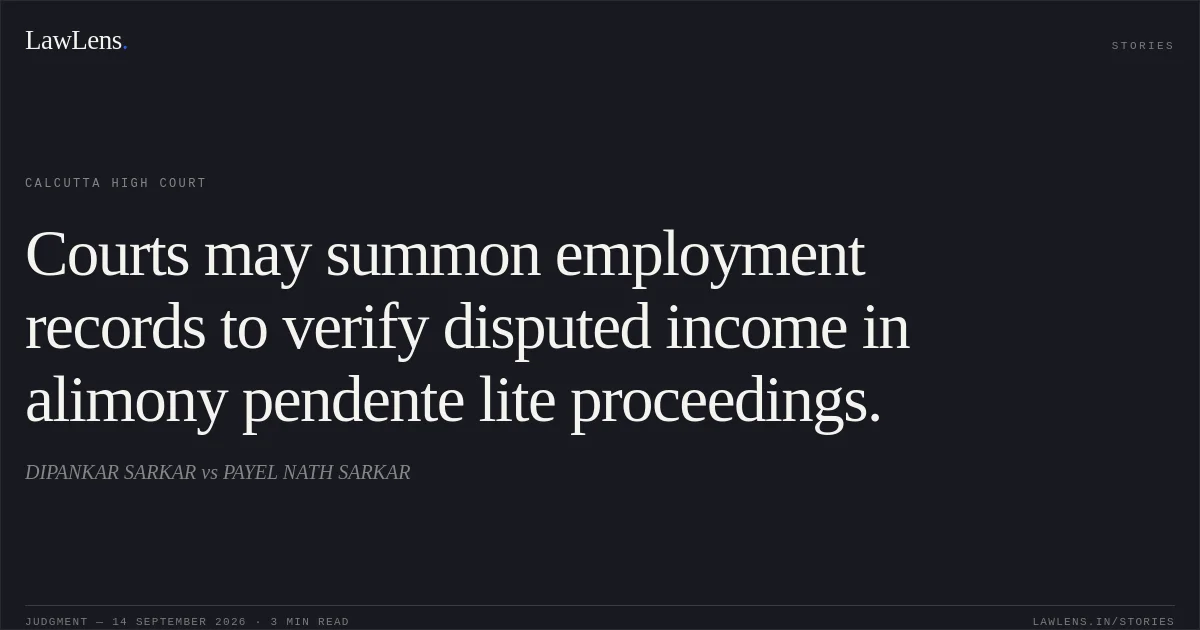
The petitioner-husband instituted Matrimonial Suit No. 19 of 2025 seeking divorce under Sections 27(1)(b) and 27(1)(d) of the Special Marriage Act, 1954. The opposite party-wife filed an application under Section 36 of the Act claiming alimony pendente lite.
Source reference: paras. 1–2, 9–16; pp. 1–6In response, the husband alleged that the wife was employed and earning at “Sishutirtha Academy” and therefore was not entitled to maintenance. The parties were directed to file affidavits of assets. The husband alleged that the wife had not fully disclosed her income or bank statements, citing a machinery problem with her bank passbook. He consequently sought summons to the head of “Sishutirtha Academy” for production of documents, including records relating to the wife’s alleged employment and attendance.
Source reference: paras. 1–2, 9–16; pp. 1–6The Trial Court dismissed the application, holding, inter alia, that the wife’s employment address was not mentioned in her Section 36 application, that the husband had produced no supporting material, and that the alimony application could be decided summarily on affidavit evidence. The husband challenged that order in revision.
Source reference: paras. 1–2, 9–16; pp. 1–6Issues
Whether the Trial Court was justified in refusing to issue witness summons to the head of “Sishutirtha Academy” for production of documents relevant to the wife’s alleged employment and income in proceedings under Section 36 of the Special Marriage Act, 1954.
Source reference: paras. 13–16, 20; pp. 5–7Whether the summary nature of proceedings for alimony pendente lite under Section 36 of the Special Marriage Act precluded the husband from producing documentary material to test the wife’s disclosure of income and financial status.
Source reference: paras. 17–20; pp. 6–7Law Applied
The Court applied Section 36 of the Special Marriage Act, 1954, which governs claims for alimony pendente lite and requires the Court to assess the parties’ financial circumstances.
Source reference: paras. 9–10, 16–20; pp. 4–7Although proceedings under Section 36 are to be dealt with summarily and ordinarily on the basis of affidavits, the affidavits must disclose the parties’ true financial position. The Court further applied the procedural principle that relevant documentary evidence may be summoned where it is material to determining a disputed issue, particularly the existence and extent of a party’s income.
Source reference: paras. 9–10, 16–20; pp. 4–7The Court held that the summary character of the proceeding does not justify excluding relevant evidence capable of clarifying alleged suppression or non-disclosure of income.
Source reference: paras. 9–10, 16–20; pp. 4–7Reasoning
The wife claimed to have no independent income and to be dependent on alimony, whereas the husband asserted that she was working and earning at “Sishutirtha Academy.” This created a direct and material dispute concerning her entitlement to alimony pendente lite.
Source reference: paras. 11–20; pp. 4–7The Court considered the husband’s allegation that the wife had failed to provide complete bank-account information and had relied on a machinery problem to explain the non-updation of her passbook. In those circumstances, records from the institution could assist the Court in determining whether she was employed and earning. The Trial Court’s reliance on the summary nature of Section 36 proceedings was therefore insufficient, because summary adjudication still requires truthful and complete financial disclosure and does not prevent the production of relevant documents. The refusal to summon the institutional records consequently amounted to an unjustified denial of material evidence.
Source reference: paras. 11–20; pp. 4–7Holding
The High Court allowed the revision and set aside the impugned Order No. 9 dated 19 November 2025.
It directed the Trial Court to issue witness summons to the head of “Sishutirtha Academy” for production of the documents specified in the husband’s petition dated 2 September 2025. The Trial Court was directed thereafter to decide the wife’s application under Section 36 of the Special Marriage Act in accordance with law. The revisional application and connected application were disposed of, and any interim order was vacated.
Source reference: paras. 21–24; p. 8Acts & Sections Cited
2 provisions across 1 statute referred to in this judgment. Each provision opens on LawLens.
Special Marriage Act, 19542
Original Court PDF
DIPANKAR SARKARvsPAYEL NATH SARKAR
Click to open original judgment
Original judgment, available to read, download and summarize on LawLens.in