Facts
The petitioner’s complaint under Section 138 of the Negotiable Instruments Act, 1881, concerning a cheque for ₹10,00,000, resulted in the respondent’s acquittal on 7 October 2025.
Source reference: paras. 2–5The petitioner filed a criminal appeal with an application under Section 5 of the Limitation Act seeking condonation of approximately six months’ delay.
Source reference: paras. 2–5He attributed the delay to a ligament tear, hospitalization and depression, and produced a medical certificate dated 4 April 2026.
Source reference: paras. 2–5The appellate court dismissed the application because the certificate did not establish incapacity throughout the delay and the application did not specify the exact number of delayed days; it consequently dismissed the appeal as time-barred.
Source reference: paras. 2–5The petitioner challenged that order in revision.
Source reference: paras. 2–5Issues
1. Whether the appellate court adopted an unduly rigid approach in rejecting the application for condonation of delay despite the petitioner’s stated medical circumstances and supporting certificate.
Source reference: paras. 5, 8–112. Whether the refusal to condone the delay warranted interference in revision and restoration of the appeal for decision on its merits.
Source reference: para. 12Law Applied
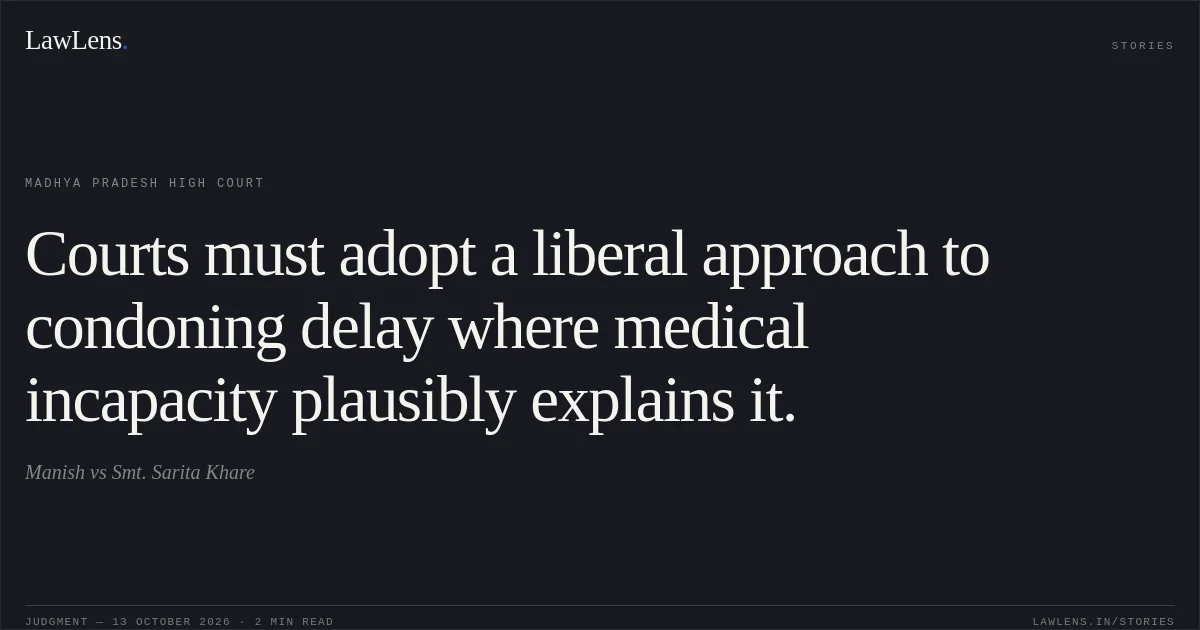
Section 5 of the Limitation Act permits condonation where “sufficient cause” is shown; that expression is to be applied meaningfully and liberally to advance substantial justice, rather than through a pedantic or hyper-technical approach.
Source reference: paras. 9, 11The Court relied on Collector, Land Acquisition, Anantnag v. Mst. Katiji, (1987) 2 SCC 107; N. Balakrishnan v. M. Krishnamurthy, (1998) 7 SCC 123; and Esha Bhattacharjee v. Managing Committee of Raghunathpur Nafar Academy, (2013) 12 SCC 649, for the principle that delay may be condoned where the explanation is bona fide and negligence, inaction or lack of bona fides is not attributable to the applicant.
Source reference: paras. 9, 11The Court also stated that revisional power under Section 438 of the BNSS is exercised sparingly, including where material irregularity or failure of justice is shown.
Source reference: para. 12Reasoning
The petitioner gave a specific medical explanation and supported it with a certificate from a qualified medical practitioner.
Source reference: para. 10Although the certificate did not account for every day of the delay, the appellate court should not have rejected it mechanically or treated the absence of an exact calculation as determinative.
Source reference: para. 10The record disclosed no indication that the delay was deliberate or arose from negligence or lack of bona fides.
Source reference: para. 11In the High Court’s view, dismissing the appeal on limitation through a hyper-technical approach risked defeating substantial justice and constituted a failure of justice warranting revisional interference.
Source reference: paras. 10–12Holding
The High Court answered the issues in the petitioner’s favour, allowed the criminal revision, set aside the appellate court’s order, and condoned the delay in filing the appeal.
It directed restoration of MJCR No. 182/2026 to its original number and required the appellate court to decide the appeal on its merits after hearing both parties, preferably within three months of receiving the certified copy of the order.
Source reference: paras. 13–15No order as to costs was made.
Source reference: paras. 13–15Acts & Sections Cited
3 provisions across 3 statutes referred to in this judgment. Each provision opens on LawLens.
Bharatiya Nagarik Suraksha Sanhita, 20231
Negotiable Instruments Act, 18811
Limitation Act, 19631
Original Court PDF
ManishvsSmt. Sarita Khare
Click to open original judgment
Original judgment, available to read, download and summarize on LawLens.in