Facts
Jotindra Infrastructure Limited preferred an appeal under Section 58 of the Real Estate (Regulation and Development) Act, 2016 against the order dated 25.03.2026 of the Haryana Real Estate Appellate Tribunal, Chandigarh, which dismissed its appeal after refusing to condone a delay of 516 days.
Source reference: [para. 1]The appeal before the Appellate Tribunal challenged orders dated 03.05.2023 and 13.05.2024 passed by the Authority constituted under the 2016 Act and was accompanied by an application seeking condonation of delay.
Source reference: [para. 3]The appellant contended that sufficient cause existed and that the Appellate Tribunal had not considered the reasons advanced for the delay.
Source reference: [para. 4]Respondent No. 1 opposed condonation, alleging intentional delay, but stated that if the delay were condoned, the appellant should be subjected to costs.
Source reference: [para. 5]Issues
Whether the Appellate Tribunal erred in refusing to condone the appellant’s 516-day delay and dismissing the appeal without adequately considering the reasons advanced for the delay?
Source reference: [paras. 3–4]Whether, in the interests of substantial justice, the delay ought to be condoned so that the appeal could be adjudicated on merits, subject to appropriate costs?
Source reference: [paras. 7–9]Law Applied
The Court applied Section 58 of the Real Estate (Regulation and Development) Act, 2016, under which an appeal lies to the High Court from an order of the Real Estate Appellate Tribunal.
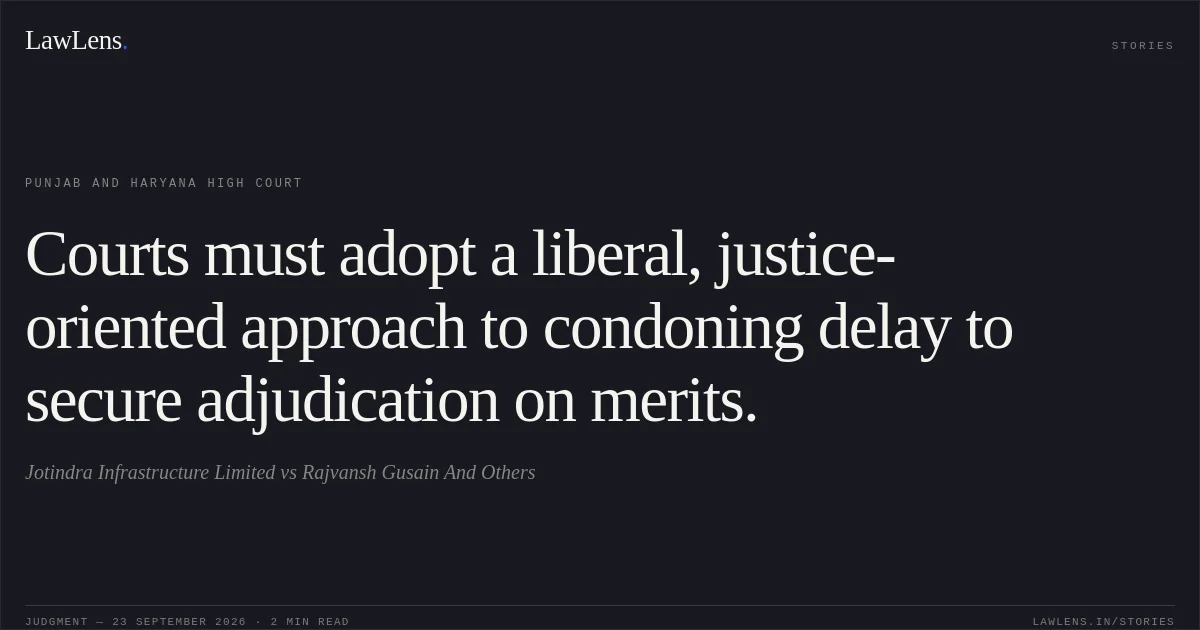
Source reference: [para. 1]It reiterated the settled principle that applications for condonation of delay should not be approached pedantically; courts should adopt a pragmatic, justice-oriented, liberal and holistic approach, particularly where adjudication on merits is possible.
Source reference: [para. 7]Relying on Suresh Kumar v. State of Haryana, 2025 SCC OnLine SC 896, the Court held that limitation-related discretion should ordinarily be exercised to advance substantial justice and that a technical approach should not defeat adjudication on merits.
Source reference: [para. 8]The Court also relied on the broader principle that delay may be balanced through appropriate conditions, including costs or denial of consequential benefits for the period of delay.
Source reference: [para. 8]Reasoning
The High Court found that the Appellate Tribunal had refused to condone the 516-day delay and dismissed the appeal, while the appellant specifically contended that the reasons for delay had not been discussed or properly considered.
Source reference: [paras. 3–4]Applying the liberal and justice-oriented approach to condonation of delay, the Court held that the matter should preferably be decided on merits rather than rejected on a technical ground.
Source reference: [para. 7]Although the respondent alleged intentional delay, the Court balanced that prejudice by imposing costs of ₹75,000 on the appellant.
Source reference: [para. 9]It therefore set aside the Tribunal’s order and directed the Appellate Tribunal to adjudicate the appeal on merits.
Source reference: [para. 9]Holding
The High Court allowed the appeal and set aside the Haryana Real Estate Appellate Tribunal’s order dated 25.03.2026 refusing to condone the delay.
The Appellate Tribunal was directed to decide the appellant’s appeal on merits.
Source reference: [para. 9]The appellant was ordered to pay ₹75,000 as costs to respondent No. 1; ₹50,000 was handed over by draft in Court and the remaining ₹25,000 was undertaken to be paid within two weeks.
Source reference: [para. 10]The parties were directed to appear before the Appellate Tribunal on 05.10.2026, and pending applications, if any, were disposed of.
Source reference: [paras. 11–13]Acts & Sections Cited
1 provisions across 1 statute referred to in this judgment. Each provision opens on LawLens.
Real Estate (Regulation and Development) Act, 2016.1
Original Court PDF
Jotindra Infrastructure LimitedvsRajvansh Gusain And Others
Click to open original judgment
Original judgment, available to read, download and summarize on LawLens.in