Facts
On 12 May 2022, the ten-year-old son of the informant died after coming into contact with a live electric wire hanging at a low height.
Source reference: pp. 2–3The prosecution alleged that the appellants had used the wire to draw electricity unlawfully to their house and had left it in a dangerous position despite warnings from local residents.
Source reference: pp. 2–3The appellants were charged under Section 304 Part II read with Section 34 IPC and Section 135 of the Electricity Act, 2003. The trial court convicted them under Sections 304-A read with Section 34 IPC and 135(1) of the Electricity Act, sentencing each to imprisonment and fines.
Source reference: pp. 4–6In appeal, counsel confined submissions to sentence; the High Court nevertheless considered the evidence and upheld the convictions.
Source reference: pp. 8–9Issues
Whether the evidence established the appellants’ guilt under Section 304-A read with Section 34 IPC and Section 135(1) of the Electricity Act, 2003.
Source reference: pp. 8–9Whether, having regard to the circumstances, antecedents and period since the occurrence, the appellants should receive probation under Section 4 of the Probation of Offenders Act, 1958 instead of serving their custodial sentences.
Source reference: pp. 9–13Law Applied
Section 304-A IPC penalises causing death by a rash or negligent act not amounting to culpable homicide; Section 34 IPC attributes joint liability where a criminal act is done in furtherance of common intention. Section 135(1)(a) of the Electricity Act, 2003 criminalises dishonest tapping or unauthorised connection to an electricity line or service.
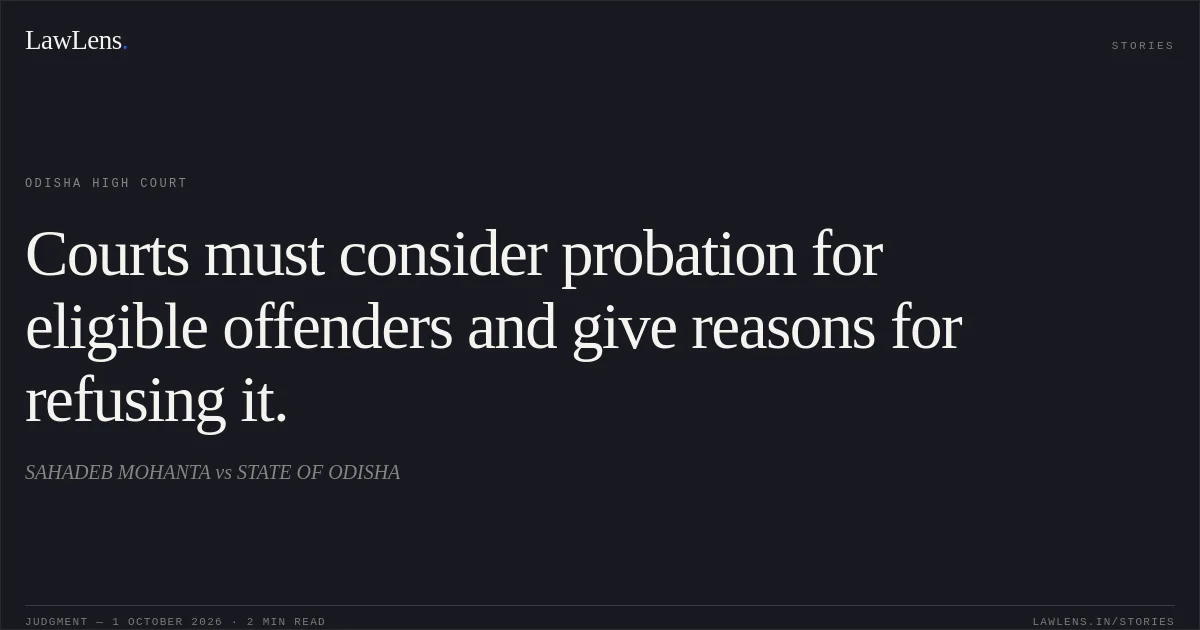
Source reference: pp. 6–8Under Section 4 of the Probation of Offenders Act, 1958, a court may release an eligible offender on probation where the statutory conditions are met; Chellammal v. State, 2025 INSC 540, holds that the court must consider probation where applicable and give reasons if it declines to grant it.
Source reference: pp. 11–12Section 5 of the Probation Act permits an order for compensation.
Source reference: p. 14Reasoning
The High Court found that the consistent evidence of the locality witnesses and the informant established that the appellants had used the live wire to supply electricity to their house and left it hanging at a dangerous height. The medical evidence established death by electrocution, and the absence of technical evidence did not undermine the otherwise cogent oral evidence; the convictions therefore warranted no interference.
Source reference: pp. 8–9On sentence, the Court considered the nature of the offences, the passage of more than four years since the occurrence, the appellants’ period in custody, lack of criminal antecedents and reported settled lives. Applying the duty to consider probation under Chellammal, it concluded that probation was appropriate.
Source reference: pp. 9–13Holding
The appeal was partly allowed: the convictions remained unchanged, but the custodial sentences were replaced with release under Section 4 of the Probation of Offenders Act for six months.
Each appellant was directed to execute a bond of Rs. 5,000 with one surety for the like amount, maintain peace and good behaviour, and remain under the supervision of the Probation Officer during that period. Under Section 5, each appellant was also ordered to pay Rs. 20,000 as compensation to the deceased’s parents within four weeks.
Source reference: pp. 13–14Acts & Sections Cited
10 provisions across 4 statutes referred to in this judgment. Each provision opens on LawLens.
Code of Criminal Procedure, 19735
Indian Penal Code, 18602
Electricity Act, 20031
Original Court PDF
SAHADEB MOHANTAvsSTATE OF ODISHA
Click to open original judgment
Original judgment, available to read, download and summarize on LawLens.in