Facts
Lokesi Sahu, married to appellant No. 1, was found dead on a railway track on 25 October 1994.
Source reference: p. 3Her father alleged that the appellants had subjected her to physical and mental cruelty over demands for a motorcycle and additional gold ornaments.
Source reference: pp. 3–5The trial court acquitted all three appellants of abetment of suicide under Section 306 read with Section 34 IPC but convicted them under Section 498-A read with Section 34 IPC and imposed two years’ rigorous imprisonment and a fine.
Source reference: pp. 3–5During the appeal, appellants Nos. 1 and 2 died, and their appeals abated; the appeal continued for appellant No. 3, Khira Sahu, the deceased’s mother-in-law.
Source reference: p. 2Issues
Whether the trial court’s conviction of appellant No. 3 under Section 498-A read with Section 34 IPC disclosed any perversity or manifest illegality warranting appellate interference.
Source reference: p. 6Whether, having regard to the circumstances of the case, appellant No. 3 should receive the benefit of release on probation under Section 4 of the Probation of Offenders Act, 1958, instead of serving the custodial sentence.
Source reference: pp. 6–9Law Applied
Section 498-A IPC criminalizes a husband’s or relative’s subjecting a woman to cruelty; Section 34 IPC provides for joint liability where a criminal act is done in furtherance of common intention.
Source reference: no citationSection 4 of the Probation of Offenders Act, 1958 permits release on probation for an offence not punishable with death or imprisonment for life.
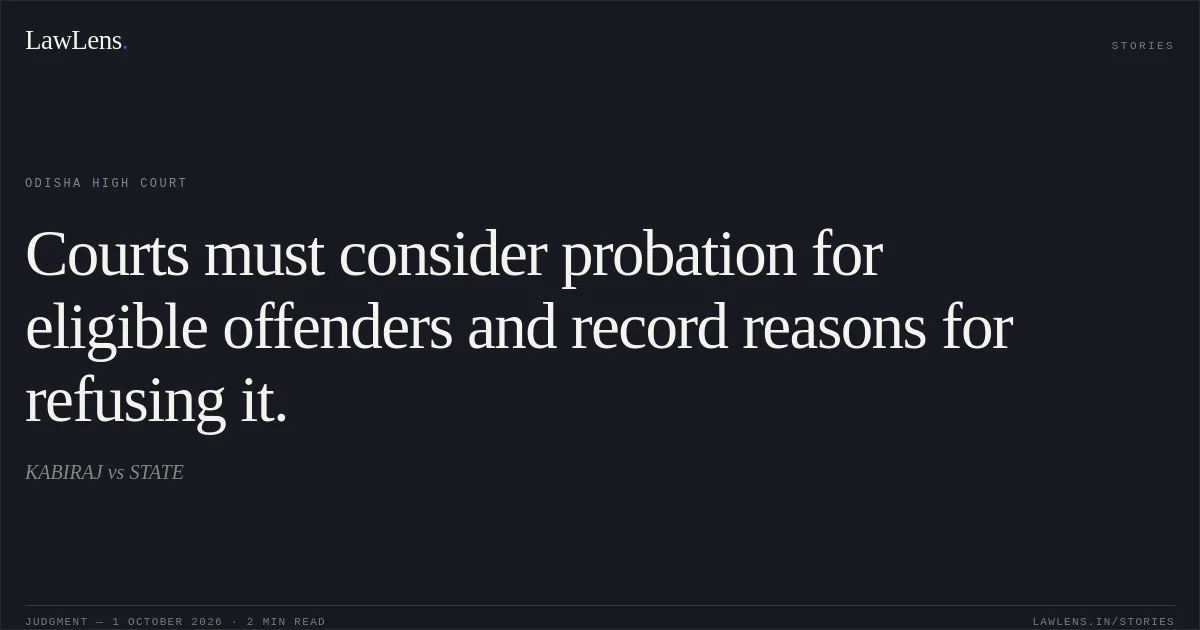
Source reference: pp. 7–9Relying on Chellammal and Another v. State represented by the Inspector of Police, 2025 INSC 540, the Court stated that, where Section 4 may apply, the court must consider probation; if it declines to grant it, reasons should be recorded.
Source reference: pp. 7–9The judgment also referred to Section 361 CrPC in discussing that obligation.
Source reference: pp. 7–9Reasoning
The Court found no perversity or manifest illegality in the trial court’s assessment supporting the Section 498-A conviction.
Source reference: pp. 5–6The trial court had distinguished the unproved charge under Section 306 IPC from the cruelty charge, relying on oral testimony concerning dowry demands and harassment, together with evidence relating to the pledged gold ornament.
Source reference: pp. 5–6On sentence, the Court considered that the occurrence was more than three decades old, appellant No. 3 was over seventy-five, no criminal antecedents or subsequent criminal activity were shown, and the surviving conviction was only under Section 498-A IPC.
Source reference: pp. 6–9Applying Chellammal, it concluded that probation was appropriate.
Source reference: pp. 6–9Holding
The Court upheld appellant No. 3’s conviction but modified the custodial disposition by releasing her on probation under Section 4 of the Probation of Offenders Act for one year.
She was directed, within one month, to execute a bond of Rs. 5,000 with one surety for the like amount, to appear and receive sentence if called upon, keep the peace and maintain good behaviour, and remain under the supervision of the concerned Probation Officer.
Source reference: pp. 9–10The appeal was partly allowed; the appeals of appellants Nos. 1 and 2 had abated.
Source reference: pp. 2, 9–10Acts & Sections Cited
6 provisions across 3 statutes referred to in this judgment. Each provision opens on LawLens.
Code of Criminal Procedure, 19733
Indian Penal Code, 18602
Probation of Offenders Act, 19581
Original Court PDF
KABIRAJvsSTATE
Click to open original judgment
Original judgment, available to read, download and summarize on LawLens.in