Facts
The appellant instituted Probate Case No. 31 of 2014 seeking probate of an alleged Will. After the respondent entered a caveat and disputed the Will, the proceeding became contentious and was registered as Title Suit No. 01 of 2016 under Section 295 of the Indian Succession Act, 1925.
Source reference: para. 2During the suit, the District Magistrate, Gaya, assessed the value of the estate at ₹7,26,033, following which the trial court directed the appellant to deposit the requisite court fee. The respondent thereafter sought rejection of the plaint under Order VII Rule 11(c) CPC on the ground of non-payment of court fee. Although the appellant opposed the application and sought permission to pay the court fee at a later stage, the trial court rejected the plaint and dismissed the suit on 10.02.2017. The appellant challenged that judgment and decree in the present appeal.
Source reference: paras. 2.1–2.2Issues
1. Whether the trial court was justified in rejecting the plaint under Order VII Rule 11(c) CPC for non-payment of the requisite court fee without considering the appellant’s request under Section 149 CPC to make good the deficiency?
Source reference: para. 82. Whether the provisions of Section 149 CPC required the trial court to exercise its discretion judicially before imposing the drastic consequence of rejection of the plaint?
Source reference: paras. 13–153. Whether the conversion of the probate proceeding into a contentious title suit affected the appellant’s obligation to pay the requisite court fee?
Source reference: paras. 4–5.4Law Applied
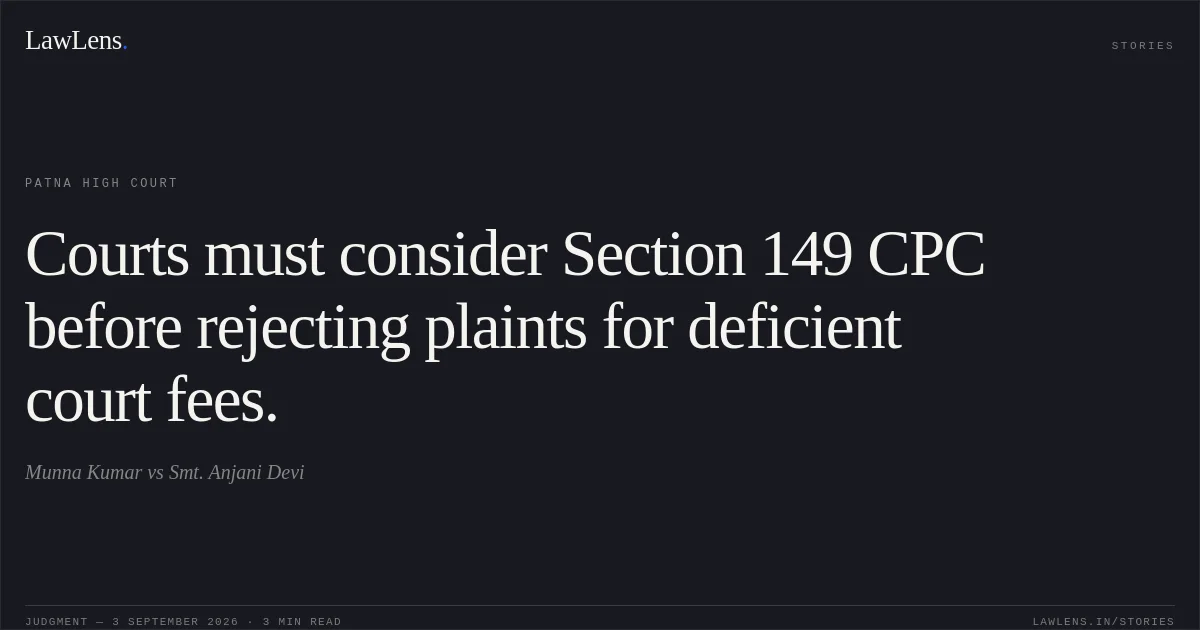
The Court applied Order VII Rule 11(c) CPC, under which a plaint may be rejected where the requisite court fee is not supplied within the time fixed by the court, read harmoniously with Section 149 CPC, which empowers the court, in its discretion, to permit payment of deficient court fee at any stage and gives the document retrospective validity upon such payment.
Source reference: para. 6Section 4 of the Court-Fees Act, 1870 embodies the general requirement of payment of court fee before a chargeable document is acted upon, but does not override the curative power under Section 149 CPC.
Source reference: paras. 9–10Relying on Mannan Lal v. Mst. Chhotka Bibi, AIR 1971 SC 1374, the Court held that Section 149 CPC operates as a proviso to Section 4 of the Court-Fees Act and that payment of the deficit cures the defect from the date of original presentation.
Source reference: paras. 7, 11The Court further relied on A. Nawab John v. V.N. Subramaniyam, (2012) 7 SCC 738, for the principle that discretion under Section 149 CPC must be exercised judicially and in furtherance of substantial justice.
Source reference: para. 12Section 107 CPC empowered the appellate court to determine or remand the case.
Source reference: para. 6Reasoning
The High Court held that the trial court treated non-payment of court fee as automatically attracting rejection under Order VII Rule 11(c) CPC, without examining whether the deficiency could be permitted to be cured under Section 149 CPC.
Source reference: paras. 13–15The record showed that the appellant had sought permission to deposit the requisite court fee and had expressed willingness to comply with the statutory requirement.
Source reference: paras. 13, 16Since the deficiency was curable and there was no indication of deliberate, contumacious conduct or abuse of process, the trial court was required to consider the appellant’s request by exercising its discretionary jurisdiction under Section 149 CPC.
Source reference: para. 16Its failure to undertake that exercise amounted to non-exercise of jurisdiction and rendered the rejection of the plaint legally unsustainable.
Source reference: paras. 14, 17The Court therefore found it unnecessary to sustain the dismissal merely because the proceeding had originated as a probate case and later become a contentious title suit; the decisive error was the failure to consider the statutory power to cure the court-fee deficiency.
Source reference: no citationHolding
The appeal was allowed.
The judgment and decree dated 10.02.2017 rejecting the plaint in Title Suit No. 01 of 2016 were set aside.
Source reference: para. 18The matter was remitted to the trial court with a direction that the appellant deposit the deficient court fee within one month from the date of judgment. Upon such deposit, the suit was directed to be restored to its original file and proceeded with and decided on merits, uninfluenced by the observations of the High Court.
Source reference: para. 18Acts & Sections Cited
5 provisions across 3 statutes referred to in this judgment. Each provision opens on LawLens.
Indian Succession Act, 19251
Code of Civil Procedure, 19083
Court-Fees Act, 18701
Original Court PDF
Munna KumarvsSmt. Anjani Devi
Click to open original judgment
Original judgment, available to read, download and summarize on LawLens.in