Facts
The appellant was prosecuted in connection with an occurrence at Panthanivas, Bhubaneswar, on the night intervening 30 November and 1 December 1997.
Source reference: p.2–3The informant, an actress staying in Room No. 208, alleged that the appellant forcibly entered her room, attempted to remove her bathrobe, used criminal force against her, pressed her throat, and left when she raised an alarm.
Source reference: p.2–3The appellant was charged under Sections 452, 307, 354 and 376/511 of the Indian Penal Code.
Source reference: p.2The trial court acquitted him of Sections 452, 307 and 376/511 IPC, but convicted him under Sections 354 and 451 IPC, sentencing him to rigorous imprisonment of one and a half years and one year, respectively, with fines; the substantive sentences were directed to run concurrently.
Source reference: p.2, p.4–6The appellant challenged the conviction and sentence before the High Court.
Source reference: no citationIssues
Whether the evidence established the appellant’s guilt under Sections 354 and 451 IPC, notwithstanding his acquittal of the graver charges under Sections 452, 307 and 376/511 IPC.
Source reference: p.4–6, p.7–8Whether, having regard to the nature of the occurrence, the prolonged pendency of the proceedings and the circumstances of the appellant, he should receive the benefit of release on probation under Section 4 of the Probation of Offenders Act, 1958.
Source reference: p.6–10If probation were granted, whether a monetary condition under Section 5(1)(b) of the Probation of Offenders Act could appropriately be imposed.
Source reference: p.10–11Law Applied
Section 354 IPC applies where a person assaults or uses criminal force against a woman with the intention or knowledge that her modesty is likely to be outraged.
Source reference: p.4–6Section 451 IPC covers house-trespass in order to commit an offence punishable with imprisonment.
Source reference: p.4–6Section 452 IPC additionally requires house-trespass after preparation for causing hurt, assault, wrongful restraint or fear; absent proof of such prior preparation, conviction under Section 451 may nevertheless follow.
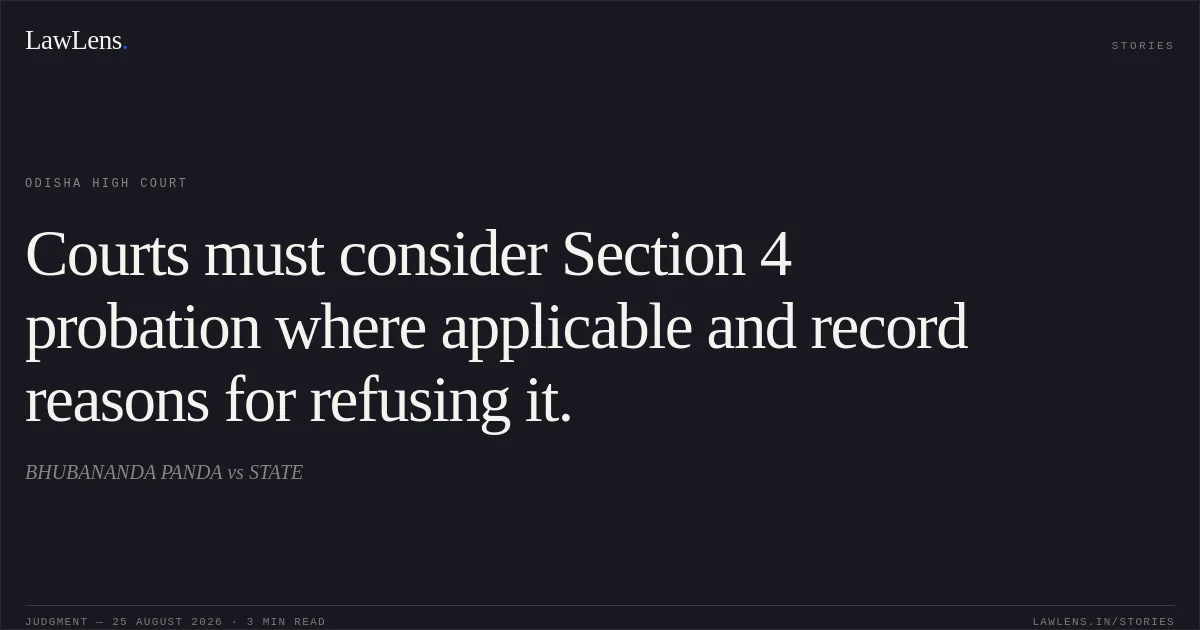
Source reference: p.4–6Section 4 of the Probation of Offenders Act, 1958 enables release on probation where the offence is not punishable with death or imprisonment for life.
Source reference: p.8–10Section 5(1)(b) permits the court to impose payment of costs or compensation, while Section 361 CrPC requires special reasons where a court could have dealt with an offender under the Probation of Offenders Act but does not do so.
Source reference: p.8–10Relying on Chellammal and Another v. State represented by the Inspector of Police , 2025 INSC 540, the Court held that applicability of Section 4 must be considered where its statutory conditions are attracted; although probation is not claimable as of right, refusal to grant it should be supported by reasons.
Source reference: p.7–10Reasoning
The High Court found the testimony of the informant to be cogent and trustworthy, and considered it materially supported by other evidence, including evidence concerning the appellant’s presence and identification and the medical evidence.
Source reference: p.4, p.7–8The appellant’s forcible entry into the occupied hotel room and use of criminal force while attempting to disrobe the informant established the ingredients of Sections 451 and 354 IPC.
Source reference: p.4–6However, the prosecution failed to prove the prior preparation necessary for Section 452 IPC, the intention to cause death under Section 307 IPC, or conduct amounting to an attempt to commit rape under Section 376/511 IPC.
Source reference: p.4–6On sentence, the Court considered that the occurrence dated back to 1997, the prosecution had remained pending for a considerable period, and the graver allegations had not been proved.
Source reference: p.6–7, p.10Applying the reformative purpose of the Probation of Offenders Act and the principles in Chellammal , the Court concluded that the appellant’s case warranted probation rather than substantive imprisonment.
Source reference: p.7–10It considered Rs.50,000 as a reasonable condition towards the costs of the proceedings under Section 5(1)(b).
Source reference: p.10–11Holding
The High Court affirmed the appellant’s convictions under Sections 354 and 451 IPC and maintained his acquittal under Sections 452, 307 and 376/511 IPC.
The substantive sentences of imprisonment were set aside in favour of release under Section 4 of the Probation of Offenders Act for six months.
Source reference: p.10–11The appellant was directed to execute a bond of Rs.5,000 with one surety for the like amount, to appear and receive sentence if called upon, maintain peace and good behaviour, and remain under the supervision of the concerned Probation Officer.
Source reference: p.10–11He was further directed to deposit Rs.50,000 with the District Legal Services Authority within four weeks towards costs under Section 5(1)(b) of the Act.
Source reference: p.10–11The criminal appeal was accordingly partly allowed.
Source reference: p.11Acts & Sections Cited
11 provisions across 3 statutes referred to in this judgment. Each provision opens on LawLens.
Code of Criminal Procedure, 19733
Indian Penal Code, 18606
Original Court PDF
BHUBANANDA PANDAvsSTATE
Click to open original judgment
Original judgment, available to read, download and summarize on LawLens.in
![Courts will not interfere with transfers absent mala fides or violation of statutory rules.. M Ramya vs EMPLOYEES STATE INSURANCE CORPORATION (ESIC). CAT - ['Chennai']. LawLens](/stories/thumbnails/courts-will-not-interfere-with-transfers-absent-mala-fides-or-violation-of-statutory-rules-a6845e9ca6f548fca284c51c8351957f.webp)
![Courts cannot direct one-time recruitment age relaxation absent authority in the governing rules or advertisement.. UT OF PUDUCHERRY vs M ANDAL. CAT - ['Chennai']. LawLens](/stories/thumbnails/courts-cannot-direct-one-time-recruitment-age-relaxation-absent-authority-in-the-governing-895d78fde47143e2a8ed0207c4b6a44f.webp)
![A review cannot correct an allegedly erroneous decision absent an error apparent on the record.. Ajit Kumar Jha vs RAILWAY BOARD. CAT - ['Delhi']. LawLens](/stories/thumbnails/a-review-cannot-correct-an-allegedly-erroneous-decision-absent-an-error-apparent-on-the-re-8ac952fd4eba470c92f7da20af72a220.webp)