Facts
The appeal challenged the judgment dated 22 January 2009 of the Ad hoc Additional Sessions Judge, Fast Track Court, Padampur, in C.T. Case No. 74/28 of 2008.
Source reference: para. 4The prosecution alleged that, during a factional dispute concerning a Namajagya in village Amilipali, the appellants formed an unlawful assembly, armed themselves with lathis, tangias and stones, assaulted members of the rival group, caused simple injuries, used abusive language and damaged property.
Source reference: para. 4Although the appellants were initially charged under Sections 147, 148, 294, 506, 323, 307, 341, 427 and 380 read with Section 149 IPC, the Trial Court acquitted them of the graver and allied charges but convicted them under Sections 147 and 323 read with Section 149 IPC.
Source reference: paras. 4–6They were sentenced to rigorous imprisonment for one year under Section 323/149 IPC and six months under Section 147 IPC, with fines, both substantive sentences to run concurrently.
Source reference: para. 1During the pendency of the appeal, the proceedings abated against appellant Nos. 8, 14 and 18 upon proof of their deaths and in the absence of an application under Section 394 CrPC.
Source reference: para. 2The surviving appellants challenged both the conviction and sentence, principally seeking the benefit of probation.
Source reference: paras. 5, 7–8Issues
1. Whether the conviction of the appellants under Sections 147 and 323 read with Section 149 IPC required interference in appeal.
Source reference: paras. 7–82. Whether, having regard to the appellants’ status as first offenders, the simple nature of the injuries, the local factional background and the substantial lapse of time, they were entitled to release on probation under Section 4 of the Probation of Offenders Act, 1958.
Source reference: paras. 7–103. Whether the appeal abated in respect of the deceased appellant Nos. 8, 14 and 18 in the absence of an application under Section 394 CrPC.
Source reference: para. 2Law Applied
The Court applied Sections 147 and 323 read with Section 149 IPC concerning unlawful assembly and voluntarily causing hurt in prosecution of the assembly’s common object.
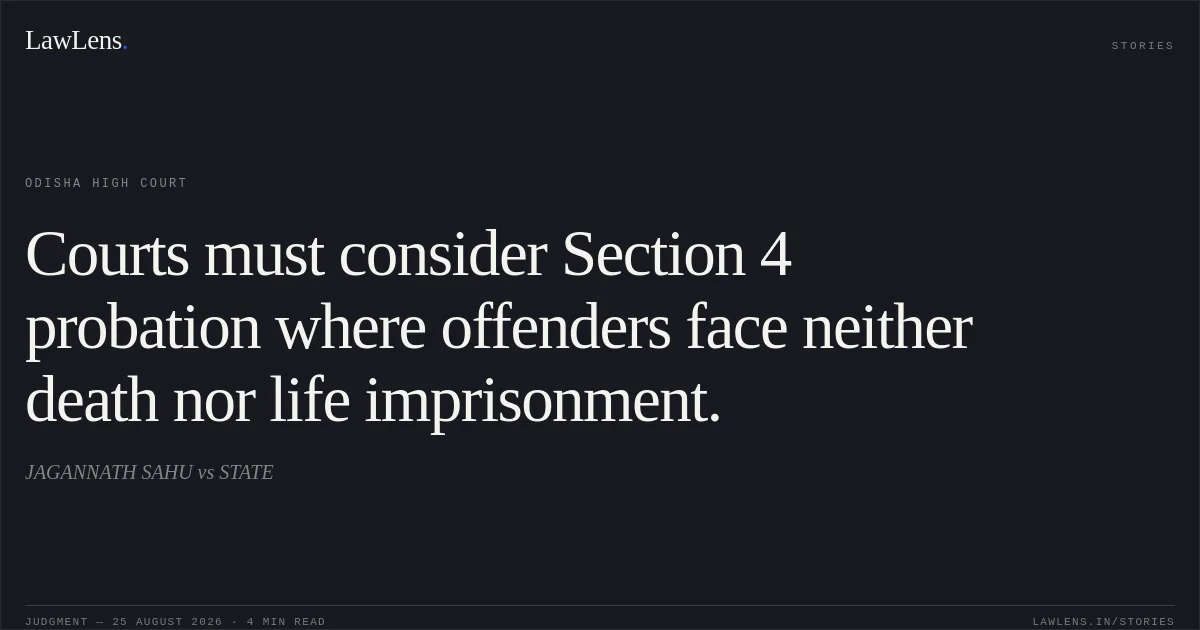
Source reference: no citationSection 4 of the Probation of Offenders Act, 1958 permits release on probation where a person is found guilty of an offence not punishable with death or imprisonment for life, subject to the court’s consideration of the circumstances of the case and the offender.
Source reference: no citationSection 360 CrPC and Section 361 CrPC were considered in relation to probation, with Section 361 requiring reasons where a court could have dealt with an offender under the Probation of Offenders Act but does not do so.
Source reference: para. 9Relying on Chellammal v. State represented by the Inspector of Police , 2025 INSC 540, the Court held that consideration of probation is a statutory duty where Section 4 is potentially applicable, although the offender has no absolute right to its grant; refusal must be supported by reasons.
Source reference: para. 9The Court also relied on Pathani Parida v. Abhaya Kumar Jagdevmohapatra , 2012 (Supp-II) OLR 469, and Dhani @ Dhaneswar Sahu v. State of Orissa , 2007 (Supp.II) OLR 250.
Source reference: para. 10Proceedings against a deceased appellant abate under Section 394 CrPC unless the legal representative or next friend obtains permission to continue the appeal.
Source reference: para. 2Reasoning
The Court declined to disturb the conviction because the surviving findings established the appellants’ participation in an unlawful assembly and the causing of simple hurt, while the Trial Court had already rejected the more serious allegations relating to attempt to murder, dangerous weapons, theft and property damage.
Source reference: paras. 6–8On sentence, the Court found the requirements for consideration under Section 4 of the Probation of Offenders Act satisfied: the appellants were first offenders, the occurrence arose from local factional hostility, the injuries were simple, the appellants were rural residents of varying ages, no subsequent criminal conduct or misuse of liberty was shown, and nearly two decades had elapsed since the occurrence.
Source reference: paras. 7–10Applying Chellammal , the Court treated consideration of probation as mandatory and concluded that the reformative purpose of the statute outweighed the need for imprisonment in the circumstances.
Source reference: para. 9The appeal therefore succeeded only to the extent of modification of sentence.
Source reference: paras. 10–12Holding
The appeal was dismissed insofar as it challenged the conviction under Sections 147 and 323 read with Section 149 IPC.
However, the custodial sentences were substituted by release under Section 4 of the Probation of Offenders Act, 1958, for one year.
Source reference: para. 11Each surviving appellant was directed to execute a bond of Rs. 5,000 with one surety for the like amount within one month, to appear and receive sentence if called upon during the probation period, maintain peace and good behaviour, and remain under the supervision of the concerned Probation Officer.
Source reference: para. 11The appeal was accordingly partly allowed.
Source reference: para. 11It had already abated in respect of appellant Nos. 8, 14 and 18 due to their deaths.
Source reference: para. 2Acts & Sections Cited
17 provisions across 3 statutes referred to in this judgment. Each provision opens on LawLens.
Code of Criminal Procedure, 19735
Indian Penal Code, 1860
Probation of Offenders Act, 19581
Original Court PDF
JAGANNATH SAHUvsSTATE
Click to open original judgment
Original judgment, available to read, download and summarize on LawLens.in
![Courts will not interfere with transfers absent mala fides or violation of statutory rules.. M Ramya vs EMPLOYEES STATE INSURANCE CORPORATION (ESIC). CAT - ['Chennai']. LawLens](/stories/thumbnails/courts-will-not-interfere-with-transfers-absent-mala-fides-or-violation-of-statutory-rules-a6845e9ca6f548fca284c51c8351957f.webp)
![Courts cannot direct one-time recruitment age relaxation absent authority in the governing rules or advertisement.. UT OF PUDUCHERRY vs M ANDAL. CAT - ['Chennai']. LawLens](/stories/thumbnails/courts-cannot-direct-one-time-recruitment-age-relaxation-absent-authority-in-the-governing-895d78fde47143e2a8ed0207c4b6a44f.webp)
![A review cannot correct an allegedly erroneous decision absent an error apparent on the record.. Ajit Kumar Jha vs RAILWAY BOARD. CAT - ['Delhi']. LawLens](/stories/thumbnails/a-review-cannot-correct-an-allegedly-erroneous-decision-absent-an-error-apparent-on-the-re-8ac952fd4eba470c92f7da20af72a220.webp)