Facts
On October 27, 2004, the accused persons allegedly demanded ₹2,000 from the informant’s son, assaulted him upon refusal, entered the informant's house, and damaged roof tiles
Source reference: p. 3The trial court acquitted the accused of house trespass (Section 452 IPC), robbery (Sections 394/398 IPC), and Arms Act charges due to inconsistencies between ocular and medical evidence
Source reference: p. 2, 6However, the court convicted them under Sections 385/34 (extortion) and 427/34 (mischief) of the IPC, sentencing them to one year of rigorous imprisonment
Source reference: p. 2During the pendency of the appeal, Appellant No. 1 died, leading to the abatement of his appeal
Source reference: p. 2Appellant No. 2 challenged the conviction and the trial court's refusal to grant the benefit of the Probation of Offenders (P.O.) Act
Source reference: p. 8Issues
1. Whether the conviction of Appellant No. 2 under Sections 385/34 and 427/34 of the IPC is sustainable despite the acquittal on major charges
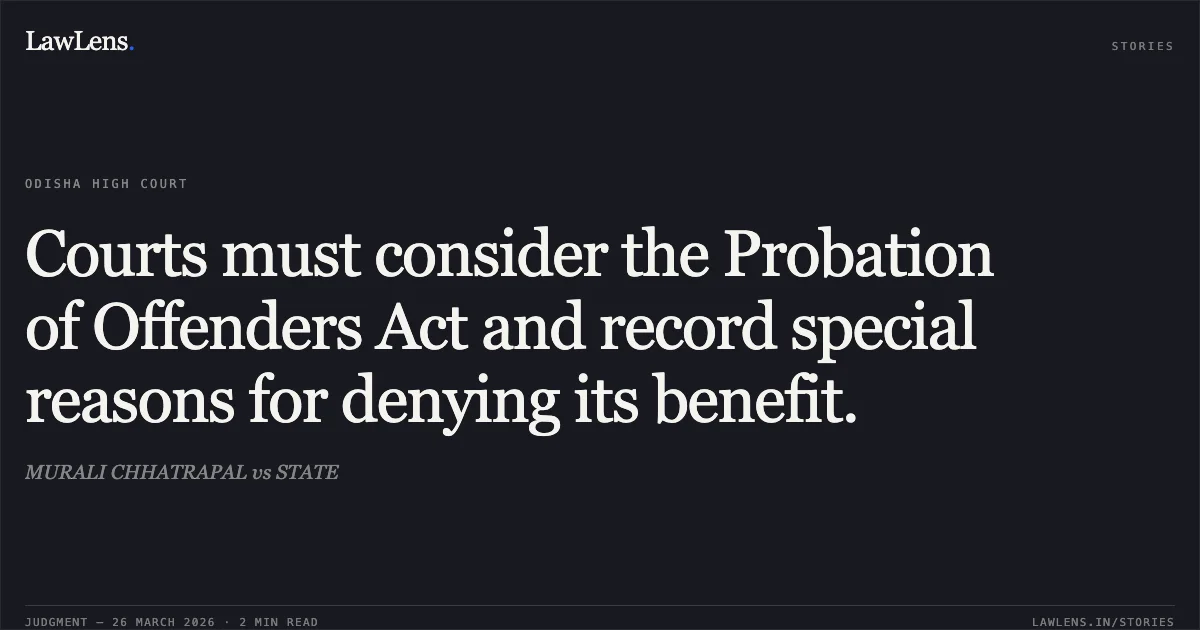
Source reference: p. 7-82. Whether the court is duty-bound to consider the benefit of the Probation of Offenders Act, 1958, for a non-heinous offense occurring over two decades ago
Source reference: p. 8-10Law Applied
The court applied Section 385 (putting person in fear of injury to commit extortion) and Section 427 (mischief causing damage) of the IPC
Source reference: p. 6It primarily relied on Section 4 of the Probation of Offenders Act, 1958, which allows for the release of certain offenders on probation for good conduct
Source reference: p. 9The court further applied the principles from Chellammal and Another v. State (2025 INSC 540), which established that the P.O. Act is reformative and requires courts to record "special reasons" under Section 361 of the CrPC if they decline to grant probation for eligible offenses
Source reference: p. 8-10Reasoning
The High Court affirmed the conviction, reasoning that while major charges failed, the core evidence regarding the demand for money, intimidation, and property damage remained credible and supported by witnesses
Source reference: p. 7-8Regarding the sentence, the court noted that the incident occurred in 2004 and arose from a local dispute over festival subscriptions rather than a heinous intent
Source reference: p. 10Applying the Chellammal precedent, the court found that since Appellant No. 2 was not a habitual offender and had already served 285 days in custody—nearly the entirety of the one-year sentence—further incarceration served no reformative purpose
Source reference: p. 11The court held that the trial court erred in summarily refusing probation without justifying why such a reformative measure was inappropriate given the circumstances
Source reference: p. 10Holding
The High Court upheld the conviction under Sections 385/34 and 427/34 IPC but set aside the sentence of imprisonment
The Court directed that Appellant No. 2 be released under Section 4 of the Probation of Offenders Act for a period of six months upon executing a bond of ₹5,000 with one surety
Source reference: p. 11The appellant is required to maintain peace and remain under the supervision of a Probation Officer during this period
Source reference: p. 12The appeal was partly allowed
Source reference: p. 12Original Court PDF
MURALI CHHATRAPALvsSTATE
Click to open original judgment
Original judgment, available to read, download and summarize on LawLens.in