Facts
The Respondent/Plaintiff filed a civil suit seeking a declaration of title, possession, and permanent injunction, alleging that a Power of Attorney (PoA) purportedly executed in favor of Defendant No. 2 was forged
Source reference: para. 3Defendant No. 1 (the Appellant) filed a written statement asserting he was a bona fide purchaser who paid full consideration
Source reference: para. 4However, both defendants failed to appear during the evidence stage and were proceeded against ex-parte
Source reference: para. 4–5The Trial Court decreed the suit ex-parte, relying on forensic expert testimony which concluded the PoA signatures were forged
Source reference: para. 6The Appellant subsequently filed applications under Order 9 Rule 13 of the CPC and Section 5 of the Limitation Act to set aside the decree, citing negligence and lack of communication from his previous counsel
Source reference: para. 7The Trial Court rejected these applications solely on the ground of delay without considering the merits
Source reference: para. 8Issues
1. Whether the Trial Court erred in rejecting the application under Order 9 Rule 13 CPC and the associated condonation of delay application based on a technical/strict interpretation of the Limitation Act
Source reference: para. 9, 132. Whether a litigant should be penalized for the negligence or inaction of their counsel in failing to monitor proceedings or communicate hearing dates
Source reference: para. 14Law Applied
The court primarily applied Order 9 Rule 13 of the Code of Civil Procedure (CPC) regarding the setting aside of ex-parte decrees and Section 5 of the Limitation Act, 1963, for the condonation of delay
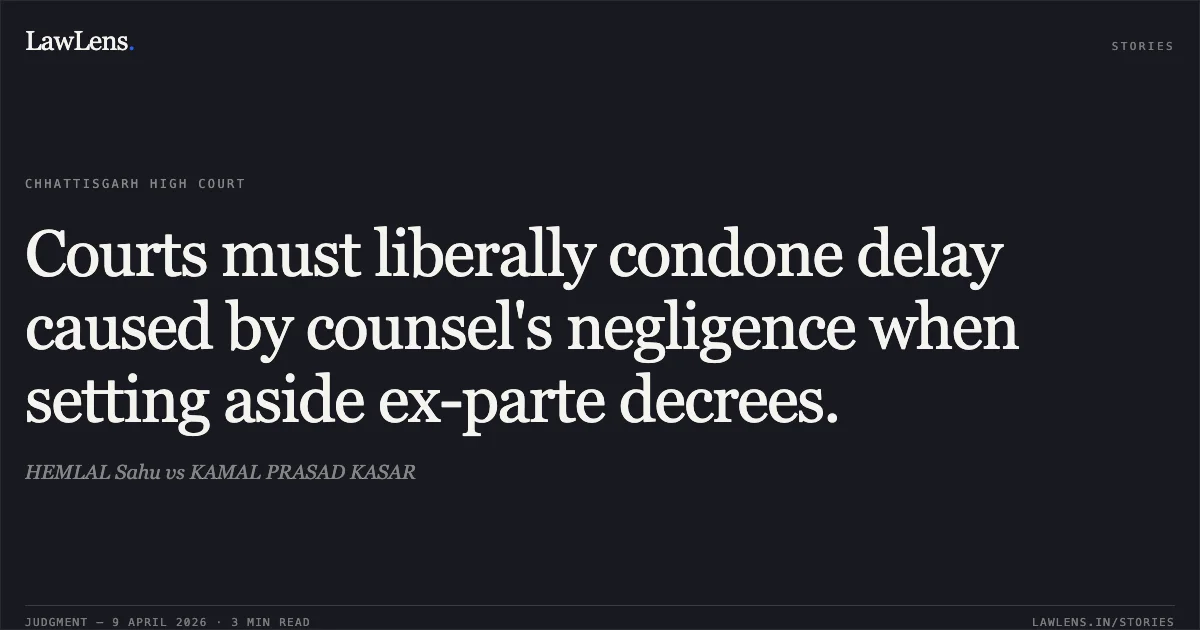
Source reference: para. 2, 13It relied on the principle established in Rafiq & Anr. v. Munshilal & Anr. (1981), which dictates that a litigant should not suffer for the fault, negligence, or inaction of their counsel
Source reference: para. 14the court applied the doctrine from Dwarika Prasad v. Prithvi Raj Singh (2024), emphasizing that procedure is the "handmaid of justice" and that courts should avoid hyper-technical views regarding delay applications when a party acts bona fide
Source reference: para. 15Reasoning
The High Court observed that the Appellant’s absence was not deliberate but resulted from a lapse by his legal counsel, who failed to inform him of hearing dates or file appropriate applications
Source reference: para. 12, 14The Court reasoned that once a litigant engages an advocate, they are entitled to presume proper representation and cannot be expected to act as a "watchdog" over the advocate's professional duties
Source reference: para. 14The Court criticized the Trial Court's rigid approach, stating that when considering Section 5 of the Limitation Act and Order 9 Rule 13, a liberal approach must be adopted to ensure disputes are resolved on their merits rather than technicalities
Source reference: para. 13By integrating the reasoning in Dwarika Prasad, the Court held that the explanation for the delay—the search for proper legal guidance and the previous counsel's negligence—constituted "sufficient cause" and that the procedural requirements should not obstruct a just outcome
Source reference: para. 15–16Holding
The High Court allowed all the appeals and set aside the Trial Court's orders dated January 5, 2022
The Court condoned the delay in filing the MJCs and remanded the matters back to the Trial Court with a direction to decide the Order 9 Rule 13 applications afresh on their merits
Source reference: para. 16–17The parties were directed to appear before the Trial Court on April 21, 2026, with a mandate for the Trial Court to dispose of the applications within 30 days thereafter
Source reference: para. 18Acts & Sections Cited
3 provisions across 2 statutes referred to in this judgment. Each provision opens on LawLens.
Code of Civil Procedure, 19082
Limitation Act, 19631
Original Court PDF
HEMLAL SahuvsKAMAL PRASAD KASAR
Click to open original judgment
Original judgment, available to read, download and summarize on LawLens.in