Facts
A judgment and decree was passed by the Civil Judge, Class I, Joura, in Civil Suit No. 19-A/2012 on 21.06.2013.
Source reference: para. 4The appellant’s counsel obtained the certified copy on 27.06.2013, but the first appeal was filed only on 08.08.2013, resulting in a delay of approximately 17 days.
Source reference: para. 4The appellant sought condonation of delay under Section 5 of the Limitation Act, stating that his counsel had not informed him about obtaining the certified copy and that, during the relevant period, his cousin Ajay Sharma had suffered a serious accident, was referred to Delhi for treatment, and died on 22.07.2013.
Source reference: para. 5The appellant stated that he came to Joura on 07.08.2013 and immediately instructed counsel to file the appeal, which was filed on the following day.
Source reference: para. 5The First Additional District Judge, Joura, rejected the Section 5 application and dismissed the first appeal as time-barred by judgment dated 12.08.2013.
Source reference: paras. 1, 6Issues
Whether the first appellate court erred in dismissing the appellant’s first appeal as barred by limitation?
Source reference: para. 2Whether the appellant established sufficient cause under Section 5 of the Limitation Act for condonation of the 17-day delay in filing the appeal?
Source reference: para. 2Law Applied
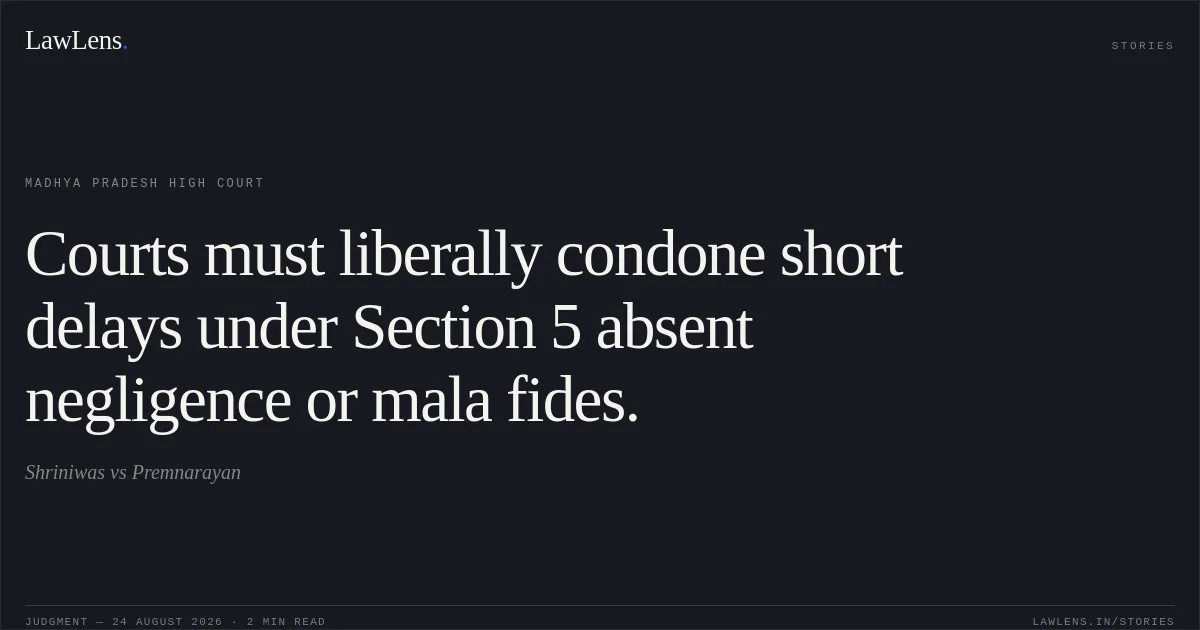
The Court applied Section 5 of the Limitation Act, 1963, under which delay may be condoned where the applicant demonstrates “sufficient cause.”
Source reference: para. 10Relying on Ram Nath Sao v. Gobardhan Sao, (2002) 3 SCC 195, the Court held that “sufficient cause” should receive a liberal construction to advance substantial justice, and that acceptance of a bona fide explanation should ordinarily be the rule while rejection should be the exception, subject to absence of negligence, inaction, or mala fides.
Source reference: para. 10The Court further relied on S. Ganesharaju (Dead) through LRs. v. Narasamma (Dead) through LRs., (2013) 11 SCC 341, which held that limitation provisions are not intended to destroy substantive rights, that matters should ordinarily be decided on merits, and that delay should generally be condoned where the party acted with reasonable diligence and was not negligent or callous.
Source reference: para. 11Reasoning
The High Court found that the first appellate court had failed to consider the appellant’s explanation concerning his cousin’s accident and subsequent death.
Source reference: para. 12Applying the liberal and justice-oriented interpretation of “sufficient cause” under Section 5, the Court held that the family emergency, coupled with the short delay of only 17 days, constituted a sufficient explanation.
Source reference: para. 12The Court also found no mala fide intention because the appellant would not derive any benefit from deliberately filing the appeal beyond the limitation period.
Source reference: para. 12The appellate court therefore adopted an unduly narrow approach in rejecting the delay-condonation application.
Source reference: para. 12Holding
The substantial question of law was answered in favour of the appellant.
The High Court held that sufficient cause had been established for condoning the 17-day delay.
Source reference: para. 12Accordingly, it set aside the judgment dated 12.08.2013, allowed the appellant’s application under Section 5 of the Limitation Act, condoned the delay, and remitted the matter to the first appellate court for adjudication of the appeal on merits.
Source reference: para. 13The second appeal was allowed and disposed of in those terms.
Source reference: para. 14Acts & Sections Cited
1 provisions across 1 statute referred to in this judgment. Each provision opens on LawLens.
Limitation Act, 19631
Original Court PDF
ShriniwasvsPremnarayan
Click to open original judgment
Original judgment, available to read, download and summarize on LawLens.in