01Facts
Respondent No. 1/plaintiff instituted a civil suit seeking declaration of title, partition of a 1/5th share, and possession in respect of agricultural lands comprising Khasra Nos. 67, 180 and 297, measuring 12.35 acres in total.
¶ 1The Civil Judge, Class-I, Ambagarh Chowki, dismissed the suit by judgment and decree dated 19 November 2009.
¶ 1The appellants/defendants thereafter filed a first appeal under Section 96 of the Code of Civil Procedure, 1908, but the appeal was delayed.
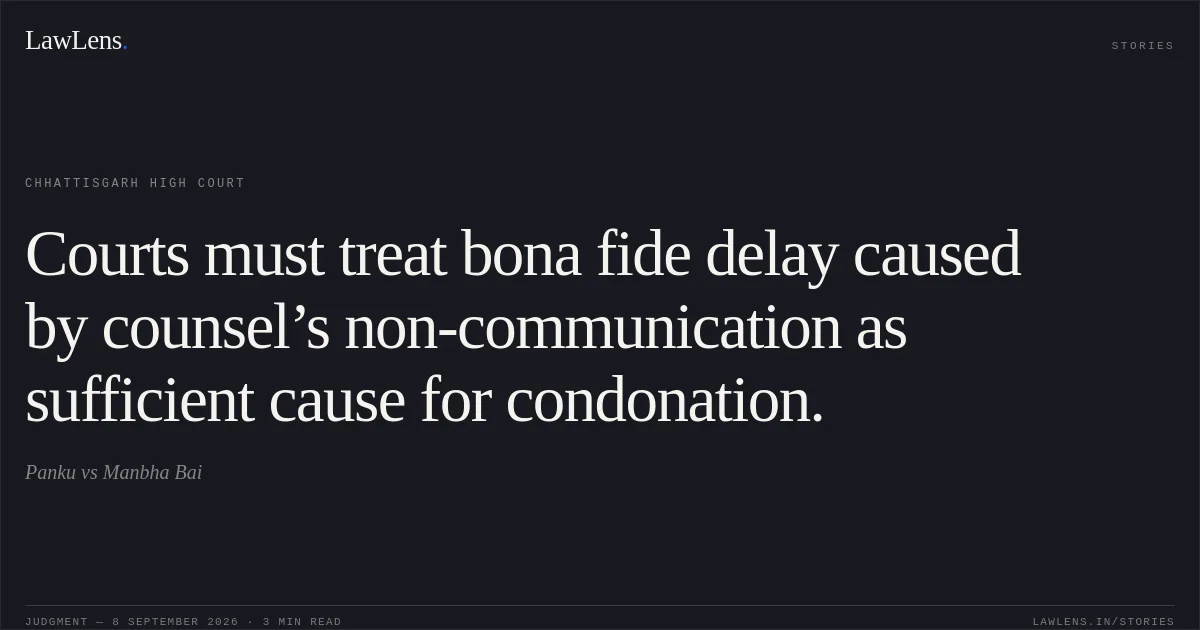
¶ 2They filed an application for condonation of delay under Order XLI Rule 3 CPC, stating that their earlier counsel had not informed them of the judgment.
¶ 2They claimed that they learnt of the dismissal only after receiving summons from the Tahsildar on 29 June 2010 and being informed on 2 August 2010 that the suit had been dismissed and partition proceedings had been initiated.
¶ 2They obtained the certified copy on 9 August 2010 and filed the appeal on 25 August 2010.
¶ 2The Additional District Judge rejected the application for condonation of delay and consequently dismissed the first appeal.
¶ 202Issues
i.Whether the first appellate court exercised its jurisdiction fairly and judiciously while rejecting the appellants’ application for condonation of delay in filing the first appeal?
¶ 2ii.Whether the appellants established “sufficient cause” for condoning the delay in filing the appeal under the applicable limitation principles?
¶ 3, 7–1003Law Applied
The Court considered the appellate jurisdiction under Sections 96 and 100 CPC and the procedural requirements under Order XLI Rule 3 CPC.
It applied the “sufficient cause” standard governing condonation of delay under the Limitation Act, holding that limitation provisions are intended to prevent dilatory tactics, not to destroy substantive rights.
¶ 8Relying on N. Balakrishnan v. M. Krishnamurthy, (1998) 7 SCC 123, the Court held that “sufficient cause” should receive a liberal construction where refusal to condone delay would defeat a party’s opportunity to pursue its remedy.
¶ 8It also relied on Esha Bhattacharjee v. Managing Committee of Raghunathpur Nafar Academy, (2013) 12 SCC 649, which requires a liberal, pragmatic and justice-oriented approach, while still considering negligence, bona fides, the length of delay, prejudice to the opposite party, and whether the explanation is genuine.
¶ 9Provisions in the judgment · 3 · Linked ones open on LawLens
Code of Civil Procedure, 1908 Section 100Section 96
Limitation Act, 1963 Section 5
04Reasoning
The Court found that the appellants had specifically explained that they were unaware of the judgment because their counsel had failed to inform them.
¶ 7The record showed that, upon learning of the dismissal through the Tahsildar, they took steps to obtain the case file and certified copy and filed the appeal promptly on 25 August 2010.
¶ 7Applying the principles that delay is not presumed to be deliberate and that substantial justice should prevail over technical considerations, the Court held that the appellants had demonstrated sufficient cause.
¶ 8–10The first appellate court had therefore adopted an unduly restrictive approach in rejecting the application, particularly when the appellants’ conduct after acquiring knowledge of the judgment was prompt and bona fide.
¶ 8–1005Holding
The substantial question of law was answered in favour of the appellants.
¶ 10The High Court held that the first appellate court had erred in rejecting the application for condonation of delay.
¶ 10The impugned order dismissing the application and the consequential dismissal of the first appeal were set aside, and the matter was remanded to the first appellate court for decision on merits.
¶ 10The parties were directed to appear before that court on 12 October 2026; the records were ordered to be transmitted forthwith, with liberty to the appellate court to issue notices if the parties failed to appear.
¶ 10Original Court PDF
PankuvsManbha Bai
Click to open original judgment
Original judgment, available to read, download and summarize on LawLens.in