Facts
The petitioner, a Sub-Inspector appointed on 15.05.2015 and posted at Police Station University, Gwalior, proceeded on medical leave from 10.01.2025 to 14.01.2025. During this period, a police raid was conducted at a spa centre on 13.01.2025, resulting in registration of Crime No. 23 of 2025.
Source reference: paras. 2, 7The petitioner was subsequently issued a show-cause notice and a joint charge-sheet alleging, inter alia, failure to maintain surveillance and prevent illegal activities within his beat area, rather than merely alleging responsibility for the raid conducted during his leave.
Source reference: paras. 2, 7The Superintendent of Police, Gwalior, found the petitioner’s explanation satisfactory by order dated 08.01.2026. Respondent No. 3 thereafter directed initiation of departmental proceedings and appointed an Inquiry Officer.
Source reference: paras. 3, 8In an earlier writ petition, the High Court remanded the matter with a direction to record specific reasons for disagreeing with the Superintendent of Police’s opinion. In compliance, respondent No. 3 passed the impugned order dated 06.05.2026, recording reasons for disagreement and directing that a departmental inquiry proceed. The petitioner challenged that order under Article 226 of the Constitution.
Source reference: paras. 1, 14Issues
Whether a writ petition under Article 226 is maintainable against an order recording disagreement with an earlier administrative opinion and directing initiation of a departmental inquiry, when no punishment or final finding of guilt has been imposed.
Source reference: paras. 9–15, 19–21Whether the impugned order dated 06.05.2026 was without jurisdiction or otherwise illegal because the Superintendent of Police had accepted the petitioner’s explanation and because the petitioner alleged non-compliance with Police Regulations 221, 223, 229 and 270.
Source reference: paras. 3, 14–20Whether the High Court could examine, at the stage of initiation of departmental proceedings, the correctness of the allegations and the petitioner’s defence that he was on sanctioned leave on the date of the raid.
Source reference: paras. 7, 16, 19–20Law Applied
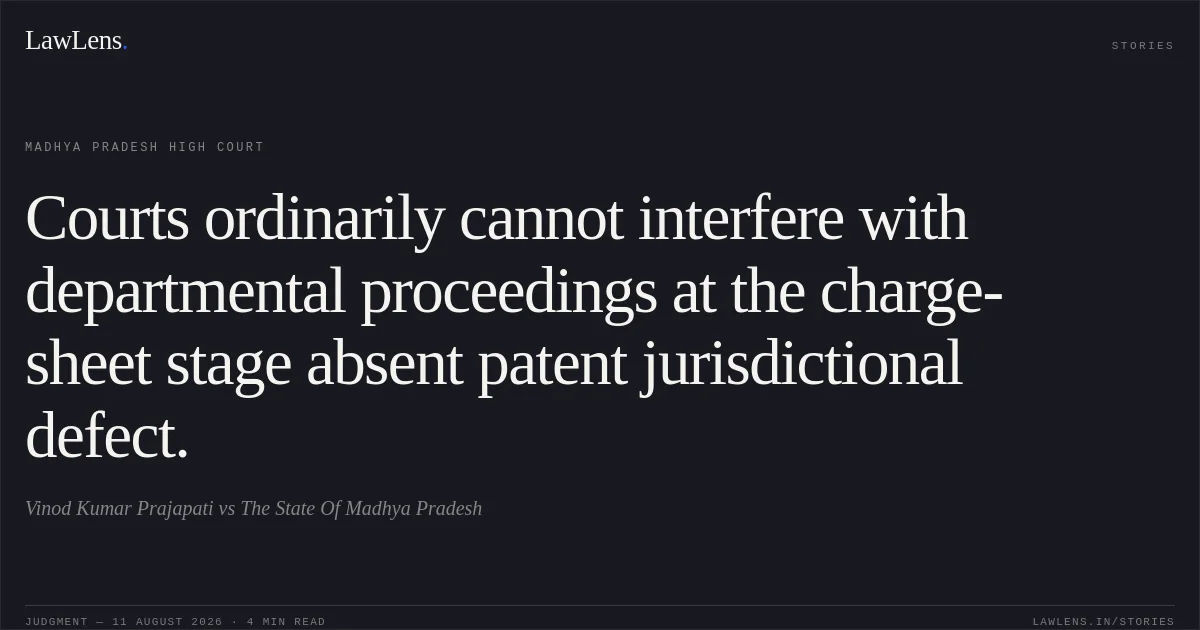
The Court applied the principle that a charge-sheet or order initiating disciplinary proceedings ordinarily does not give rise to a cause of action for writ jurisdiction unless it is issued by an incompetent authority, is wholly without jurisdiction, or is vitiated by an exceptional legal defect; this principle was drawn from Union of India v. Kunisetty Satyanarayana, (2006) 12 SCC 28, Secretary, Ministry of Defence v. Prabhash Chandra Mirdha, (2012) 11 SCC 565, and Jagdish Baheti v. High Court of M.P., 2015 (2) MPHT 382.
Source reference: paras. 9, 12Under Union of India v. Upendra Singh, (1994) 3 SCC 357, judicial interference at the charge-sheet stage is limited to cases where the alleged facts, even if accepted, do not constitute misconduct or where the proceedings are contrary to law; the Court cannot determine the truth of the charges.
Source reference: para. 11Transport Commissioner, Madras v. A. Radha Krishna Moorthy, (1995) 1 SCC 332, similarly confines judicial review to the decision-making process and not the correctness of the factual allegations.
Source reference: para. 10The Court also relied on Police Regulation 270, which permits a superior authority to exercise suo motu revisional power over an order of punishment or exoneration and, for recorded reasons, order a fresh inquiry, subject to an opportunity of hearing before varying or reversing the order.
Source reference: paras. 17–18Reasoning
The Court held that the impugned order neither imposed punishment nor recorded a final finding of guilt; it merely complied with the earlier judicial direction by providing reasons for disagreement with the Superintendent of Police and directing a departmental inquiry.
Source reference: paras. 14–15The Superintendent of Police’s statement that the petitioner’s explanation was “satisfactory” was not treated as a detailed and final order of exoneration, particularly because it did not record findings negating misconduct or the petitioner’s alleged failure to supervise his beat.
Source reference: paras. 15–16The Court further found that the allegations extended beyond the date of the raid and concerned the petitioner’s alleged failure, while posted in the relevant beat, to monitor and prevent unlawful activities. These allegations required evidentiary examination in a departmental inquiry and could not be adjudicated in writ proceedings at the threshold.
Source reference: para. 16The Court accepted that Police Regulation 270 empowered the superior authority to revisit an order of exoneration and found that respondent No. 3 had recorded specific reasons for disagreement in compliance with the earlier order.
Source reference: paras. 17–18Applying the settled rule against judicial interference with charge-sheets and preliminary disciplinary action, the Court declined to examine the petitioner’s leave-based defence, the merits of the allegations, or the ultimate correctness of the proposed inquiry at that stage.
Source reference: paras. 19–20Holding
The High Court dismissed the writ petition, holding that the order dated 06.05.2026 disclosed no illegality, arbitrariness, or jurisdictional error warranting interference under Article 226.
The departmental inquiry was permitted to proceed in accordance with law, with the petitioner entitled to participate, cross-examine witnesses, produce material, and establish his defence.
Source reference: para. 19The Court clarified that its observations were confined to deciding the writ petition and would not influence the departmental inquiry or its final outcome.
Source reference: para. 21Original Court PDF
Vinod Kumar PrajapativsThe State Of Madhya Pradesh
Click to open original judgment
Original judgment, available to read, download and summarize on LawLens.in