Facts
The petitioners, together with respondent Nos. 2–30, filed O.S. No. 136/2021 seeking a declaration of ownership over the suit property.
Source reference: pp. 7–8After respondent No. 1 filed a written statement and the trial court framed issues, the petitioners applied under Order VI Rule 17 CPC to amend the plaint.
Source reference: pp. 7–8The trial court rejected the application on 10 July 2024.
Source reference: pp. 7–8The petitioners challenged that order under Article 227 of the Constitution
Source reference: pp. 7–8, 10–11Issues
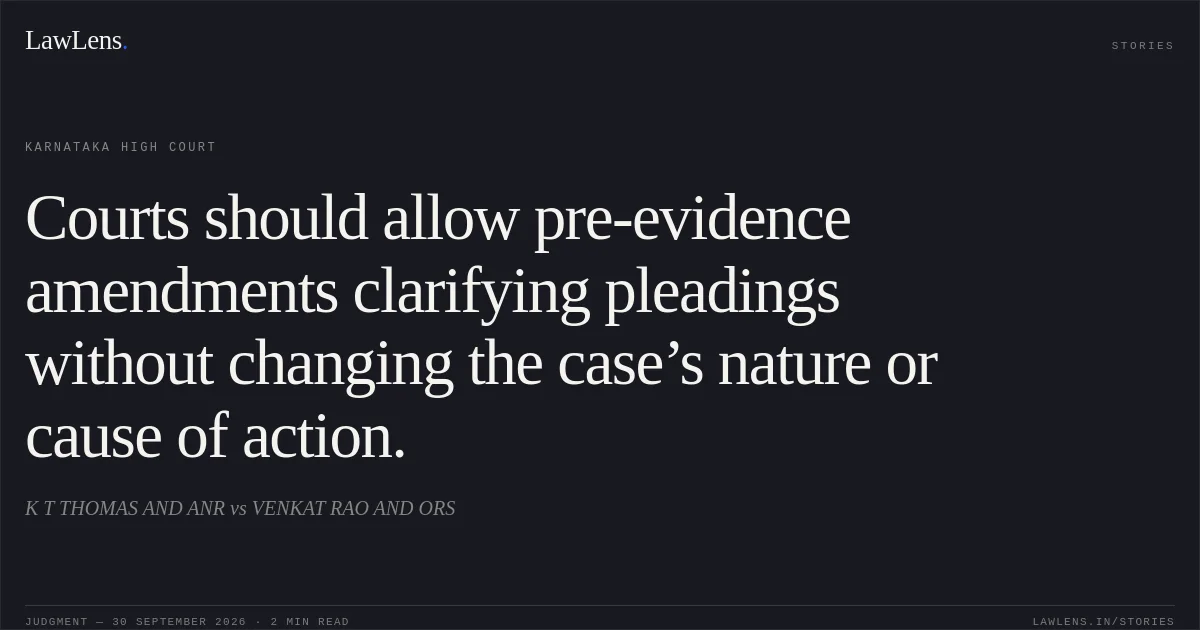
1. Whether the trial court erred in rejecting the petitioners’ application under Order VI Rule 17 CPC to amend the plaint before commencement of their evidence
Source reference: pp. 8–112. Whether the proposed amendment could be allowed as an explanation of existing pleadings without changing the nature of the case or its cause of action
Source reference: p. 10Law Applied
The Court considered Order VI Rule 17 CPC, which empowers a court to permit amendment of pleadings to determine the real questions in controversy, subject to the statutory due-diligence proviso where trial has commenced.
Source reference: pp. 8–11It also exercised supervisory jurisdiction under Article 227 of the Constitution to review the trial court’s order.
Source reference: pp. 8–11No precedent was cited or relied upon in the judgment
Source reference: pp. 8–11Reasoning
The High Court found that the amendment application was filed before the petitioners began giving evidence and that the proposed changes merely explained matters already pleaded; they did not alter the nature of the case or the cause of action.
Source reference: pp. 10–11It held that allowing the amendment would help avoid multiplicity of litigation, while any prejudice to respondent No. 1 could be addressed by costs and permission to file an additional written statement.
Source reference: pp. 10–11The trial court had not adequately considered these matters or given proper reasons for rejecting the application.
Source reference: pp. 10–11Holding
The High Court allowed the writ petition and set aside the trial court’s order dated 10 July 2024.
It allowed I.A. No. 8, subject to the petitioners paying respondent No. 1 costs of ₹5,000 on the next date of hearing, and reserved liberty for respondent No. 1 to file an additional written statement.
Source reference: pp. 11–12Original Court PDF
K T THOMAS AND ANRvsVENKAT RAO AND ORS
Click to open original judgment
Original judgment, available to read, download and summarize on LawLens.in