Facts
The appellant had instituted a suit for permanent and mandatory injunction in 2014, later renumbered as CS SCJ No. 35831/2016.
Source reference: para. 1–4, 9The suit was dismissed for non-prosecution on 19 August 2023.
Source reference: para. 1–4, 9The appellant stated that he learned of the dismissal after receiving a legal notice in July 2024 and thereafter filed an application under Order IX Rule 9 CPC, dated 26 July 2024, which he said was filed on 31 July 2024.
Source reference: para. 1–4, 9The Trial Court dismissed the application for condonation of the 318-day delay and consequently dismissed the restoration application as time-barred.
Source reference: para. 1–4, 9The appellant challenged that order in this appeal.
Source reference: para. 1–4, 9Issues
Whether the appellant’s explanation for the delay in applying to restore the suit constituted “sufficient cause” for condonation.
Source reference: para. 8Whether the Trial Court’s refusal to condone the delay should be set aside and the suit restored.
Source reference: para. 11–13Law Applied
Order XLIII Rule 1(d) read with Section 104 CPC provided the basis for the appeal; Order IX Rule 9 CPC governed the application to restore the suit dismissed for non-prosecution; and Section 5 of the Limitation Act governed condonation of delay.
Source reference: para. 1, 4, 10The Court applied the principle that “sufficient cause” should receive a liberal, justice-oriented construction where the explanation is bona fide and does not show deliberate inaction or lack of good faith.
Source reference: para. 1, 4, 10It relied on *Collector, Land Acquisition, Anantnag v. Mst. Katiji*, (1987) 2 SCC 107, on the liberal approach to condonation, and *Rafiq v. Munshilal*, (1981) 2 SCC 788, on protecting a bona fide litigant, in appropriate circumstances, from the consequences of counsel’s lapse.
Source reference: para. 1, 4, 10Reasoning
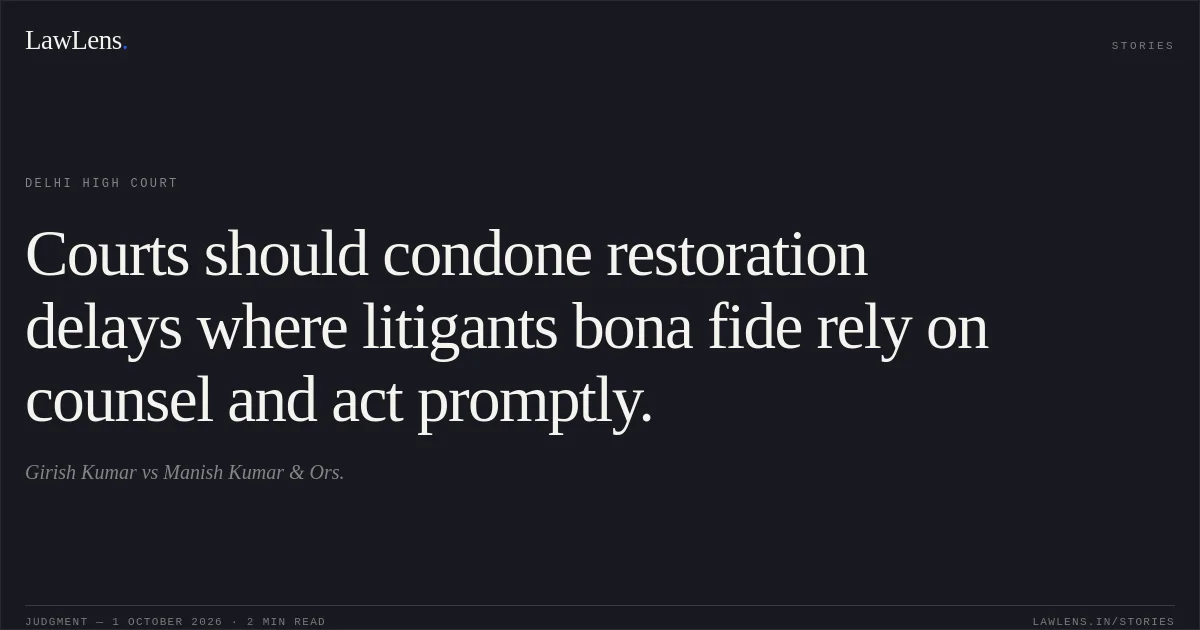
The Court accepted the appellant’s explanation that he had relied on his previous counsel for information about the proceedings and was not told that counsel had stopped appearing.
Source reference: para. 9It also noted that, after learning of the dismissal in July 2024, the appellant acted to seek restoration and could not be regarded as inactive.
Source reference: para. 9Applying the liberal approach to “sufficient cause,” the Court concluded that the dispute should be determined on its merits rather than terminated solely because of the delay.
Source reference: para. 10–11Holding
The Court allowed the appeal, set aside the Trial Court’s order dated 13 October 2025, and condoned the 318-day delay, subject to payment of ₹2,000 in costs to the respondents within two weeks.
It directed that the Order IX Rule 9 CPC application stand allowed and the suit be restored to its original position.
Source reference: para. 12–17The matter was listed before the Trial Court for 12 October 2026; the Court expressed no view on the merits of the suit.
Source reference: para. 12–17Acts & Sections Cited
2 provisions across 2 statutes referred to in this judgment. Each provision opens on LawLens.
Code of Civil Procedure, 19081
Limitation Act, 19631
Original Court PDF
Girish KumarvsManish Kumar & Ors.
Click to open original judgment
Original judgment, available to read, download and summarize on LawLens.in