Facts
The applicant was arrested in connection with Crime No. 284/2018, registered for offences under Sections 420 and 34 of the IPC, and was granted bail on 7 February 2022.
Source reference: para. 2–8He thereafter regularly appeared before the trial court.
Source reference: para. 2–8On 23 April 2026, neither he nor his counsel appeared; the bail bonds were cancelled and an arrest warrant was issued.
Source reference: para. 2–8He was produced before the trial court on 23 June 2026 and remanded to judicial custody.
Source reference: para. 2–8The applicant attributed his absence to miscommunication with local counsel, while the State opposed bail on the ground that he might abscond.
Source reference: para. 2–8The charge-sheet had been submitted, and the applicant had remained in custody since 23 June 2026.
Source reference: para. 2–8Issues
1. Whether the applicant should be enlarged on bail after his bail bonds were cancelled and an arrest warrant issued following his non-appearance before the trial court.
Source reference: para. 3–82. Whether the applicant’s single non-appearance and the State’s asserted risk of absconding justified continued detention, having regard to the procedural safeguards discussed in Satender Kumar Antil v. Central Bureau of Investigation.
Source reference: para. 4, 7–8Law Applied
Section 483 of the Bharatiya Nagarik Suraksha Sanhita, 2023 provides the basis for the bail application.
Source reference: para. 1The alleged offences are under Sections 420 and 34 of the Indian Penal Code.
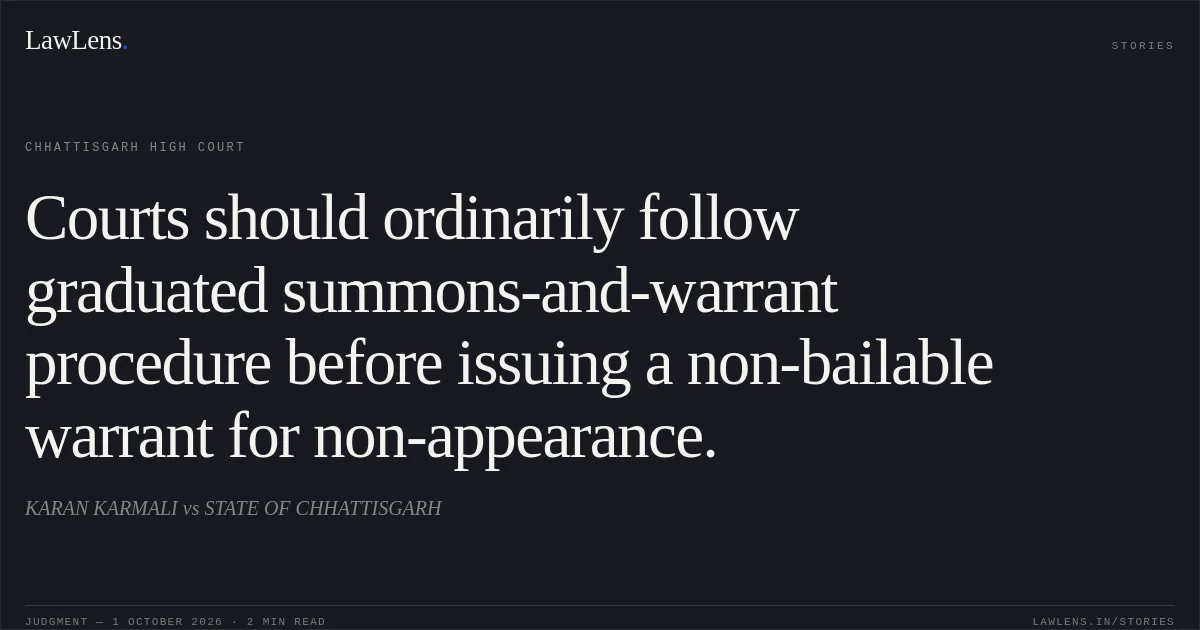
Source reference: para. 1Relying on Satender Kumar Antil v. Central Bureau of Investigation, (2021) 10 SCC 773, the Court noted that, in addressing an accused’s non-appearance, courts should ordinarily follow a graduated procedure of issuing summons, then a bailable warrant, and, where warranted, a non-bailable warrant.
Source reference: para. 7Reasoning
The Court considered that the applicant had regularly appeared after being granted bail and that the non-appearance occurred on one occasion, which the applicant attributed to miscommunication with counsel.
Source reference: paras. 2–3, 6It applied the procedural approach discussed in Satender Kumar Antil and weighed the circumstances against the State’s concern that the applicant might abscond.
Source reference: paras. 4, 7–8The charge-sheet had been filed, the applicant had been in custody since 23 June 2026, and the trial was likely to take considerable time.
Source reference: para. 8On balance, the Court considered release on bail just and proper.
Source reference: para. 8Holding
The Court allowed the application and directed that the applicant be released on bail upon executing a personal bond of ₹50,000 to the satisfaction of the trial court.
Bail was subject to conditions requiring him to be available for police interrogation when required, not to influence or threaten persons acquainted with the facts, and not to act prejudicially to a fair and expeditious trial.
Source reference: para. 9The Court clarified that its observations were limited to the bail application and would not affect the trial court’s independent determination on the merits.
Source reference: para. 9Acts & Sections Cited
3 provisions across 2 statutes referred to in this judgment. Each provision opens on LawLens.
Bharatiya Nagarik Suraksha Sanhita, 20231
Indian Penal Code, 18602
Original Court PDF
KARAN KARMALIvsSTATE OF CHHATTISGARH
Click to open original judgment
Original judgment, available to read, download and summarize on LawLens.in