01Facts
The Petitioner, a member of the Revanta Multi State CGHS Ltd (the 'Society'), filed a writ petition under Article 226 of the Constitution challenging an election notice dated January 19, 2026
pp. 1-2The Petitioner sought to reschedule the elections set for March 29, 2026, alleging that the electoral roll was published incorrectly and the eligibility of voters had not been properly verified by the Returning Officer
p. 1, 3Previously, in Mukesh Kumar v. Central Registrar of Cooperative Societies [W.P.(C) 12765/2025], the Court had observed that the Managing Committee of the same Society had lost its mandate and that any member aggrieved by the fresh election process should seek remedies only after the elections were concluded
pp. 3-402Issues
i.1. Whether the Court should interdict or reschedule the ongoing election process of the Society based on allegations of an incorrect electoral roll
p. 1, 5ii.2. Whether the Petitioner is entitled to seek a stay on elections under Article 226 while the election process is already underway
pp. 4-503Law Applied
Sections 28 and 29 of the Multi-State Cooperative Societies Act, 2002, which govern the preparation of the list of eligible members and the recovery of dues
p. 3The Court primarily applied the established judicial principle that courts should not generally interfere with or interdict an election process once it has commenced, as established in its previous ruling in Mukesh Kumar v. Central Registrar of Cooperative Societies
p. 4The Court also highlighted the ethical principle that a lawyer who is a member of a society and a previous litigant in related matters should ideally not appear as counsel in the same cause
p. 5Provisions in the judgment · 2 · Linked ones open on LawLens
Multi-State Co-operative Societies Act, 2002 Section 28Section 29
04Reasoning
The Court reasoned that the District Magistrate/Collector serving as the Returning Officer is an independent authority expected to have verified member eligibility before drawing the provisional list
p. 5It observed that interfering with the elections only days before the scheduled polling (March 29, 2026) would be contrary to the interests of the Society, which consists of over 4,000 members
p. 5The Court noted that allowing individual writ petitions to challenge the process mid-way would lead to a situation where elections could never be completed
p. 5The Court reiterated its stance from the Mukesh Kumar case, stating that the proper course of action for any aggrieved member is to challenge the election through appropriate legal remedies after the conclusion of the polls
p. 4, 5The Court also noted the impropriety of the Petitioner’s counsel, Mr. Mukesh Kumar, appearing in the matter as he was the petitioner in a related case and a member of the Society himself
p. 505Holding
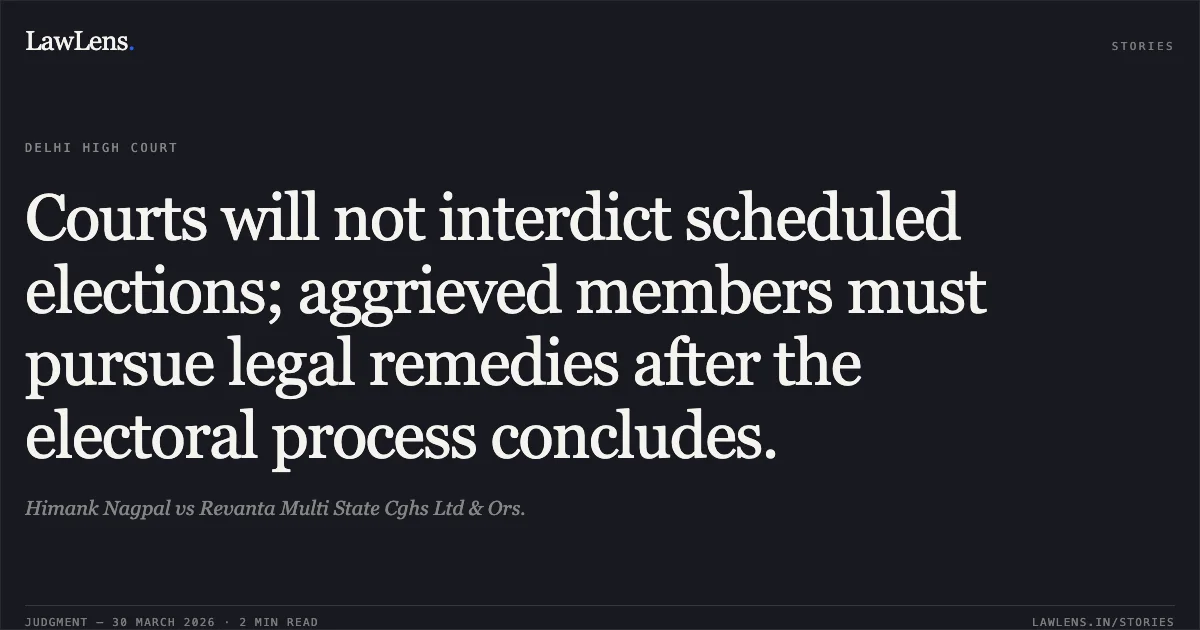
The High Court dismissed the petition, declining to entertain the challenge to the elections or member eligibility at this stage
p. 5The Court held that interdicting the process would not serve the Society's interest and that the Petitioner remains free to avail of legal remedies after the elections are concluded
p. 5The petition and all pending applications were disposed of accordingly
p. 5Original Court PDF
Himank NagpalvsRevanta Multi State Cghs Ltd & Ors.
Click to open original judgment
Original judgment, available to read, download and summarize on LawLens.in