Facts
The appellant was issued a charge-sheet in 2012 by Indian Oil Corporation Limited regarding allegations of dereliction of duty
Source reference: para. 1Following an inquiry concluded in 2014, two charges were proven, and the Disciplinary Authority imposed the punishment of "censure"
Source reference: para. 1The appellant’s internal appeal was dismissed
Source reference: para. 2Initially, the appellant filed a writ petition seeking both the opening of a "sealed cover" for promotion and a challenge to the penalty; however, he restricted that petition to the sealed cover issue while reserving liberty to challenge the penalty separately
Source reference: para. 4Consequently, he filed a subsequent petition challenging the censure, seeking promotion from Grade-B to Grade-C, arrears of pay, and Rs. 10 crores in damages
Source reference: para. 5The learned Single Judge dismissed the challenge to the penalty, noting that censure did not harm future prospects and relegated the claim for damages to a Civil Court
Source reference: paras. 6–7Issues
1. Whether the High Court, under Article 226 of the Constitution of India, can interfere with a departmental inquiry and the resulting penalty of censure when the delinquent participated fully in the proceedings.
Source reference: para. 10–112. Whether the prayer for promotion and arrears of pay survived after the respondent granted retrospective promotion and paid the alleged dues during the pendency of proceedings.
Source reference: para. 8–9Law Applied
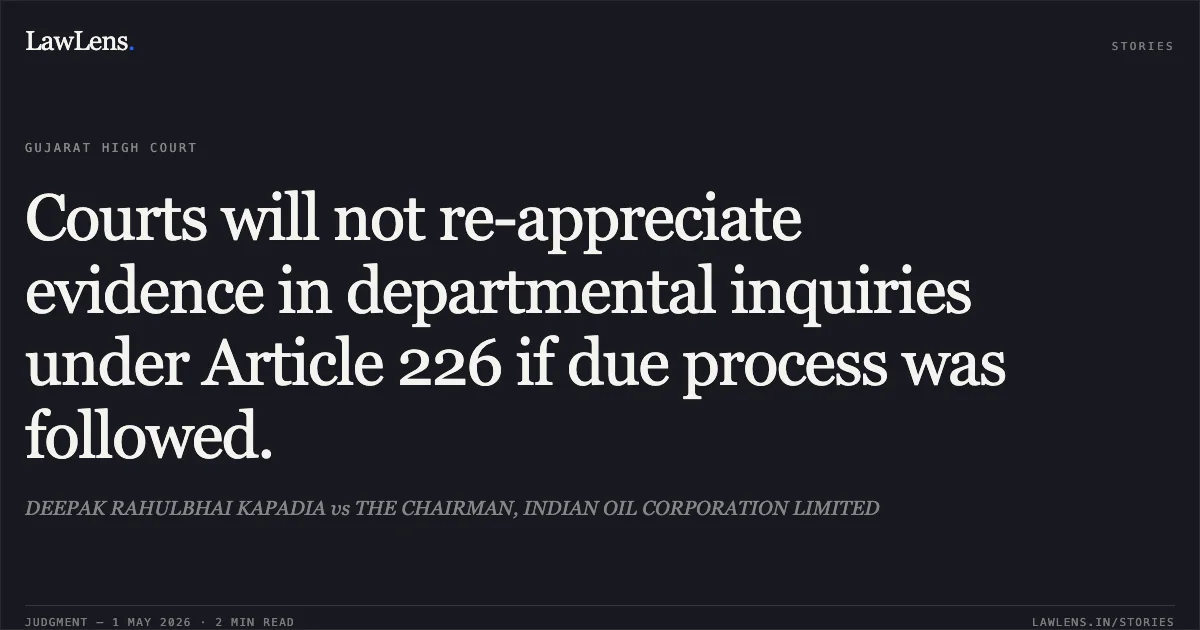
The court applied the established principle of judicial review under Article 226 of the Constitution of India, which dictates that in departmental proceedings, the High Court does not sit as a Court of Appeal and will not re-appreciate evidence if the inquiry followed due process
Source reference: para. 10It further relied on the doctrine that if an administrative penalty (like censure) does not adversely affect future career prospects, and the inquiry was conducted fairly, the scope of interference is extremely limited
Source reference: para. 6, 11Reasoning
The Court observed that the appellant had participated fully in the disciplinary inquiry and all his contentions were considered by the Inquiry Officer and the Disciplinary Authority
Source reference: para. 10Since the inquiry report was accepted and a mild penalty of censure was imposed, the Court found no procedural or legal infirmity
Source reference: para. 11Regarding the prayers for promotion and arrears, the Court noted that the respondent had already granted the appellant retrospective promotion and settled the calculated arrears; therefore, these grievances were largely redressed
Source reference: para. 8The Court emphasized that it cannot act as a secondary disciplinary body to re-evaluate the merits of the evidence when the procedural requirements of natural justice were satisfied
Source reference: para. 10Holding
The Court dismissed the appeal, holding that there was no merit in the challenge to the disciplinary proceedings or the imposition of the censure penalty
The Court clarified that while the current appeal is dismissed, the appellant remains at liberty to initiate separate appropriate proceedings if he is aggrieved by the specific computation of arrears or any technical aspect of his retrospective promotion
Source reference: para. 9, 13Relief for damages was maintained as a matter for the Civil Court as determined by the Single Judge
Source reference: para. 7Original Court PDF
DEEPAK RAHULBHAI KAPADIAvsTHE CHAIRMAN, INDIAN OIL CORPORATION LIMITED
Click to open original judgment
Original judgment, available to read, download and summarize on LawLens.in


