01Facts
The petitioner, Sameer, was detained by the District Magistrate, Shamli, under Section 3(3) of the National Security Act (NSA), 1980, via an order dated 15.05.2025.
¶ 1The detention followed an incident on 15.03.2025, where police discovered remains of slaughtered cows in Village Lavvadaudpur.
¶ 2The discovery led to significant communal unrest, including road blockades by various organizations and the deployment of additional police forces to maintain peace.
¶ 5-6, 12The petitioner was arrested on 17.03.2025 with an illicit knife and confessed to the slaughter.
¶ 10While the petitioner was in custody for the substantive offense, the Detaining Authority received intelligence reports (Beat G.D. No. 20 and LIU reports) indicating that the petitioner intended to resume cow slaughter activities immediately upon his expected release on bail.
¶ 14-16The State Government confirmed the detention for 12 months on 12.06.2025.
¶ 1, 1902Issues
i.1. Whether the Detaining Authority passed the detention order without due application of mind.
¶ 23, 26ii.2. Whether the act of cow slaughter in the present circumstances constitutes a disturbance of "public order" or merely a "law and order" violation.
¶ 27iii.3. Whether there was reliable material to justify the subjective satisfaction that the petitioner, if released on bail, would indulge in activities prejudicial to public order.
¶ 38, 41iv.4. Whether there was an inordinate and unexplained delay in the disposal of the petitioner’s representation.
¶ 44-4503Law Applied
The court primarily applied Section 3 of the National Security Act, 1980, regarding the power to make orders detaining certain persons.
¶ 1It relied on the distinction between "law and order" and "public order" established in Ram Manohar Lohia v. State of Bihar, defining public order as the "even tempo of life of the community".
¶ 28The court further applied the "even tempo" test from Arun Ghosh v. State of W.B. to determine the reach and degree of the act's impact on society.
¶ 29Regarding the detention of persons already in custody, the court followed the three-pronged test from Kamarunnissa v. Union of India: (i) awareness of custody, (ii) reliable material suggesting a real possibility of release on bail, and (iii) a probability of the detenu indulging in prejudicial activity upon release.
¶ 39Provisions in the judgment · 12 · Linked ones open on LawLens
National Security Act, 1980 Section 3Section 8Section 9Section 10Section 11Section 12Section 14
Arms Act, 1959 Section 3Section 4Section 25Section 27
Bharatiya Nyaya Sanhita, 2023 Section 109
04Reasoning
The Court rejected the plea of non-application of mind, noting that the grounds of detention copiously detailed the impact of the crime on the locale.
¶ 26On the distinction between law and order and public order, the Court held that cow slaughter is a sensitive issue with the inherent potential to provoke communal tension and violent reactions.
¶ 30In this specific case, the act led to massive crowds, traffic jams, and necessitated heavy police surveillance, thereby disturbing the "even tempo of life".
¶ 35-37Regarding the petitioner's status in custody, the Court found that the Detaining Authority relied on "reliable material," specifically Beat Information G.D. No. 20 and LIU reports, which verified the petitioner’s intent to repeat the offense.
¶ 42This satisfied the requirements of the Kamarunnissa precedent.
¶ 43Finally, the Court scrutinized the calendar of events provided by the State and found that the timeline for approval and disposal of representations was sufficiently explained and lacked inordinate delay.
¶ 4505Holding
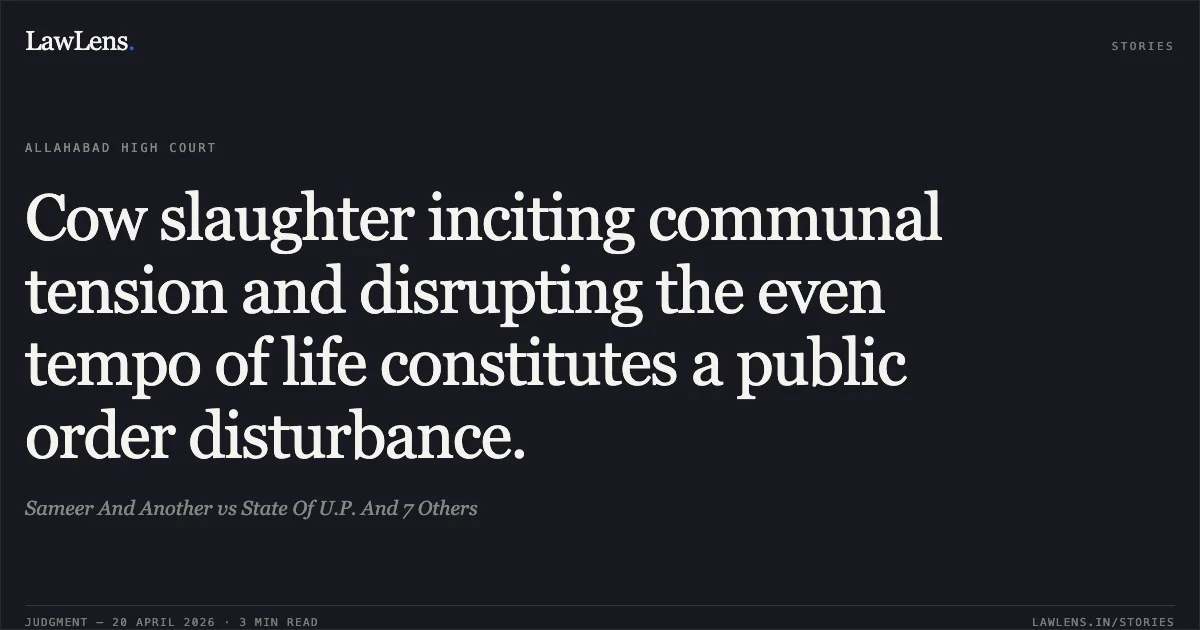
The Court held that the incident was not a mere infraction of law and order but a grave disturbance of public order due to its communal ramifications and impact on the community's tranquility.
¶ 37, 43The Court found no procedural infirmity or unexplained delay in the processing of the detention.
¶ 46Consequently, the High Court dismissed the habeas corpus writ petition and upheld the detention order.
¶ 47Original Court PDF
Sameer And AnothervsState Of U.P. And 7 Others
Click to open original judgment
Original judgment, available to read, download and summarize on LawLens.in