Facts
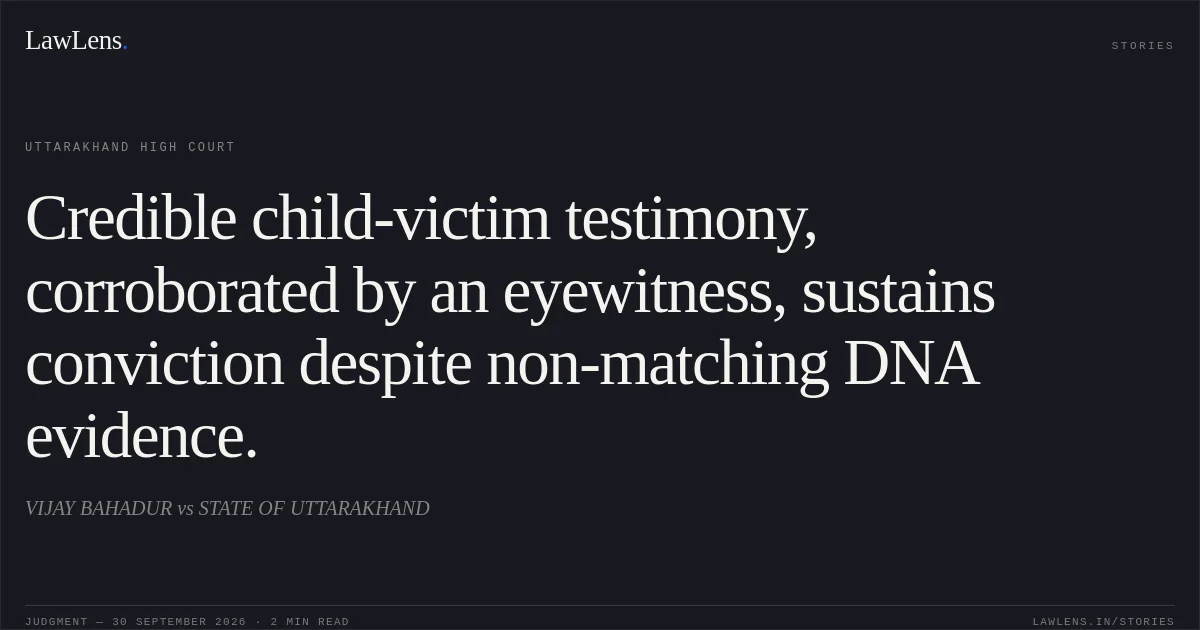
The appellant was convicted by the Special Sessions Judge, Bageshwar, under Section 376(2)(i) IPC and Section 3(a) read with Section 4 of the POCSO Act for sexually assaulting a child on 27 April 2017.
Source reference: para. 1The trial court sentenced him to 12 years’ rigorous imprisonment and a fine of ₹10,000.
Source reference: para. 1The victim and her 12-year-old brother identified the appellant; the brother claimed to have witnessed the incident.
Source reference: paras. 7–22The victim’s medical examination recorded a ruptured hymen, while the forensic report found no semen and stated that the victim’s and appellant’s DNA did not match.
Source reference: paras. 7–22The appellant challenged the conviction, relying, among other grounds, on delay in lodging the FIR and the absence of medical and forensic corroboration.
Source reference: paras. 25–27Issues
Whether the victim’s and her brother’s testimony, considered alongside the delayed FIR and medical and forensic evidence, proved the appellant’s guilt beyond reasonable doubt.
Source reference: paras. 26–37Whether the sentence of 12 years’ rigorous imprisonment warranted modification.
Source reference: para. 39Law Applied
The Court applied Section 376(2)(i) IPC and Sections 3(a) and 4 of the POCSO Act, under which the charged sexual assault of a child attracts criminal liability and punishment.
Source reference: paras. 1, 6It reiterated that a reliable and convincing testimony of the victim can, by itself, sustain a conviction in a rape case; corroborative evidence is not indispensable.
Source reference: para. 36The Court treated the forensic evidence as corroborative in nature and assessed its absence alongside the testimonial and medical evidence.
Source reference: para. 37Reasoning
The Court found the victim’s account consistent with her brother’s evidence on the incident’s date, time, and manner, and considered neither witness shaken in cross-examination.
Source reference: paras. 29, 35–36It accepted the father’s explanation that the FIR was delayed because he was illiterate and unaware of the process for reporting the offence.
Source reference: paras. 31–33The recorded hymenal rupture provided medical support, while the absence of semen and a matching DNA profile did not displace the consistent eyewitness testimony because the Court regarded the forensic evidence as corroborative rather than decisive.
Source reference: paras. 30, 34, 37It therefore found the prosecution had proved guilt beyond reasonable doubt.
Source reference: para. 37Given that the appellant had served more than nine years and two months, the Court considered a 10-year sentence sufficient.
Source reference: para. 39Holding
The appeal succeeded in part.
The Court affirmed the conviction under Section 376(2)(i) IPC and Section 3(a) read with Section 4 of the POCSO Act, but reduced the sentence from 12 to 10 years’ rigorous imprisonment, retaining the fine of ₹10,000.
Source reference: paras. 39–40The appellant was directed to serve the remaining sentence.
Source reference: paras. 39–40Acts & Sections Cited
6 provisions across 3 statutes referred to in this judgment. Each provision opens on LawLens.
Indian Penal Code, 18601
Code of Criminal Procedure, 19733
Original Court PDF
VIJAY BAHADURvsSTATE OF UTTARAKHAND
Click to open original judgment
Original judgment, available to read, download and summarize on LawLens.in