Facts
The case arises from an incident on 06.11.2001 where the accused, Rajesh and Harish Kumar, engaged in a scuffle with Shiv Kumar (PW9) near their field.
Source reference: para 2When the informant, Urmila Devi (PW5), and her mother, Ram Piari (PW1), intervened, Rajesh struck Urmila on the face with a flat piece of wood, causing broken teeth and lip injuries, while Harish assaulted Ram Piari with a stick.
Source reference: para 2, 22Medical evidence confirmed Urmila sustained grievous injuries (fractured incisors and dislocated jaw).
Source reference: para 26-27The Trial Court convicted the accused under Sections 323 and 325 read with Section 34 IPC, sentencing Rajesh to six months' imprisonment and Harish to one month.
Source reference: para 6The Appellate Court upheld the conviction but modified the sentence, granting the accused the benefit of the Probation of Offenders Act and ordering compensation.
Source reference: para 7The accused filed a revision against the conviction, and the victims filed an appeal against the grant of probation.
Source reference: para 8-10Issues
1. Whether the High Court, in its revisional jurisdiction, should interfere with the concurrent findings of conviction by reappreciating evidence in the absence of perversity.
Source reference: para 16-202. Whether the non-explanation of minor injuries on the accused by the prosecution is fatal to the case.
Source reference: para 523. Whether the Appellate Court was justified in granting the benefit of the Probation of Offenders Act to the accused despite the nature of the injuries.
Source reference: para 57-61Law Applied
The Court applied the principles of revisional jurisdiction under Section 397 CrPC, as elucidated in Malkeet Singh Gill v. State of Chhattisgarh, which restricts interference to patent defects or jurisdictional errors.
Source reference: para 16-17Regarding injured witnesses, the court followed Neeraj Sharma v. State of Chhattisgarh, establishing that their testimony is "extremely valuable" and shouldn't be discarded for minor contradictions.
Source reference: para 28-29The "alternative hypothesis" in medical evidence does not override credible ocular testimony, per Ramakant Rai v. Madan Rai.
Source reference: para 33The rule regarding non-explanation of injuries to the accused was derived from Takhaji Hiraji v. Thakore Kubersing Chamansing, stating it is not fatal if the prosecution’s evidence is otherwise clear.
Source reference: para 52Reformative principles for probation were applied per Section 4 of the Probation of Offenders Act and MCD v. State of Delhi.
Source reference: para 57-59Reasoning
The Court found that the presence of the victims was indisputable due to their sustained injuries, according their testimony "special status".
Source reference: para 32, 50It dismissed the accused's reliance on minor contradictions regarding distances and locations, noting that such discrepancies are natural due to the 25-year time lapse since the incident.
Source reference: para 36, 40The Court held that the medical officer’s admission that injuries could be caused by a fall was merely an alternative possibility that did not diminish the credible ocular account of assault.
Source reference: para 33-34Furthermore, the non-explanation of minor bruises on the accused did not shake the core of the prosecution’s case because the ocular evidence was cogent and corroborated.
Source reference: para 53Regarding probation, the Court noted the lack of premeditation, the absence of criminal antecedents over two decades, and the reformative object of the Act, concluding the Appellate Court exercised its discretion responsibly.
Source reference: para 61Holding
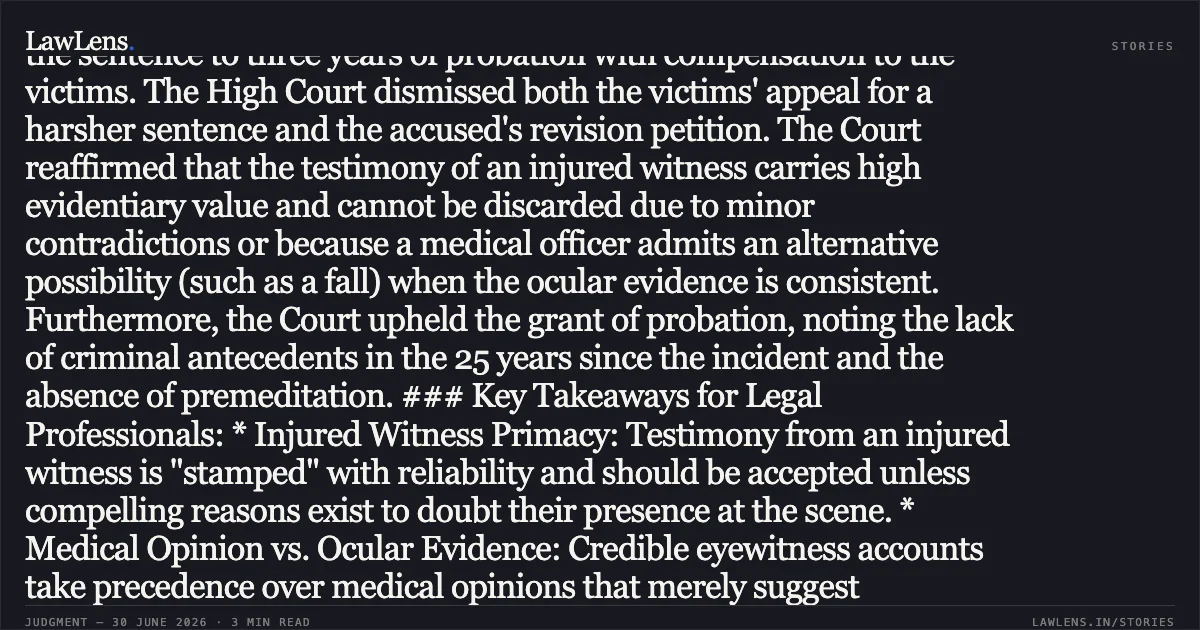
The High Court dismissed both the revision by the accused and the appeal by the victims.
Revisional courts cannot act as appellate courts to re-evaluate evidence unless findings are perverse.
Source reference: para 18, 20Minor contradictions and non-explanation of superficial injuries to the accused do not invalidate the testimony of stamped injured witnesses.
Source reference: para 39, 53The grant of probation was appropriate given the offenders' character and the long interval of good conduct since the offence.
Source reference: para 61The compensation of ₹25,000 to the informant and ₹5,000 to the mother was deemed adequate.
Source reference: para 62Acts & Sections Cited
20 provisions across 3 statutes referred to in this judgment. Each provision opens on LawLens.
Code of Criminal Procedure, 1973
Indian Penal Code, 18604
Original Court PDF
URMILA DEVIvsRAJESH KUMAR
Click to open original judgment
Original judgment, available to read, download and summarize on LawLens.in