Facts
The Appellant, an Operational Creditor of CAN Enterprises Pvt. Ltd., challenged the order dated 30.09.2025 passed by NCLT Ahmedabad.
Source reference: para. 1The impugned order approved a Resolution Plan submitted by Respondent No. 1 (SRA) for the Corporate Debtor, Afcan Impex Private Limited.
Source reference: para. 1The Appellant contended that Respondent No. 1 was statutorily ineligible under Section 29A of the IBC because he was a promoter/director of CAN Enterprises, a company already undergoing CIRP before NCLT Mumbai.
Source reference: para. 2, 4Respondent No. 1 had offered a 100% settlement of the Appellant’s claims in the CAN Enterprises matter, which the Appellant rejected.
Source reference: para. 4(vii), 25Crucially, the Appellant was not a creditor or stakeholder in the Afcan Impex CIRP and did not participate in the proceedings before the Adjudicating Authority.
Source reference: para. 20, 53By the time of the appeal, the Resolution Plan for Afcan Impex had been fully implemented, with all creditors paid.
Source reference: para. 31, 69Issues
1. Whether the Appellant has the locus standi to maintain the appeal as a "person aggrieved" under Section 61 of the IBC when they are not a stakeholder in the specific CIRP of the Corporate Debtor.
Source reference: para. 412. Whether Respondent No. 1 was ineligible under Section 29A(c) or (e) of the IBC due to his association with another company under CIRP.
Source reference: para. 41, 59Law Applied
Section 61 of the IBC, which restricts the right of appeal to a "person aggrieved".
Source reference: para. 49Supreme Court’s interpretation in GLAS Trust Company LLC v. BYJU Raveendran, establishing that a "person aggrieved" must be a stakeholder (creditor, applicant, etc.) in the specific collective proceedings (in rem).
Source reference: para. 51-52Section 29A(c) and (e) of the IBC.
Source reference: para. 58Section 164 of the Companies Act, 2013.
Source reference: para. 62The precedent in M.K. Rajagopalan v. Dr. Periasamy Palani Gounder, which held there is no "deemed disqualification" under Section 164; a formal declaration by the Registrar of Companies (RoC) is mandatory to trigger ineligibility under Section 29A(e).
Source reference: para. 65Reasoning
The Tribunal first determined that the Appellant lacked locus standi. Under Section 61, an appellant must demonstrate a direct legal injury; here, the Appellant was an Operational Creditor of a separate entity (CAN Enterprises) and held no claim or stake in Afcan Impex.
Source reference: para. 53-55The Tribunal noted that the Appellant's grievance was collateral and remote, rather than a direct outcome of the Afcan Impex resolution.
Source reference: para. 57On the merits of Section 29A, the Tribunal found that the mere pendency of CIRP against a related company does not trigger ineligibility under Section 29A(c) unless the account was classified as an NPA under RBI guidelines, for which no evidence was provided.
Source reference: para. 60-61Regarding Section 29A(e), the Tribunal held that Respondent No. 1 could not be "deemed" disqualified as a director; in the absence of a formal RoC order under Section 164 of the Companies Act, the resolution applicant remains eligible.
Source reference: para. 64-66Finally, the Tribunal observed that the Appellant's failure to participate below and the subsequent full implementation of the plan barred the challenge.
Source reference: para. 68-71Holding
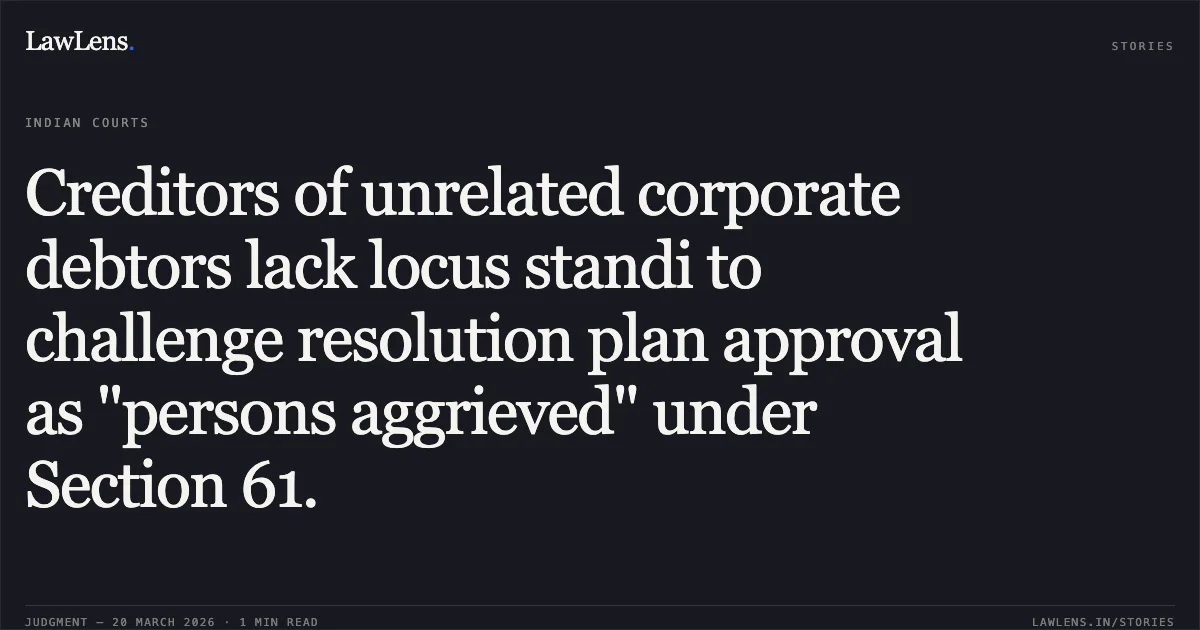
The Appellate Tribunal held that the Appellant was not a "person aggrieved" under Section 61 of the IBC and therefore lacked the locus to challenge the resolution plan of an unrelated corporate debtor.
It further held that Respondent No. 1 was not ineligible under Section 29A, as there was neither an NPA classification nor a formal disqualification order under the Companies Act.
Source reference: para. 61, 66Consequently, the appeal was dismissed, and the NCLT's approval of the Resolution Plan was upheld. No order was made as to costs.
Source reference: para. 73Acts & Sections Cited
14 provisions across 4 statutes referred to in this judgment. Each provision opens on LawLens.
Advocates Act, 19612
Companies Act, 20134
Maharashtra Value Added Tax Act, 2002.1
Insolvency and Bankruptcy Code, 2016.7
Original Court PDF
Malharshanti EnterprisesvsNaresh Sevantilal Shah & Ors.
Click to open original judgment
Original judgment, available to read, download and summarize on LawLens.in


