Facts
The petitioner, a practising Chartered Accountant and member of the Institute of Chartered Accountants of India, was accused of furnishing false and fabricated income-tax challans while representing an assessee before the Income Tax Department. The complaint was based, inter alia, on his statement recorded under Section 131 of the Income Tax Act, 1961.
Source reference: para. 3Following disciplinary proceedings, the competent authority recorded a finding of professional misconduct on 10 February 2023 and, after hearing the petitioner on the question of penalty, ordered removal of his name from the Register of Members for 15 days on 15 June 2023.
Source reference: paras. 6–8The petitioner appealed under Section 22G of the Chartered Accountants Act, 1949, contending, among other things, that the disciplinary proceedings violated Article 20(3), relied upon an uncorroborated statement, and should have been stayed pending the criminal proceedings.
Source reference: paras. 9–11The Appellate Authority dismissed the appeal on 3 June 2026, and a consequential notification directed removal of the petitioner’s name for 15 days with effect from 18 August 2026.
Source reference: paras. 13–14The petitioner challenged the appellate order and consequential notification under Article 226 of the Constitution.
Source reference: para. 2Issues
1. Whether the disciplinary and appellate authorities’ orders were liable to be quashed for violation of natural justice, non-application of mind, perversity, or failure to pass a speaking order.
Source reference: paras. 15–172. Whether the pendency and eventual outcome of the criminal proceedings required the disciplinary proceedings to be stayed or the finding of professional misconduct to be set aside.
Source reference: paras. 19–233. Whether the disciplinary finding could properly be sustained on the material relied upon, including the petitioner’s statement recorded under Section 131 of the Income Tax Act, 1961, in proceedings under Article 226.
Source reference: paras. 24–304. Whether the penalty of removal from the Register of Members for 15 days was so disproportionate as to warrant judicial interference.
Source reference: paras. 31–34Law Applied
The Court applied Article 226 of the Constitution, under which judicial review in disciplinary matters is ordinarily confined to the legality and fairness of the decision-making process, compliance with natural justice, and the existence of perversity, rather than reappreciation of evidence.
Source reference: paras. 24–30It considered the disciplinary and penalty framework under Sections 21 and 21A of the Chartered Accountants Act, 1949, including the requirement that the competent authority record a determinative finding of misconduct and afford the member an opportunity of hearing before imposing punishment.
Source reference: para. 27The Court relied on D.K. Agrawal v. Council of the Institute of Chartered Accountants of India, 2021 SCC OnLine SC 903, for the distinction between tentative conclusions and the final finding of misconduct, and the requirement of hearing at the penalty stage.
Source reference: para. 27It further relied on Lucknow Kshetriya Gramin Bank v. Rajendra Singh, (2013) 12 SCC 372, holding that the quantum of disciplinary punishment primarily falls within the disciplinary authority’s jurisdiction and may be interfered with only where the penalty is shocking to the conscience of the Court.
Source reference: para. 32The Court also applied the principle that criminal and disciplinary proceedings operate in distinct fields and that the result of one does not automatically govern the other.
Source reference: paras. 19–23Reasoning
The Court found that the petitioner had received the prima facie opinion and relevant material, filed a written statement and rejoinder, made further written submissions, and was heard separately on the question of penalty; therefore, no denial of natural justice or specific prejudice was established.
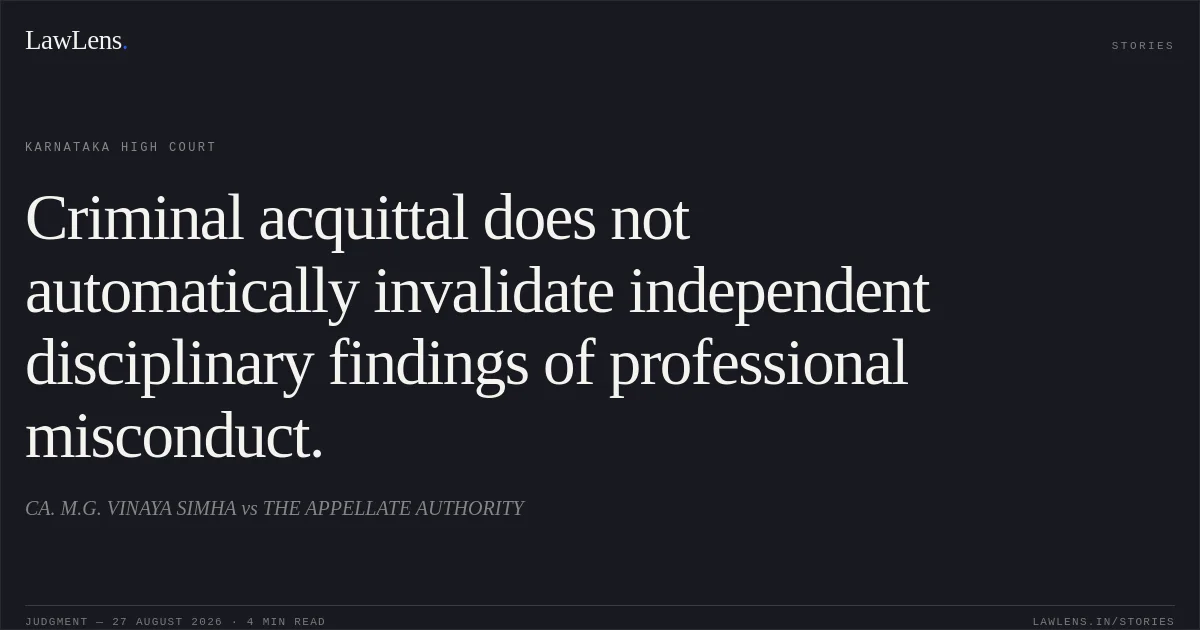
Source reference: paras. 21–22, 26The mere pendency, and eventual acquittal, in the criminal case did not invalidate the disciplinary proceedings because the latter concerned professional conduct under the Chartered Accountants Act, whereas the criminal case concerned penal liability.
Source reference: paras. 19–23The Court declined to reassess the evidentiary value of the Section 131 statement, observing that Article 226 does not permit the writ court to substitute its assessment for that of the disciplinary authority unless the finding is unsupported, perverse, or procedurally unlawful.
Source reference: paras. 24–30It also held that the appellate order’s failure to address every submission in the manner desired by the petitioner did not, without demonstrated prejudice or failure of decision-making, render it invalid.
Source reference: para. 28Given the seriousness of dishonesty-related misconduct by a Chartered Accountant, the 15-day removal was not shockingly disproportionate and was, if anything, relatively lenient.
Source reference: paras. 31–34Holding
The Court answered the issues against the petitioner. It held that the disciplinary and appellate proceedings were conducted in accordance with law, that the criminal proceedings did not require suspension or nullification of the disciplinary action, that no ground existed for reappreciation of the evidence, and that the punishment was not shockingly disproportionate.
The writ petition was accordingly dismissed, the Appellate Authority’s order dated 3 June 2026 and the consequential notification removing the petitioner’s name from the Register of Members for 15 days were upheld, and there was no order as to costs.
Source reference: p. 21Acts & Sections Cited
9 provisions across 2 statutes referred to in this judgment. Each provision opens on LawLens.
Chartered Accountants Act, 19491
Indian Penal Code, 18608
Original Court PDF
CA. M.G. VINAYA SIMHAvsTHE APPELLATE AUTHORITY
Click to open original judgment
Original judgment, available to read, download and summarize on LawLens.in
![Courts will not interfere with transfers absent mala fides or violation of statutory rules.. M Ramya vs EMPLOYEES STATE INSURANCE CORPORATION (ESIC). CAT - ['Chennai']. LawLens](/stories/thumbnails/courts-will-not-interfere-with-transfers-absent-mala-fides-or-violation-of-statutory-rules-a6845e9ca6f548fca284c51c8351957f.webp)
![Courts cannot direct one-time recruitment age relaxation absent authority in the governing rules or advertisement.. UT OF PUDUCHERRY vs M ANDAL. CAT - ['Chennai']. LawLens](/stories/thumbnails/courts-cannot-direct-one-time-recruitment-age-relaxation-absent-authority-in-the-governing-895d78fde47143e2a8ed0207c4b6a44f.webp)
![A review cannot correct an allegedly erroneous decision absent an error apparent on the record.. Ajit Kumar Jha vs RAILWAY BOARD. CAT - ['Delhi']. LawLens](/stories/thumbnails/a-review-cannot-correct-an-allegedly-erroneous-decision-absent-an-error-apparent-on-the-re-8ac952fd4eba470c92f7da20af72a220.webp)