Facts
On 14 October 2005, at approximately 1:20 a.m., a Hyundai Santro car, driven by the claimant’s husband, Nandan Shet, collided with a KSRTC bus on NH-48 near Kunigal, Karnataka. The claimant was travelling in the Santro and sustained grievous injuries; her husband, mother-in-law Geetha Shet, and family friend Mahesh died in the accident.
Source reference: para. 2The claimant filed separate claim petitions for the death of her husband, the death of her mother-in-law, and her own injuries.
Source reference: para. 3The Motor Accidents Claims Tribunal attributed the accident entirely to the negligent driving of the KSRTC bus driver. However, it denied compensation for loss of dependency arising from the husband’s death on the ground that the claimant was herself employed, awarding only ₹1,50,000 under consortium and funeral expenses.
Source reference: para. 7It awarded ₹1,50,000 for the mother-in-law’s death and ₹1,67,000 for the claimant’s injuries.
Source reference: para. 8The Karnataka High Court enhanced the compensation for the husband’s death to ₹14,35,267 but reduced it by 50% on account of alleged contributory negligence by the Santro driver. It also reduced the awards relating to the mother-in-law’s death and the claimant’s injuries.
Source reference: para. 8The claimant challenged the High Court’s findings on contributory negligence, quantum of compensation, and rejection of her application to produce additional evidence.
Source reference: paras. 10–11Issues
1. Whether the High Court was justified in attributing 50% contributory negligence to the deceased driver of the Santro car on the basis of the site sketch and other evidence?
Source reference: paras. 17–22.12. Whether the acquittal of the KSRTC bus driver in the criminal case displaced or weakened the finding of negligence in the motor accident claim proceedings?
Source reference: paras. 19–22.13. Whether the claimant’s application to produce additional documentary evidence ought to have been allowed for determining just compensation?
Source reference: paras. 23–254. Whether the compensation awarded for the death of the claimant’s husband was just and reasonable, particularly in relation to his income, future prospects, and loss to the estate?
Source reference: paras. 22–285. Whether the compensation awarded for the death of the claimant’s mother-in-law and for the claimant’s injuries should be payable exclusively by KSRTC?
Source reference: para. 29Law Applied
The Court applied Sections 166, 168 and 169 of the Motor Vehicles Act, 1988: motor accident claims are decided on the standard of preponderance of probabilities, Tribunals must award “just compensation,” and they may adopt a summary procedure.
Source reference: paras. 20(E), 24FIRs, police investigation records and charge-sheets possess prima facie evidentiary value in determining negligence, although they are not conclusive.
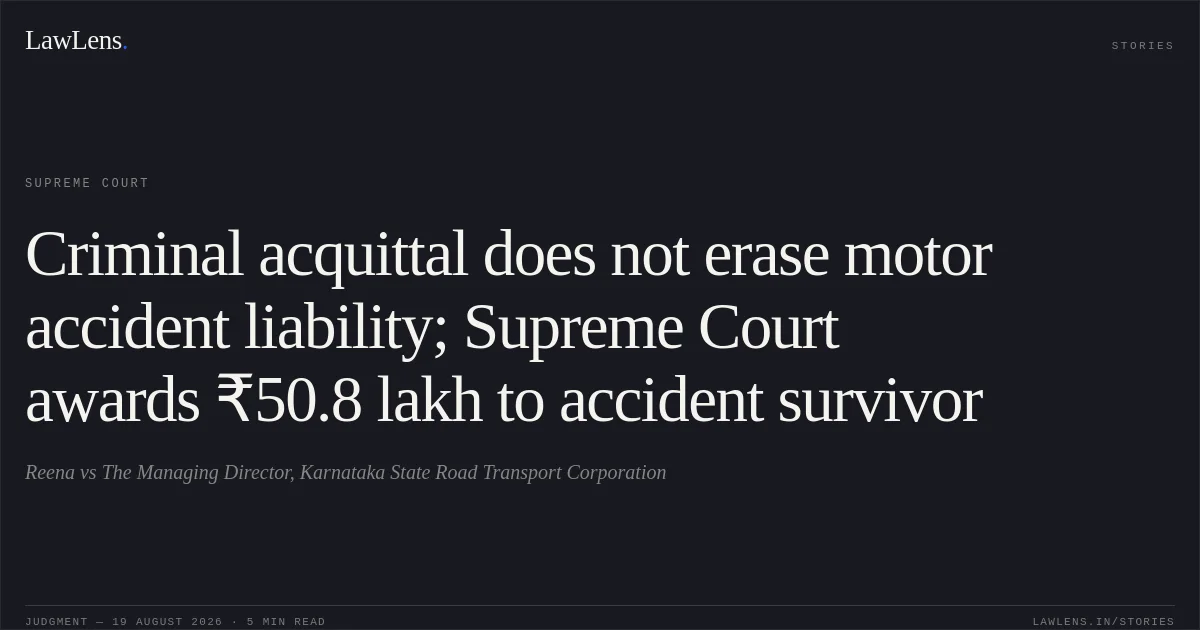
Source reference: paras. 20(A), 21(A)Criminal proceedings and motor accident claims operate in distinct legal fields; a criminal acquittal, particularly one based on benefit of doubt, does not determine civil or tortious liability.
Source reference: paras. 20(B), 21(B)A post-accident site sketch cannot, standing alone, establish contributory negligence against the driver of a smaller vehicle, because the vehicle may have been dragged or displaced by the collision.
Source reference: paras. 20(C)–(D), 21(C)The Court also applied Order XLI Rule 27(1)(b) of the Code of Civil Procedure, 1908, permitting additional evidence where necessary to enable the appellate court to pronounce judgment or for any other substantial cause.
Source reference: para. 24For quantification, the Court applied the multiplier method, future-prospects principles, and the permissible heads of compensation, including loss to estate, spousal consortium, and funeral and transportation expenses.
Source reference: para. 28Reasoning
The Court held that the High Court had wrongly treated the bus driver’s criminal acquittal and the Santro’s post-impact position in the site sketch as decisive. The acquittal was only on the benefit of doubt and could not control the civil claim.
Source reference: para. 22.1The FIR and charge-sheet were filed against the KSRTC bus driver, while the bus conductor’s statement supported the claimant’s version that the bus had been driven rashly and had dragged the Santro for 50–60 feet after impact.
Source reference: paras. 17(B), 18.1The bus driver’s evidence was found unreliable, and KSRTC’s failure to examine the conductor, who was an admitted eyewitness, weakened its defence.
Source reference: para. 22.1The Court therefore restored the Tribunal’s finding that the accident resulted from the bus driver’s negligence and rejected the finding of 50% contributory negligence against the deceased Santro driver.
Source reference: para. 22.1The Court further found that the additional documents were relevant to assessing the deceased’s actual earning capacity and that the claimant had provided a satisfactory explanation for the delay, including the trauma caused by the accident and difficulty in retrieving old bank records.
Source reference: paras. 23–25The evidence showed that the deceased possessed an engineering degree, software certifications, and had moved from salaried employment to independent IT work supported by invoices and purchase orders.
Source reference: paras. 26–27Nevertheless, the Court rejected the claimed income of ₹1,00,000–₹1,50,000 per month as unsubstantiated, while holding that the High Court’s notional income of ₹20,000 per month was too low. It fixed the deceased’s monthly income at ₹70,000, added 40% towards future prospects, deducted statutory taxes and one-third towards annual savings to the estate, and applied a multiplier of 17 for his age of 30 years.
Source reference: paras. 27–28Holding
The Court held that the accident was caused solely by the rash and negligent driving of the KSRTC bus driver; no contributory negligence could be attributed to the deceased Santro driver.
The claimant’s additional-evidence application was allowed, and the compensation for her husband’s death was recalculated at ₹50,81,876, comprising ₹50,10,376 for substantive loss to the estate, ₹52,000 for spousal consortium, and ₹19,500 for funeral and transportation expenses.
Source reference: para. 28The amount was directed to carry interest at 6% per annum from the date of filing of the claim petition until realization.
Source reference: para. 30The compensation awarded in respect of the mother-in-law’s death and the claimant’s injuries was confirmed, but liability was modified so that the amounts were payable exclusively by KSRTC.
Source reference: para. 29Civil Appeal Nos. 10755 and 10758 of 2026 were allowed, while Civil Appeal Nos. 10756 and 10757 of 2026 were disposed of with the above modification; no order as to costs was made.
Source reference: paras. 29–31Acts & Sections Cited
6 provisions across 2 statutes referred to in this judgment. Each provision opens on LawLens.
Code of Criminal Procedure, 19732
Motor Vehicles Act, 19884
Original Court PDF
ReenavsThe Managing Director, Karnataka State Road Transport Corporation
Click to open original judgment
Original judgment, available to read, download and summarize on LawLens.in