Facts
T.N. Laxmana, then a Revenue Inspector, was accused of demanding and accepting a ₹5,000 bribe in March 1999.
Source reference: para. 4–7, 15Following a trap, a departmental inquiry found the charge proved, and the Government ordered permanent withholding of 50% of his pension.
Source reference: para. 4–7, 15The Karnataka State Administrative Tribunal (KAT) reduced the penalty to 25%, citing his previous conduct.
Source reference: para. 4–7, 15Laxmana challenged the finding of misconduct, relying on his acquittal in the criminal case; the Karnataka Lokayukta separately challenged the reduction in penalty.
Source reference: para. 4–7, 15The High Court considered both petitions together.
Source reference: para. 4–7, 15Issues
Whether Laxmana’s acquittal in the criminal proceedings required the departmental finding of misconduct to be set aside.
Source reference: para. 8–14Whether the KAT was justified in reducing the permanent pension withholding from 50% to 25%, and whether that modification warranted interference.
Source reference: para. 7, 11, 15Law Applied
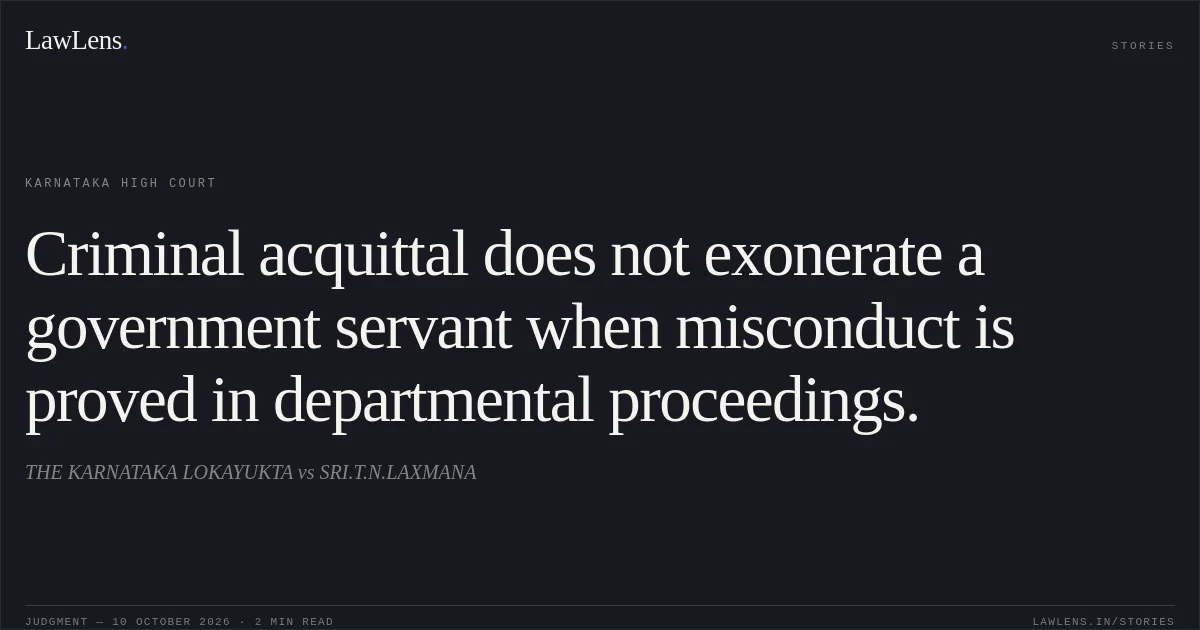
Criminal proceedings require proof beyond reasonable doubt, whereas departmental inquiries determine misconduct on the preponderance of probabilities; therefore, acquittal does not, by itself, exonerate a public servant in disciplinary proceedings.
Source reference: para. 11However, under Ram Lal v. State of Rajasthan, (2024) 1 SCC 175, a court reviewing disciplinary action must examine the substance of the criminal judgment: where the criminal court’s findings establish that an identical charge is disproved on the same evidence, disciplinary findings may not be allowed to stand.
Source reference: para. 9, 13–14The High Court’s review of the Tribunal’s order was exercised under Articles 226 and 227 of the Constitution, as invoked in the petitions.
Source reference: no citationReasoning
The High Court distinguished Ram Lal because the departmental evidence here supported the charge: the complainant, panch witness and investigating officer testified in the inquiry, and Laxmana had not shown through cross-examination that their accounts were false.
Source reference: para. 12–14The criminal acquittal alone therefore did not displace the inquiry’s findings, which the Court considered supported by cogent and convincing evidence.
Source reference: para. 12–14On penalty, the KAT had reduced the withholding after considering the absence of earlier misconduct; the High Court found no ground to interfere with that assessment.
Source reference: para. 15Holding
The Court held that the criminal acquittal did not entitle Laxmana to exoneration from the departmental charge and declined to disturb the KAT’s reduction of the penalty to permanent withholding of 25% of his pension.
Both writ petitions were dismissed.
Source reference: para. 15Original Court PDF
THE KARNATAKA LOKAYUKTAvsSRI.T.N.LAXMANA
Click to open original judgment
Original judgment, available to read, download and summarize on LawLens.in