Facts
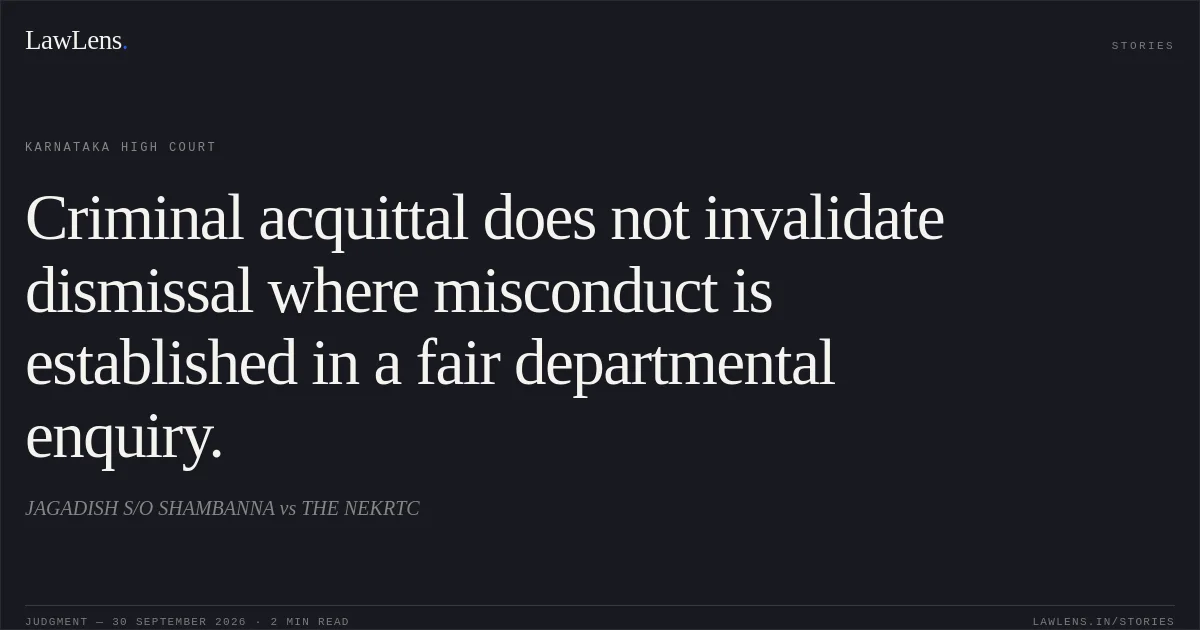
Jagadish, a trainee driver in the NEKRTC’s probationary period, was dismissed after a disciplinary enquiry concerning a fatal accident allegedly caused by his rash and negligent driving.
Source reference: para. 1The Labour Court held the domestic enquiry fair and proper but, noting his acquittal in the criminal case, set aside the dismissal and ordered reinstatement with continuity of service but without back wages.
Source reference: paras. 3–5The Corporation challenged the award; Jagadish separately sought back wages.
Source reference: paras. 7–8The Corporation also relied on a notice referring to two earlier similar incidents, which Jagadish had admitted, and submitted that he had not joined duty despite notices issued after the award.
Source reference: paras. 15–16, 20Issues
Whether the Labour Court was justified in setting aside the dismissal after finding the domestic enquiry fair and proper, particularly by relying on the workman’s acquittal in the criminal proceedings.
Source reference: paras. 6, 17–19Whether the workman was entitled to back wages, given the Labour Court’s reinstatement order and his subsequent failure to report for duty.
Source reference: paras. 2, 12, 20–21Law Applied
Under Section 10(4-A) of the Industrial Disputes Act, the workman pursued a claim before the Labour Court.
Source reference: para. 5The Court applied the principle stated in Maharashtra State Road Transport v. Dilip Uttam Jayabhay, (2022) 2 SCC 696: acquittal in a criminal trial does not determine the outcome of disciplinary proceedings, because the proceedings serve different purposes and apply different standards of proof; an acquittal for failure to prove guilt beyond reasonable doubt does not, by itself, negate misconduct established in a departmental enquiry.
Source reference: para. 18The Court also relied on the principle that disciplinary punishment must be assessed in light of the misconduct and the employee’s service record, and that a workman cannot obtain relief by taking advantage of his own failure to comply with an order to rejoin duty.
Source reference: paras. 18–21Reasoning
The Court held that the Labour Court had no sufficient basis to interfere with the disciplinary outcome merely because the workman had been acquitted criminally, particularly where the enquiry had been found fair and proper.
Source reference: paras. 6, 17–19The workman was in probation and had admitted involvement in two earlier similar incidents; the Court considered the present incident alongside that record in finding no justifiable reason for the Labour Court’s intervention.
Source reference: paras. 14–16, 19As to back wages, the workman had not rejoined despite notices and, through counsel, indicated that he did not intend to do so.
Source reference: paras. 20–21The Court found that his affidavit asserting unemployment did not warrant back wages in those circumstances.
Source reference: paras. 20–21Holding
The Court allowed the Corporation’s petition, quashed the Labour Court’s award dated 11 November 2010, and dismissed the workman’s petition seeking back wages.
Acts & Sections Cited
1 provisions across 1 statute referred to in this judgment. Linked provisions open on LawLens.
Industrial Disputes Act, 19471
Original Court PDF
JAGADISH S/O SHAMBANNAvsTHE NEKRTC
Click to open original judgment
Original judgment, available to read, download and summarize on LawLens.in