Facts
The petitioner, a Constable in the U.P. Police, was assigned to Sadar Lockup duty on December 14, 2011
Source reference: para. 2While on duty, he allegedly consumed alcohol, leading to an accidental discharge of his service rifle that injured two civilians
Source reference: para. 2, 4A criminal case (Case Crime No. 318 of 2011) was registered under Section 307 IPC (later tried under Sections 286 and 338 IPC), and simultaneous departmental proceedings were initiated under Rule 14(1) of the U.P. Police Officers of the Subordinate Ranks (Punishment and Appeal) Rules, 1991
Source reference: para. 2, 5, 7The petitioner failed to participate in the departmental inquiry despite multiple notices, leading to ex-parte proceedings
Source reference: para. 4, 6The inquiry report, which included a medical exam confirming intoxication, found him guilty and recommended removal from service
Source reference: para. 5The Disciplinary Authority ordered his removal on August 19, 2013, a decision subsequently upheld by the Appellate and Revisional Authorities
Source reference: para. 6Meanwhile, the petitioner was acquitted in the criminal trial after prosecution witnesses turned hostile
Source reference: para. 7, 28He challenged the removal, citing his acquittal and procedural irregularities in the inquiry report
Source reference: para. 7, 9Issues
1. Whether an acquittal in a criminal trial on identical charges automatically entitles a delinquent employee to reinstatement in service.
Source reference: para. 14, 272. Whether the inclusion of a punishment recommendation within the inquiry report itself, rather than separately, vitiates the entire disciplinary proceeding.
Source reference: para. 9, 13Law Applied
Rule 14(1) and Appendix 1 of the U.P. Police Officers of the Subordinate Ranks (Punishment and Appeal) Rules, 1991
Source reference: para. 2, 13departmental and criminal proceedings operate in different spheres with distinct standards of proof—preponderance of probabilities versus proof beyond reasonable doubt
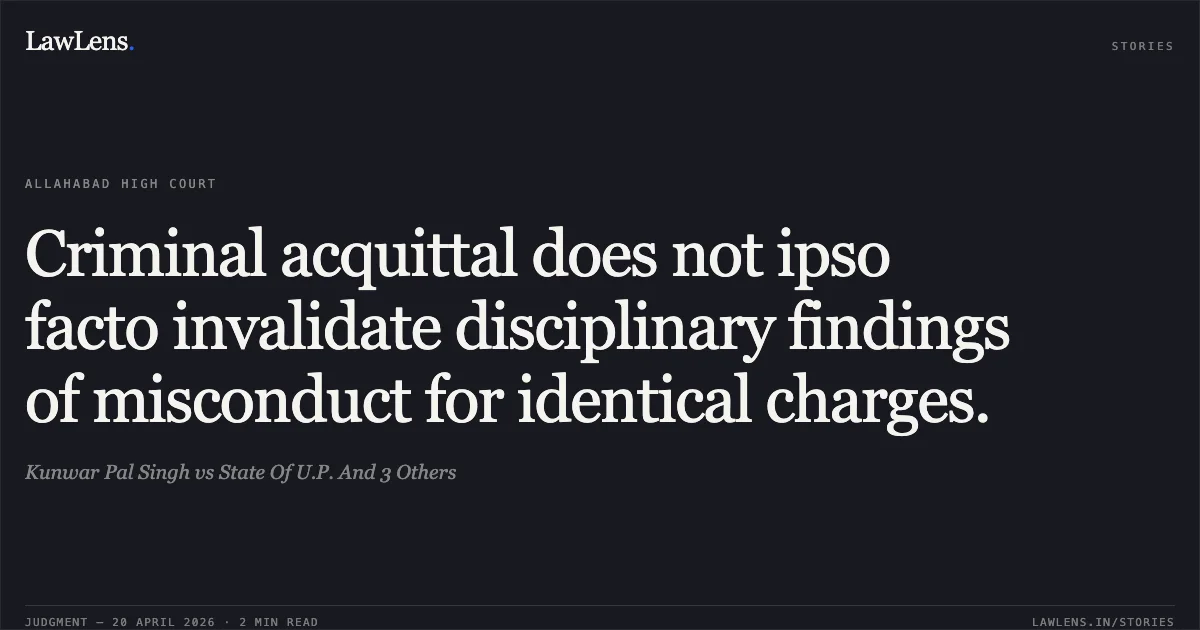
Source reference: para. 15, 18, 19acquittal in a criminal case does not ipso facto vacate a disciplinary finding of misconduct unless the acquittal is "honorable" and based on the same evidence/witnesses who supported the charge in the inquiry
Source reference: para. 11, 21, 23, 27Reasoning
The court reasoned that criminal trials and disciplinary proceedings have different objectives: one to punish an offender and the other to maintain departmental discipline
Source reference: para. 14, 19Regarding the inquiry report, the court held that while Appendix 1 suggests recommendations for punishment should ideally be made separately for administrative caution, their inclusion in the report does not vitiate the findings if the guilt is established by cogent evidence
Source reference: para. 13On the issue of acquittal, the court scrutinized the trial court's judgment and found it was not a "clean" or "honorable" acquittal; rather, the petitioner was given the "benefit of doubt" because injured witnesses turned hostile
Source reference: para. 28, 30Conversely, the departmental inquiry relied on a medical report and witness statements that conclusively proved intoxication while on duty—a standard of proof (preponderance of probabilities) sufficient for a finding of misconduct
Source reference: para. 29The court emphasized that the standard of "negligence in handling a weapon" in service is distinct from criminal liability
Source reference: para. 18Holding
The Court dismissed the writ petition, holding that the petitioner’s acquittal based on hostile witnesses did not override the well-supported findings of misconduct in the disciplinary proceedings
The court concluded that there was no illegality in the ex-parte inquiry as the petitioner was afforded sufficient opportunity to defend himself but failed to do so
Source reference: para. 10, 12The orders passed by the Disciplinary, Appellate, and Revisional Authorities were upheld
Source reference: para. 30Acts & Sections Cited
5 provisions across 2 statutes referred to in this judgment. Each provision opens on LawLens.
Indian Penal Code, 18604
Prevention of Corruption Act, 19881
Original Court PDF
Kunwar Pal SinghvsState Of U.P. And 3 Others
Click to open original judgment
Original judgment, available to read, download and summarize on LawLens.in