Facts
The petitioner, a Head Constable in the 8th Battalion of the Special Police Force, Chhindwara, was served a chargesheet on June 25, 2011, containing three charges: unauthorized absence from duty, failure to deposit government firearms and ammunition (displaying doubtful conduct), and habitual negligence
Source reference: para. 2, 7Following a departmental enquiry, the petitioner was dismissed from service on January 31, 2012
Source reference: para. 2His subsequent appeals and mercy petition were rejected
Source reference: para. 2Parallel to the departmental proceedings, the petitioner was prosecuted under Section 409 of the IPC regarding the firearm; however, he was acquitted by the Sessions Court on March 30, 2015
Source reference: para. 2Based on this acquittal, the petitioner sought reinstatement, which the respondent authority rejected on June 9, 2015
Source reference: para. 2The petitioner challenged this rejection, contending that the departmental and criminal proceedings were based on the same facts and that the enquiry was conducted ex-parte
Source reference: para. 3Issues
1. Whether the acquittal of an employee in a criminal trial entitles them to an automatic reinstatement in service when a departmental enquiry on similar facts resulted in dismissal
Source reference: para. 8, 112. Whether the departmental proceedings were vitiated by a lack of opportunity for hearing or procedural irregularities
Source reference: para. 3, 93. Whether the High Court can reappreciate evidence in a departmental enquiry under its writ jurisdiction
Source reference: para. 12Law Applied
The court applied the principle that departmental and criminal proceedings can proceed simultaneously as they operate in different fields with distinct standards of proof: a criminal case requires proof "beyond reasonable doubt," whereas a domestic enquiry requires a "preponderance of probabilities"
Source reference: para. 10Relying on Management of Bharat Heavy Electricals Limited v. M. Mani (2018) and Karnataka SRTC v. M.G. Vittal Rao (2012), the court affirmed that an independent departmental enquiry remains valid despite a subsequent criminal acquittal, unless the dismissal was based solely on a conviction that was later set aside
Source reference: para. 10, 11Reasoning
The court observed that the charges in the departmental enquiry—specifically willful absenteeism and habitual negligence (Charges 1 and 3)—were distinct from the criminal charge under Section 409 IPC
Source reference: para. 8, 11Consequently, the acquittal regarding the firearm did not exonerate the petitioner from the other counts of misconduct
Source reference: para. 11Furthermore, the court noted that the petitioner had admitted the charges during the enquiry, and his later claim that the admission was coerced was deemed an "afterthought" as it was absent from his previous appeals
Source reference: para. 9Regarding the firearm, the court highlighted that while the criminal court found no "dishonest intention" for misappropriation, the fact that the weapon was lost due to "negligence" remained relevant for disciplinary purposes
Source reference: para. 12The court emphasized that the scope of judicial interference under Article 226 is limited and does not allow for the reappreciation of evidence when the disciplinary authority reached an independent conclusion
Source reference: para. 4, 12Holding
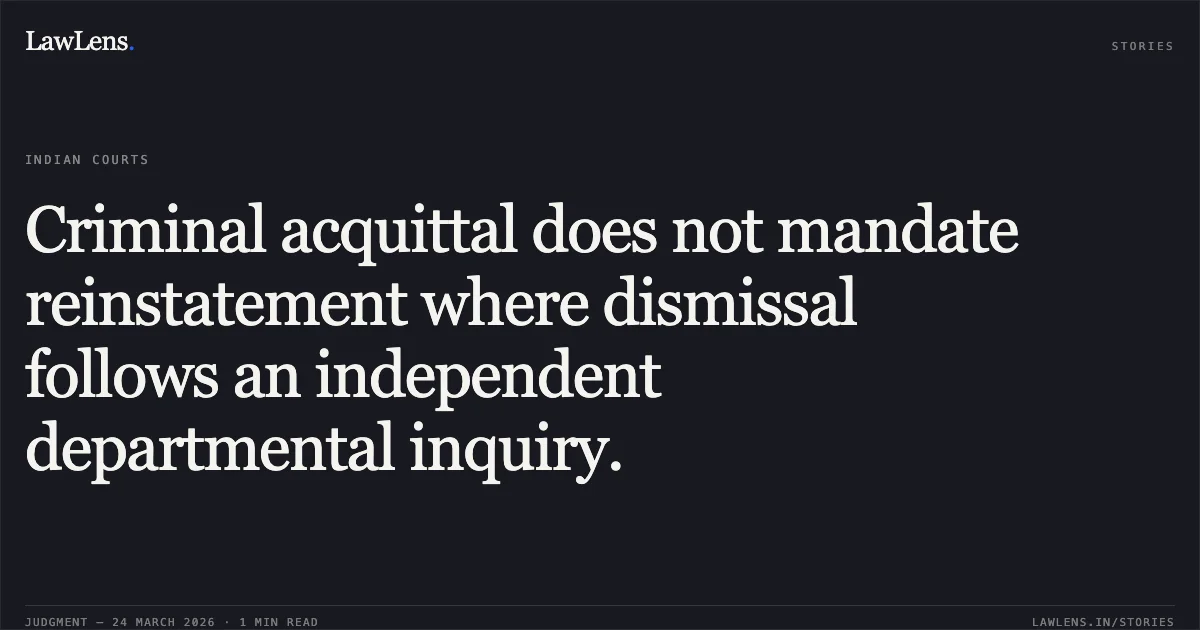
The court held that the petitioner’s acquittal in the criminal trial did not mandate reinstatement because the departmental proceedings were independent, concluded prior to the trial, and involved additional charges of misconduct not addressed by the criminal court
The court found no merit in the petitioner's claim of procedural unfairness given his prior admission of the charges
Source reference: para. 9Accordingly, the High Court dismissed the writ petition, upholding the impugned order of the respondent authority
Source reference: para. 13Acts & Sections Cited
3 provisions across 2 statutes referred to in this judgment. Each provision opens on LawLens.
Indian Penal Code, 18601
M.P. Vishesh Sashastra Bal Adhiniyam, 19682
Original Court PDF
Rajendra MarraphevsThe State Of Madhya Pradesh
Click to open original judgment
Original judgment, available to read, download and summarize on LawLens.in