Facts
The petitioner, a Constable (Driver) appointed in 2015, faced departmental proceedings arising primarily from allegations that he and others assaulted and abducted Surendra Singh, corresponding to Crime No. 200/2015 under Sections 365, 452, 323, 294 and 34 of the IPC.
Source reference: para. 2The departmental charge-sheet contained two charges: misconduct involving assault and conduct bringing disrepute to the police force, and independent misconduct involving false medical information, unauthorized absence, dereliction of duty and disobedience of orders.
Source reference: para. 7Following the inquiry, the disciplinary authority removed the petitioner from service on 30 October 2017, and the appellate authority dismissed his appeal on 20 April 2018.
Source reference: paras. 2–3The petitioner was subsequently acquitted in the connected criminal case by judgment dated 11 June 2024, principally by extending the benefit of doubt.
Source reference: para. 3In a previous writ petition, the High Court directed the respondents to consider his representation; the representation was rejected on 7 January 2025.
Source reference: para. 3The petitioner therefore sought quashing of the removal, appellate and representation-rejection orders, and reinstatement.
Source reference: paras. 2–3He alleged denial of natural justice, non-compliance with Regulation 226 of the Police Regulations, and disproportionate punishment.
Source reference: paras. 2–3The State contended that the departmental inquiry was fair, Charge No. 2 was independent of the criminal case, and the criminal acquittal did not invalidate the completed disciplinary proceedings.
Source reference: paras. 4–5Issues
1. Whether the departmental inquiry and consequential orders were vitiated by violation of natural justice or the applicable statutory procedure, including the alleged failure to permit cross-examination after the change of Inquiry Officer?
Source reference: paras. 2, 4, 12–132. Whether the petitioner’s subsequent criminal acquittal on the same or substantially similar allegations entitled him to quashing of the departmental punishment and reinstatement?
Source reference: paras. 3–5, 163. Whether the punishment of removal from service was so disproportionate as to warrant interference under Article 226 of the Constitution?
Source reference: paras. 3, 13–16Law Applied
The Court applied the settled principle that judicial review of disciplinary proceedings under Article 226 is limited to the decision-making process and does not confer appellate jurisdiction to reappreciate evidence or reassess the adequacy or reliability of evidence.
Source reference: paras. 9–15Relying on State of Karnataka v. N. Gangraj, (2020) 3 SCC 423; State of A.P. v. S. Sree Rama Rao, AIR 1963 SC 1723; B.C. Chaturvedi v. Union of India, (1995) 6 SCC 749; High Court of Bombay v. Shashikant S. Patil, (2000) 1 SCC 416; State Bank of Bikaner & Jaipur v. Nemi Chand Nalwaya, (2011) 4 SCC 584; and Union of India v. P. Gunasekaran, (2015) 2 SCC 610, the Court held that interference is permissible only where there is violation of natural justice or statutory rules, absence of evidence, perversity, arbitrariness, mala fides, or a conclusion that no reasonable person could reach.
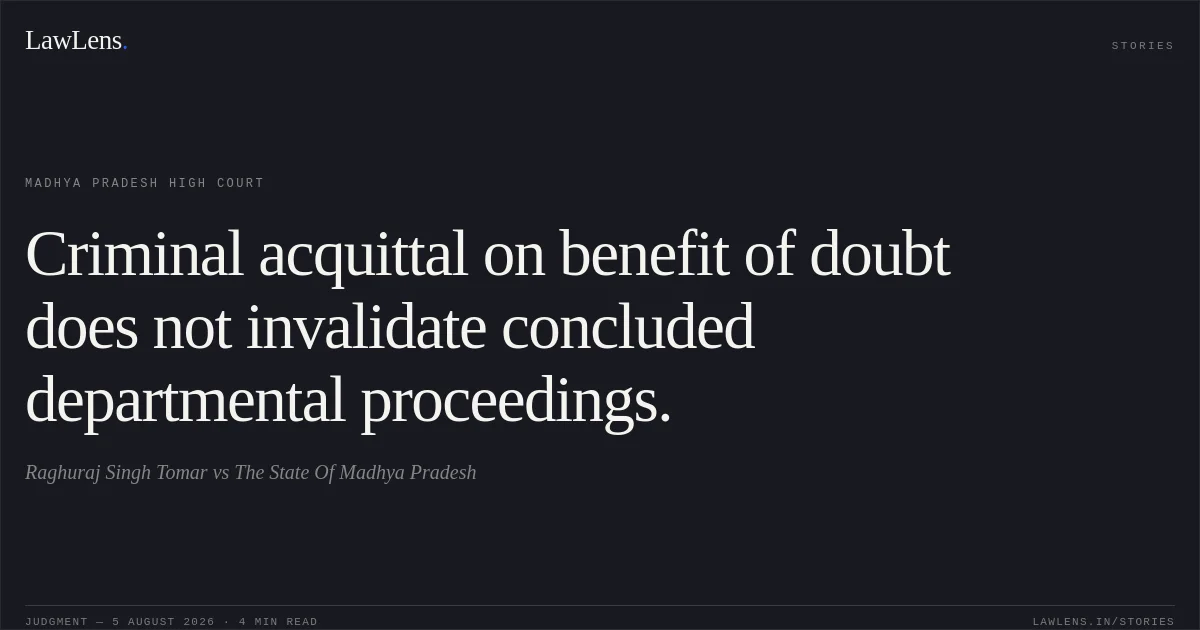
Source reference: paras. 10–13A departmental inquiry requires proof on the preponderance of probabilities, not proof beyond reasonable doubt, and a criminal acquittal, particularly one based on benefit of doubt, does not invalidate a previously concluded disciplinary proceeding.
Source reference: paras. 10–11The Court also applied the principle that punishment cannot ordinarily be reviewed unless it is mala fide or shockingly disproportionate to the proved misconduct.
Source reference: paras. 13–16The charges were framed with reference to Police Regulations, including Paragraph 64, and Rule 3 of the Madhya Pradesh Civil Services (Conduct) Rules, 1965.
Source reference: para. 7Reasoning
The Court found that the departmental inquiry had been conducted by the competent authority with adequate opportunity to the petitioner, who participated, submitted his defence and examined witnesses; no violation of natural justice or statutory procedure was established.
Source reference: para. 12The inquiry findings were based on evidence and had been accepted by both the disciplinary and appellate authorities through reasoned orders.
Source reference: paras. 12, 16The Court further noted that Charge No. 2 was independent of the criminal allegations and had independently been found proved.
Source reference: para. 8The subsequent criminal acquittal did not assist the petitioner because the criminal court applied the standard of proof beyond reasonable doubt and granted benefit of doubt, whereas the departmental inquiry operated on the preponderance-of-probabilities standard.
Source reference: paras. 8, 16Since the High Court could not reappreciate the evidence or substitute its view on the merits of the charges, and no perversity, absence of evidence, statutory violation or manifestly disproportionate punishment was shown, interference under Article 226 was unwarranted.
Source reference: paras. 13–16Holding
The Court answered the issues against the petitioner. It held that the departmental inquiry was lawful and consistent with natural justice, that the criminal acquittal by benefit of doubt did not nullify the concluded disciplinary proceedings, and that the removal penalty did not warrant judicial interference.
The writ petition was accordingly dismissed, and no order as to costs was made.
Source reference: para. 17Acts & Sections Cited
5 provisions across 1 statute referred to in this judgment. Each provision opens on LawLens.
Indian Penal Code, 18605
Original Court PDF
Raghuraj Singh TomarvsThe State Of Madhya Pradesh
Click to open original judgment
Original judgment, available to read, download and summarize on LawLens.in