Facts
The respondent, a Delhi Police officer, faced criminal proceedings arising from FIR No. 435/2008, registered under Sections 420, 468, 471 and 466 of the erstwhile IPC, concerning allegations that he had submitted false medical bills for reimbursement.
Source reference: paras. 4–6Disciplinary proceedings on the same allegations were initiated on 18 November 2009, culminating in his dismissal from service by order dated 17 August 2012; his departmental appeal was dismissed on 3 June 2025.
Source reference: para. 7During the pendency of these proceedings, the respondent was acquitted by the Judicial Magistrate First Class, Shahdara. The Criminal Court found material contradictions, non-seizure and non-examination of relevant evidence, absence of expert opinion, and failure of the prosecution to prove the charges beyond reasonable doubt.
Source reference: pp. 2–5; paras. 8, 12–17The respondent’s earlier challenge before the Central Administrative Tribunal was initially dismissed, but the dismissal was subsequently recalled, and the Tribunal directed the authorities to reconsider the matter in light of Rule 12 of the Delhi Police (Punishment and Appeal) Rules, 1980 (“DPPAR”).
Source reference: pp. 5–6; paras. 9–11The Deputy Commissioner of Police nevertheless sustained the dismissal on 3 June 2025.
Source reference: para. 12In OA 2404/2025, the Tribunal set aside the dismissal, holding that Rule 12 prohibited departmental proceedings on the same charge after acquittal unless one of its specified exceptions applied.
Source reference: para. 13–15The Delhi Police challenged that decision before the High Court.
Source reference: no citationIssues
1. Whether, in view of the respondent’s acquittal in the criminal proceedings on the same allegations, his dismissal could be sustained under Rule 12 of the DPPAR.
Source reference: paras. 14–15, 192. Whether the respondent’s acquittal was an acquittal “on technical grounds” falling within the exception under Rule 12(a) of the DPPAR.
Source reference: paras. 20–223. Whether the Tribunal was justified in interfering with the departmental punishment after the disciplinary authorities had found the charges proved.
Source reference: paras. 18–19, 23Law Applied
The Court primarily applied Rule 12 of the Delhi Police (Punishment and Appeal) Rules, 1980, which creates a general prohibition against proceeding departmentally against a Delhi Police officer on charges for which the officer has been acquitted in criminal proceedings, except in the five circumstances specified in clauses (a) to (e).
Source reference: para. 19Rule 12(a) recognises an exception where the acquittal is on technical grounds.
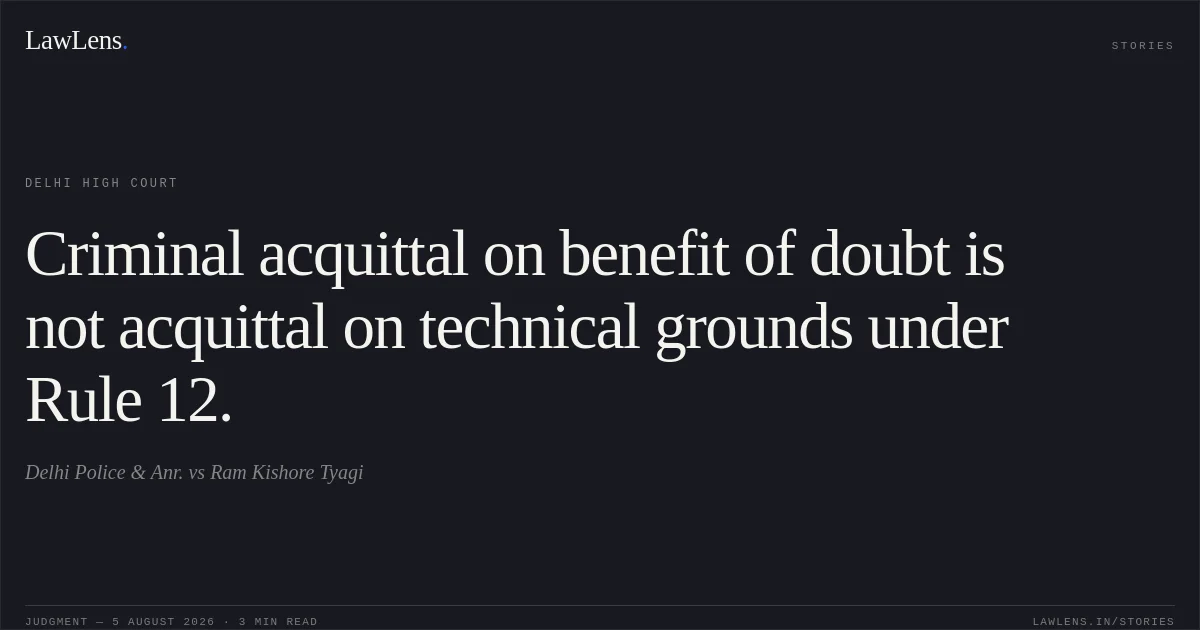
Source reference: paras. 20–21Relying on GNCTD v. Satyapal Singh Yadav , 2025 SCC OnLine Del 452, and Delhi Police v. Krishan Kumar , 2024 SCC OnLine Del 8862, the Court held that an acquittal based on benefit of doubt or failure of the prosecution to prove the charge is not automatically an acquittal on technical grounds; the criminal judgment must be examined holistically.
Source reference: para. 21The Court also relied on the principle stated in Ram Lal v. State of Rajasthan , (2024) 1 SCC 175, that courts should not be governed merely by the expression “benefit of doubt” in the operative portion of an acquittal order.
Source reference: para. 21Reasoning
Rule 12 imposed a statutory bar on departmental action for the same charges unless the case came within one of clauses (a) to (e), and the Court found that none of those exceptions applied.
Source reference: para. 19The prosecution had failed substantively to establish the alleged forgery and cheating: the original bills were not properly seized, relevant witnesses and hospital officials were not examined, no expert opinion was obtained, the electronic evidence was inconclusive, and the prosecution witnesses gave materially inconsistent accounts.
Source reference: pp. 2–5; para. 8These findings demonstrated that the acquittal was not merely attributable to a procedural or technical defect, but resulted from the prosecution’s failure to prove the respondent’s guilt beyond reasonable doubt.
Source reference: no citationApplying Krishan Kumar , the Court held that such an acquittal was not an acquittal “on technical grounds” under Rule 12(a).
Source reference: paras. 20–22The disciplinary authority’s independent finding that the charge was proved could not override the express statutory prohibition in Rule 12.
Source reference: para. 19Holding
The Court answered the issues against the Delhi Police.
It held that the respondent’s acquittal did not fall within the “technical grounds” exception under Rule 12(a), and that the dismissal based on the same allegations could not be sustained under Rule 12 of the DPPAR.
Source reference: paras. 19–22Finding no ground to interfere with the Tribunal’s judgment, the High Court upheld the setting aside of the dismissal and dismissed the writ petition.
Source reference: paras. 23–24Original Court PDF
Delhi Police & Anr.vsRam Kishore Tyagi
Click to open original judgment
Original judgment, available to read, download and summarize on LawLens.in