Facts
The petitioner sought pre-arrest bail in G.R. Case No. 490 of 2026 arising from Paradeep P.S. Case No. 147 of 2026.
Source reference: p.3The FIR alleged that three unknown persons arrived on a red motorcycle and threw three bottle bombs at the house of Basant Biswal, Chairman of Paradeep Municipality; two bombs exploded, causing smoke, while the complainant’s wife was inside offering evening prayers.
Source reference: p.3The case was initially registered under Sections 3 and 4 of the Explosive Substances Act, 1908, and Sections 288 and 3(5) of the BNS, and was subsequently altered to include Sections 61(2), 109(1), 326(g), 351(3) and 3(5) of the BNS.
Source reference: pp.2–4The prosecution alleged that the petitioner had commissioned the attack, relying principally on statements of co-accused persons and other witnesses concerning the motorcycle and attempted procurement of petrol.
Source reference: pp.5–6The petitioner denied involvement, alleged political vendetta, and contended that he was not one of the persons who threw the bombs.
Source reference: pp.4–5, 12–14Although the petitioner had several criminal antecedents, the record showed acquittals in most cases and no alleged involvement in any offence between 2018 and 2026.
Source reference: pp.7–10, 13–14Issues
1. Whether the petitioner was entitled to pre-arrest bail where the allegation against him concerned conspiracy and was principally founded on statements of co-accused persons, rather than direct attribution of the bomb attack.
Source reference: pp.12–13, para.162. Whether the petitioner’s criminal antecedents and the prosecution’s plea for custodial interrogation justified refusal of anticipatory bail.
Source reference: pp.10–14, paras.11–183. Whether custodial interrogation was necessary for a free and fair investigation in the facts of the case.
Source reference: pp.13–14, paras.17–18Law Applied
The Court applied Sections 3 and 4 of the Explosive Substances Act, 1908, concerning causing or attempting to cause an explosion likely to endanger life or property, along with the relevant provisions of the BNS, including Sections 61(2) on criminal conspiracy, 109(1) on attempt to murder, 326(g) on mischief by fire or explosive substance, 351(3) on aggravated criminal intimidation, 288 on negligent conduct involving explosive substances, and Section 3(5) on common intention.
Source reference: pp.2–4It held that anticipatory bail is a form of post-arrest bail and that the principles governing ordinary bail are relevant to pre-arrest bail: Satender Kumar Antil v. CBI.
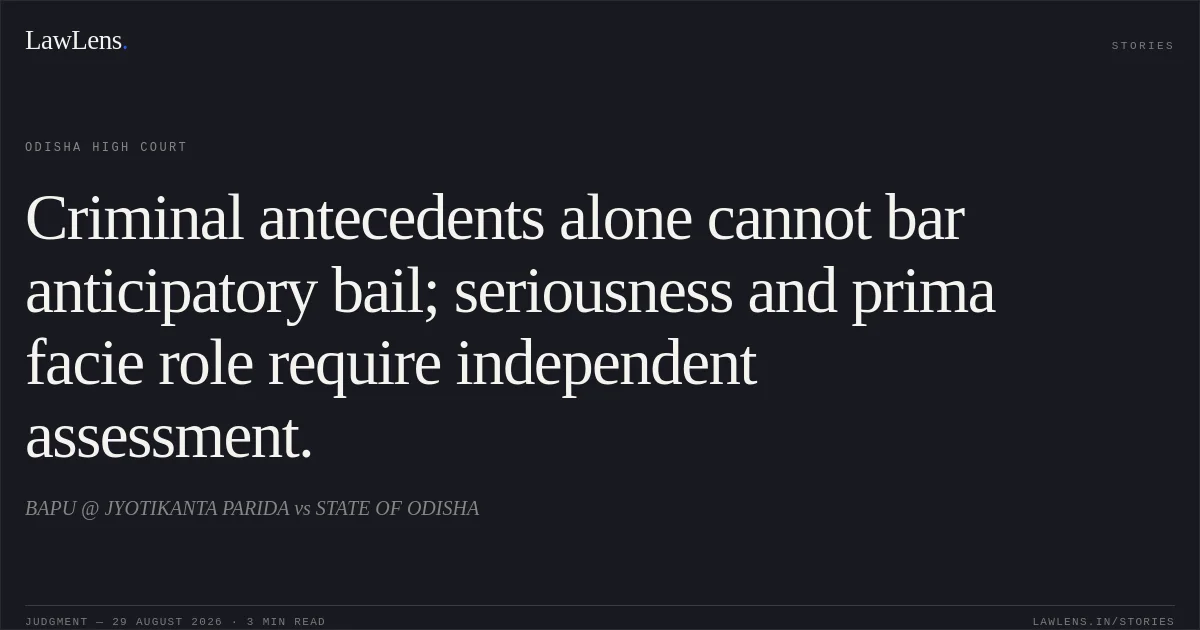
Source reference: p.11, para.13Criminal antecedents must be considered but cannot, by themselves, bar anticipatory bail; the seriousness of the offence, severity of punishment, and prima facie role of the accused must be independently assessed: Ankit Mishra v. State of Madhya Pradesh.
Source reference: p.11, para.14The Court also recognised that a co-accused’s statement may be considered during investigation, but it must be balanced against the presumption of innocence and the accused’s constitutional protection of personal liberty under Article 21: Kalyan Chandra Sarkar v. Rajesh Ranjan.
Source reference: pp.12–13, para.16The distinction between custodial interrogation with and without protective bail was noted from State v. Anil Sharma, but found inapplicable on the facts.
Source reference: p.13, para.17Reasoning
The Court found that the prosecution did not allege that the petitioner was one of the motorcyclists who physically threw the bottle bombs.
Source reference: pp.12–13, para.16His alleged involvement was limited to conspiracy, and the principal material relied upon consisted of statements made by co-accused persons in custody.
Source reference: pp.12–13, para.16Although such statements could be considered at the investigative stage, they did not, in the circumstances, outweigh the petitioner’s claim to personal liberty, particularly when the petitioner’s prior cases had largely ended in acquittal and there had been no allegation against him for approximately eight years.
Source reference: pp.9–10, 13–14, paras.9–10, 17The Court also found no persuasive basis to conclude that the petitioner would abscond or interfere with the investigation.
Source reference: p.14, paras.17–18Since he had subsequently joined the investigation and could be subjected to appropriate conditions, custodial interrogation was held unnecessary.
Source reference: p.14, paras.17–18Holding
The Court allowed the petitioner’s prayer for pre-arrest bail and directed that, in the event of his arrest in connection with Paradeep P.S. Case No. 147 of 2026, he be released on bail by the Arresting Officer on such terms as deemed just and proper.
The petitioner was specifically required to cooperate with the investigation, not leave the State of Odisha without informing the Investigating Officer and the jurisdictional Court, and not leave India without permission of the competent Court until completion of the investigation.
Source reference: p.14, para.19The ABLAPL was accordingly disposed of.
Source reference: p.15, para.20Acts & Sections Cited
39 provisions across 5 statutes referred to in this judgment. Each provision opens on LawLens.
Bharatiya Nyaya Sanhita, 20236
Indian Penal Code, 1860
Arms Act, 19592
Explosives Act, 18841
Original Court PDF
BAPU @ JYOTIKANTA PARIDAvsSTATE OF ODISHA
Click to open original judgment
Original judgment, available to read, download and summarize on LawLens.in
![A police constable cannot be removed for unauthorized absence without a Rule 359-compliant inquiry.. Mohammad Sidiq Khan vs D/o Home Ut Of Jammu & Kashmir. CAT - ['Srinagar']. LawLens](/stories/thumbnails/a-police-constable-cannot-be-removed-for-unauthorized-absence-without-a-rule-359-compliant-7b43fc316bd94f22a62676153bbc9d54.webp)
![A Review DPC lacks authority to determine or alter inter se seniority.. SAURABH KUMAR vs REVENUE. CAT - ['Patna']. LawLens](/stories/thumbnails/a-review-dpc-lacks-authority-to-determine-or-alter-inter-se-seniority-4b21640f20af46fcabdfc8273d2ce959.webp)