Facts
Two complaints were filed under Section 138 of the NI Act regarding the dishonor of cheques issued against loans totaling several crores
Source reference: p.2-3The Trial Court convicted the Petitioners (Directors/MD of Universal Buildwell Pvt. Ltd.) on 08.04.2019 and sentenced them to one year of imprisonment and substantial fines
Source reference: p.3The Petitioners filed appeals but failed to appear before the Appellate Court; consequently, they were declared Proclaimed Offenders
Source reference: p.9On 31.01.2020, the Appellate Court dismissed the appeals on merits in a summary fashion without the Petitioners or their counsel present
Source reference: p.4, 9-10The Petitioners, arrested in October 2024, filed these revision petitions after a delay of over 2100 days, seeking condonation of delay and a rehearing of the appeals
Source reference: p.4-5Issues
1. Whether the inordinate delay of over 2100 days in filing the revision petitions ought to be condoned given the Petitioners' conduct as Proclaimed Offenders
Source reference: p.6 / para. 192. Whether an Appellate Court can decide a criminal appeal on merits in the absence of the appellant or their counsel without appointing an Amicus Curiae
Source reference: p.5-6 / para. 173. Whether the impugned appellate judgments, being non-speaking "one-line dismissals," satisfy the requirement of scrupulous scrutiny on merits
Source reference: p.13 / para. 39-41Law Applied
The Court applied Section 5 of the Limitation Act, 1963, regarding the discretionary power to condone delay
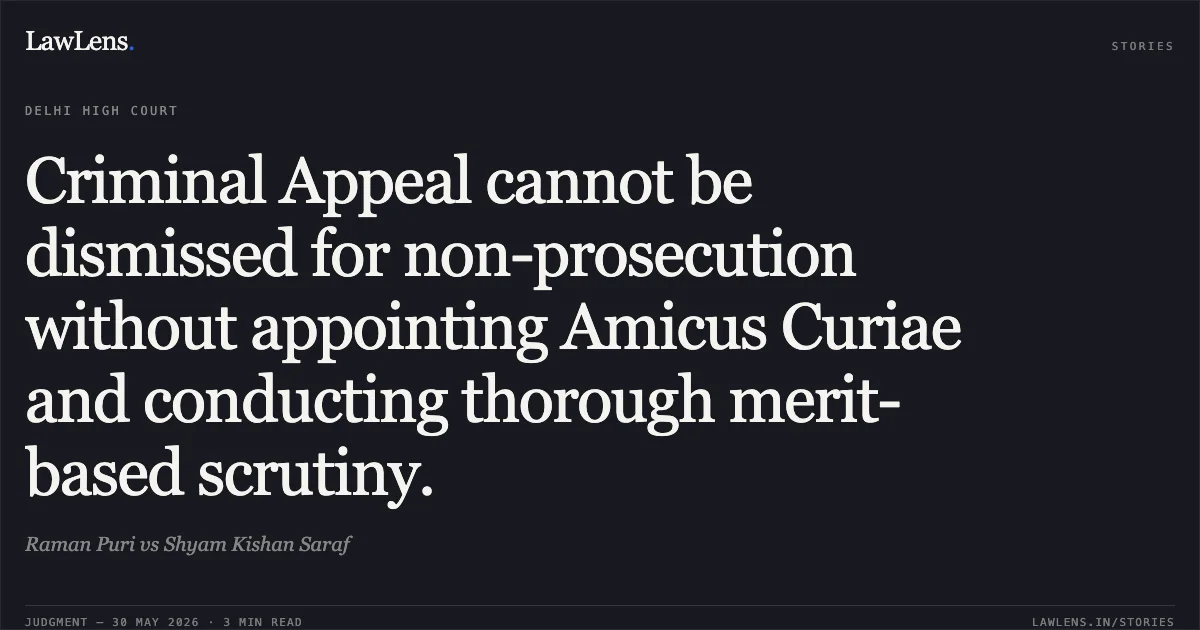
Source reference: p.4It relied heavily on the precedent in Bani Singh v. State of U.P., which mandates that a criminal appeal cannot be dismissed for non-prosecution but must be decided on merits after cross-checking the trial court’s reasoning with the evidence on record
Source reference: p.10-11principles from K. Muruganandam v. State and Mohd. Sukur Ali v. State of Assam, which establish that if an accused is unrepresented, the Court is legally obligated to appoint an Amicus Curiae before proceeding to decide the matter on merits to ensure a fair trial under Article 21 of the Constitution
Source reference: p.14-15Reasoning
The Court first observed that the Petitioners failed to provide a plausible explanation for the 2100-day delay, noting their conduct as absconders showed a lack of respect for the rule of law
Source reference: p.8-9the Court held that procedural technicalities (limitation) must yield to substantial justice when grave illegality is apparent
Source reference: p.18-19The Court found that the Appellate Court committed a jurisdictional error by deciding the appeals in the absence of the appellants without appointing an Amicus Curiae to protect their interests
Source reference: p.14Specifically, the High Court critiqued the "one-line" nature of the impugned judgments, noting that the Appellate Court failed to address any of the seventeen grounds raised in the appeal or independently evaluate the evidence, thereby violating the standard of "scrupulous scrutiny" required by Bani Singh
Source reference: p.16-18Holding
The Court allowed the Revision Petitions in part, setting aside the Appellate Court's judgments dated 31.01.2020
While refusing to condone the delay for purely equitable reasons, the Court exercised its suo moto revisional jurisdiction to remedy the patent illegality of the non-speaking orders. The Court ordered the revival of the appeals for re-hearing on the conditions that: (i) Petitioners deposit 25% of the fine amount with the Trial Court, and (ii) Petitioners pay a cost of ₹5 lakhs to each complainant within ten days. The Appellate Court was directed to dispose of the revived appeals by 31.08.2026
Source reference: p.19-20Acts & Sections Cited
17 provisions across 6 statutes referred to in this judgment. Each provision opens on LawLens.
Negotiable Instruments Act, 18814
Code of Criminal Procedure, 19737
Bharatiya Nagarik Suraksha Sanhita, 20232
Limitation Act, 19631
Indian Contract Act, 18721
Indian Penal Code, 18602
Original Court PDF
Raman PurivsShyam Kishan Saraf
Click to open original judgment
Original judgment, available to read, download and summarize on LawLens.in


