Facts
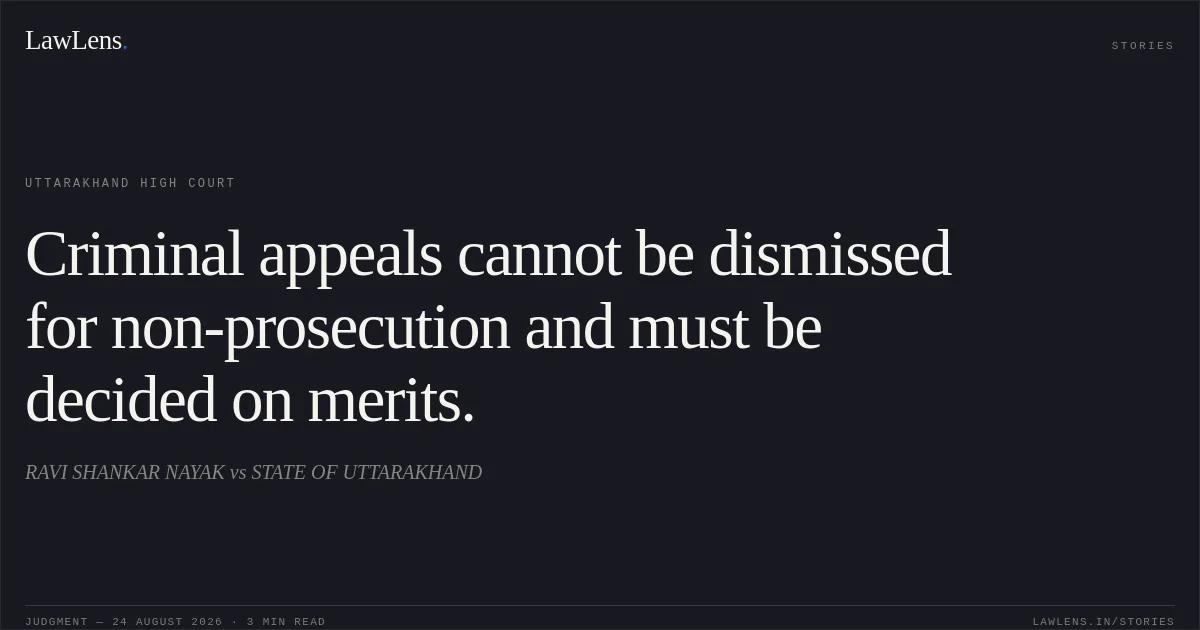
The applicant invoked Section 482 of the Code of Criminal Procedure, 1973, seeking quashing of the order dated 10 May 2016 by which the District and Sessions Judge, Dehradun dismissed Criminal Appeal No. 93 of 2016, arising from proceedings under Section 138 of the Negotiable Instruments Act, 1881, for non-prosecution.
Source reference: para. 1The applicant further sought restoration of the appeal and its adjudication on merits.
Source reference: para. 1The respondent contended that the applicant had remained continuously absent before the appellate court, while the applicant argued that the appellate court had no jurisdiction to dismiss a criminal appeal for non-prosecution and should instead have decided it on merits, including by appointing an amicus curiae if necessary.
Source reference: paras. 4–6Issues
Whether a criminal appeal arising from proceedings under Section 138 of the Negotiable Instruments Act, 1881, can be dismissed for non-prosecution or non-appearance of the appellant?
Source reference: para. 2Whether the appellate court was required to decide the appeal on merits, and, in the absence of representation for the appellant, whether it could appoint an amicus curiae to assist in the adjudication?
Source reference: paras. 3, 5, 7Law Applied
The Court applied Sections 385 and 386 of the Code of Criminal Procedure, 1973, which require an appellate court, when an appeal is not summarily dismissed, to call for the record and dispose of the appeal after hearing the appellant or counsel, and which do not contemplate dismissal of a criminal appeal for non-prosecution simpliciter.
Source reference: para. 3; para. 6The Court relied principally on Bani Singh v. State of U.P., (1996) 4 SCC 720, holding that a criminal appeal must ordinarily be disposed of on merits after examination of the record and cannot be dismissed merely for default or non-prosecution.
Source reference: para. 6Bani Singh further establishes that the appellate court is not invariably required to adjourn the appeal when the appellant or counsel is absent; it may decide the matter on merits after perusing the record, and may appoint a State-funded lawyer or amicus curiae where appropriate.
Source reference: para. 6The Court also relied on Billa @ Sunil Kumar v. State of Madhya Pradesh, which adopted the same principle.
Source reference: para. 6Reasoning
The High Court found that the Sessions Judge’s order dismissing the appeal for non-prosecution was de hors the Code of Criminal Procedure because Sections 385 and 386 do not authorise dismissal of a criminal appeal solely on account of the parties’ non-appearance.
Source reference: para. 7Even if the applicant and his counsel had repeatedly remained absent, the appellate court was required to examine the record and decide the appeal on its merits rather than terminate it for default.
Source reference: no citationConsistent with Bani Singh, the appellate court was not obliged to grant indefinite adjournments; however, where the appellant was unrepresented, it ought to have considered appointing an amicus curiae to assist the court in determining the appeal on merits.
Source reference: paras. 6–8Accordingly, the impugned dismissal could not be sustained.
Source reference: no citationHolding
The application under Section 482 CrPC was allowed.
The order dated 10 May 2016 dismissing Criminal Appeal No. 93 of 2016, Ravi Shankar Nayak v. Raj Kumar, for non-prosecution was set aside, and the appeal was restored to its original number before the Sessions Court, Dehradun for decision on merits.
Source reference: para. 9The appellate court was directed to endeavour to decide the old appeal expeditiously, in accordance with law, without granting unnecessary adjournments to either party.
Source reference: para. 10Acts & Sections Cited
4 provisions across 2 statutes referred to in this judgment. Linked provisions open on LawLens.
Code of Criminal Procedure, 19733
Negotiable Instruments Act, 18811
Original Court PDF
RAVI SHANKAR NAYAKvsSTATE OF UTTARAKHAND
Click to open original judgment
Original judgment, available to read, download and summarize on LawLens.in