Facts
The appellant, a cashier-cum-counter clerk in the Telephone Department, was charged under Section 409 IPC with collecting ₹8,73,737 in telephone charges between 1 July and 9 October 1993, allegedly depositing ₹3,88,035 belatedly and failing to deposit ₹4,75,702.
Source reference: p. 1–2The trial court acquitted him, finding the prosecution evidence vague and relevant records absent.
Source reference: p. 1–2The Bombay High Court reversed the acquittal, convicted him under Section 409 IPC and sentenced him to one year’s rigorous imprisonment and a fine.
Source reference: p. 8–9He appealed to the Supreme Court.
Source reference: p. 8–9Issues
Whether the prosecution proved entrustment of the alleged collections and dishonest misappropriation sufficient to sustain a conviction under Section 409 IPC.
Source reference: p. 13–16, 25–28Whether the High Court was justified in reversing the trial court’s acquittal on the evidence available, including the disputed seizure and the non-production of material records.
Source reference: p. 13–24Whether the High Court was required to hear the appellant on sentence before sentencing him after reversing the acquittal.
Source reference: p. 23–27Law Applied
Sections 405 and 409 IPC require proof of entrustment of property, or dominion over it, and dishonest misappropriation, conversion, use or disposal; breach of trust without dishonest intention is insufficient, though temporary misappropriation may qualify (R. Venkatakrishnan v. CBI).
Source reference: p. 13–15In an appeal against acquittal, the appellate court may reassess the evidence but must give due weight to the trial court’s assessment, the presumption of innocence and the accused’s entitlement to the benefit of doubt (Chelloor Mankkal Narayan Ittiravi Nambudiri v. State of Travancore-Cochin).
Source reference: p. 13–14Non-compliance with search-and-seizure requirements under Sections 100(4) and 100(7) CrPC does not automatically invalidate a seizure, but may affect the evidentiary weight of the recovery, particularly when considered with other deficiencies (Sunder Singh v. State of Uttar Pradesh; State of Punjab v. Balbir Singh).
Source reference: p. 20–22Section 114(g) of the Evidence Act permits an adverse inference where relevant evidence is withheld; the prosecution’s burden to prove guilt beyond reasonable doubt does not shift, and the accused need only raise a reasonably probable explanation (Rabindra Kumar Dey v. State of Orissa).
Source reference: p. 17–18, 27–28Under Section 386(a) CrPC, an appellate court convicting an accused for the first time after reversing an acquittal must itself hear the accused on sentence and impose sentence according to law.
Source reference: p. 24–27Reasoning
The prosecution did not produce the original cashbook, daily register, rough cashbook, audit report or other records needed to establish what the appellant collected and whether the collections were deposited; the investigating officer confirmed that these records had been requested but not produced.
Source reference: p. 15–18The registers sought by the appellant were also withheld, supporting the trial court’s adverse inference against the prosecution.
Source reference: p. 15–18The receipt books were not shown to have been issued to the appellant, and the unsigned, printed list at Exhibit 9 did not connect him to the alleged shortfall.
Source reference: p. 22–23The alleged seizure of documents from the appellant’s home was inadequately proved: both panch witnesses did not support it, and the statutory safeguards were not followed.
Source reference: p. 18–22In the context of the other evidentiary gaps, the High Court could not rely on that seizure or treat the appellant’s failure to explain it as proof of guilt.
Source reference: p. 27–28The prosecution therefore failed to establish either entrustment or dishonest misappropriation, and the High Court did not give the acquittal the required weight.
Source reference: p. 25–28The Supreme Court also noted that the High Court had sentenced the appellant without first hearing him, although it did not need to decide the appeal on that ground.
Source reference: p. 23–27Holding
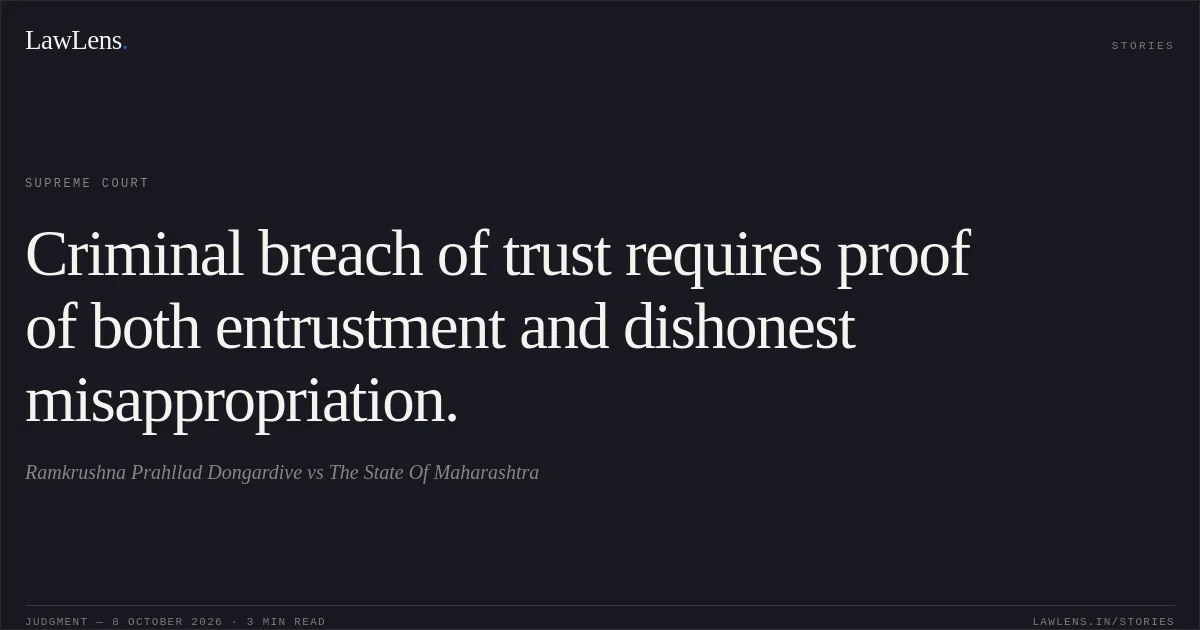
The Supreme Court held that the prosecution had failed to prove the essential ingredients of Section 409 IPC and that the High Court’s reversal of the acquittal was unwarranted.
It set aside the High Court’s judgment, restored the trial court’s acquittal, cancelled the appellant’s bail bonds and allowed the appeal.
Source reference: p. 29Acts & Sections Cited
19 provisions across 4 statutes referred to in this judgment. Each provision opens on LawLens.
Indian Penal Code, 18607
Code of Criminal Procedure, 1973
Bharatiya Nagarik Suraksha Sanhita, 20231
Negotiable Instruments Act, 18811
Original Court PDF
Ramkrushna Prahllad DongardivevsThe State Of Maharashtra
Click to open original judgment
Original judgment, available to read, download and summarize on LawLens.in