Facts
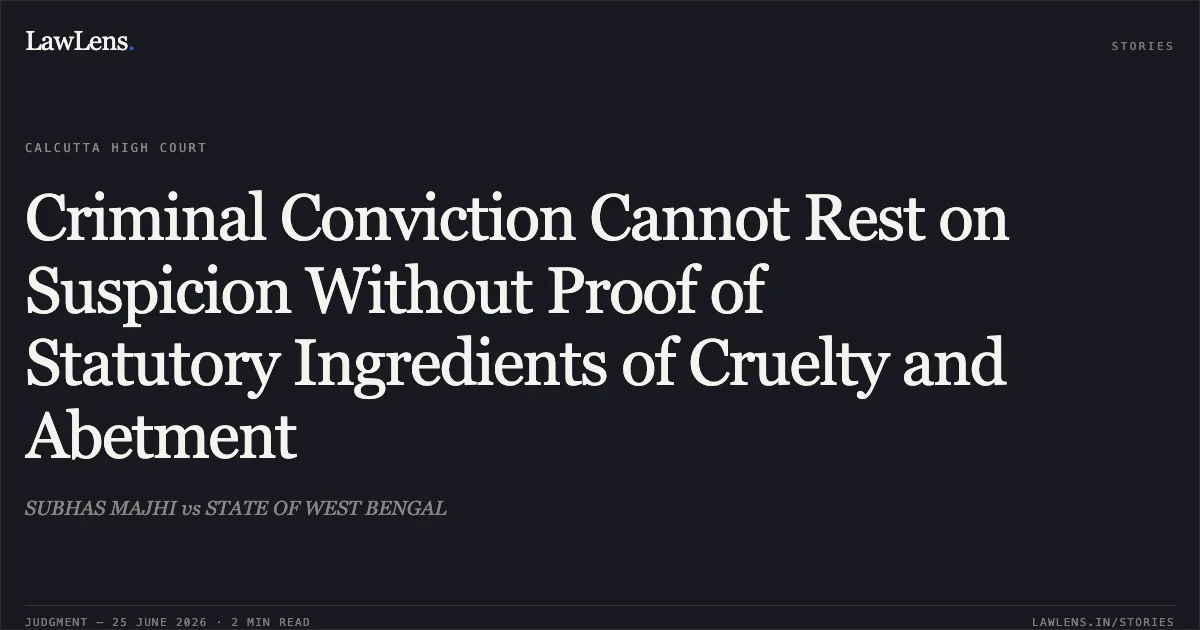
The appellant, Subhas Majhi, was married to Sefali Majhi for approximately 1.5 to 2 years. On 30.10.1994, Sefali died due to poisoning at her matrimonial home.
Source reference: para. 2The prosecution alleged that the deceased was subjected to continuous physical and mental torture over demands for additional dowry, supported by prior General Diary entries (dated 13.09.1994 and 16.09.1994) and an injury report.
Source reference: para. 2, 7(xvi), 7(xxiv)Witnesses (PW-5, 7, and 8) claimed the deceased made an oral dying declaration accusing the appellant and his mother of forcibly administering poison.
Source reference: para. 7(x), 8(vii)The Trial Court convicted the appellant under Sections 498A and 306 of the IPC but acquitted him under Section 304B.
Source reference: para. 1, 7(i)The appellant moved the High Court challenging the conviction on grounds of lack of evidence and procedural infirmities.
Source reference: para. 9Issues
1. Whether the prosecution established "cruelty" within the specific legal character defined under Section 498A of the IPC beyond reasonable doubt.
Source reference: para. 312. Whether the appellant’s conduct amounted to "abetment" of suicide under Section 306, read with Section 107 of the IPC.
Source reference: para. 40, 413. Whether the alleged oral dying declarations and evidence of a village salish (mediation) were legally reliable to sustain a conviction.
Source reference: para. 35, 38, 39Law Applied
The court applied Section 498A of the IPC, which requires "wilful conduct" likely to drive a woman to suicide or harassment for unlawful property demands.
Source reference: para. 31It referenced Section 306 regarding abetment of suicide, which must be read with Section 107 of the IPC, requiring proof of instigation, conspiracy, or intentional aid.
Source reference: para. 41, 42The court emphasized the standard of "proof beyond reasonable doubt" and the principle that suspicion, however grave, cannot replace legal proof.
Source reference: para. 43, 44Reasoning
The Court found the prosecution's evidence insufficient to meet statutory thresholds. First, regarding Section 498A, the Court noted that minor domestic discord does not equate to criminal cruelty; the provided medical evidence (PW-14) showed only "simple" injuries that the doctor admitted could have been manufactured.
Source reference: para. 31, 37The "oral dying declaration" was deemed unreliable because it was not recorded by a Magistrate or certified by a doctor, and material portions of these claims were omitted in witnesses' initial statements to the Investigating Officer (PW-10).
Source reference: para. 34, 38, 39Furthermore, no independent witnesses or written records substantiated the alleged village salish.
Source reference: para. 35Regarding Section 306, the Court held there was no evidence of any proximate act of instigation or mens rea by the appellant to drive the deceased to suicide.
Source reference: para. 42The Court concluded the Trial Court was swayed by the "tragic nature" of the death rather than objective evidence.
Source reference: para. 45Holding
The High Court allowed the appeal and set aside the conviction and sentence dated 16/17.01.2013.
The Court held that the prosecution failed to prove either the statutory form of cruelty under Section 498A or the ingredients of abetment under Section 306. The appellant was acquitted of all charges and ordered to be released from custody/discharged from bail bonds.
Source reference: para. 46, 50Acts & Sections Cited
8 provisions across 3 statutes referred to in this judgment. Each provision opens on LawLens.
Indian Penal Code, 18604
Code of Criminal Procedure, 19732
Original Court PDF
SUBHAS MAJHIvsSTATE OF WEST BENGAL
Click to open original judgment
Original judgment, available to read, download and summarize on LawLens.in